TRANSMISSION // 2611.22138v2
Many Robot Arms, One Expensive Test of AI Teamwork
Source published
In RoboTeam’s simulated tasks, two of the best tested models complete most jobs with up to 16 arms—but take hours and need frequent retries.
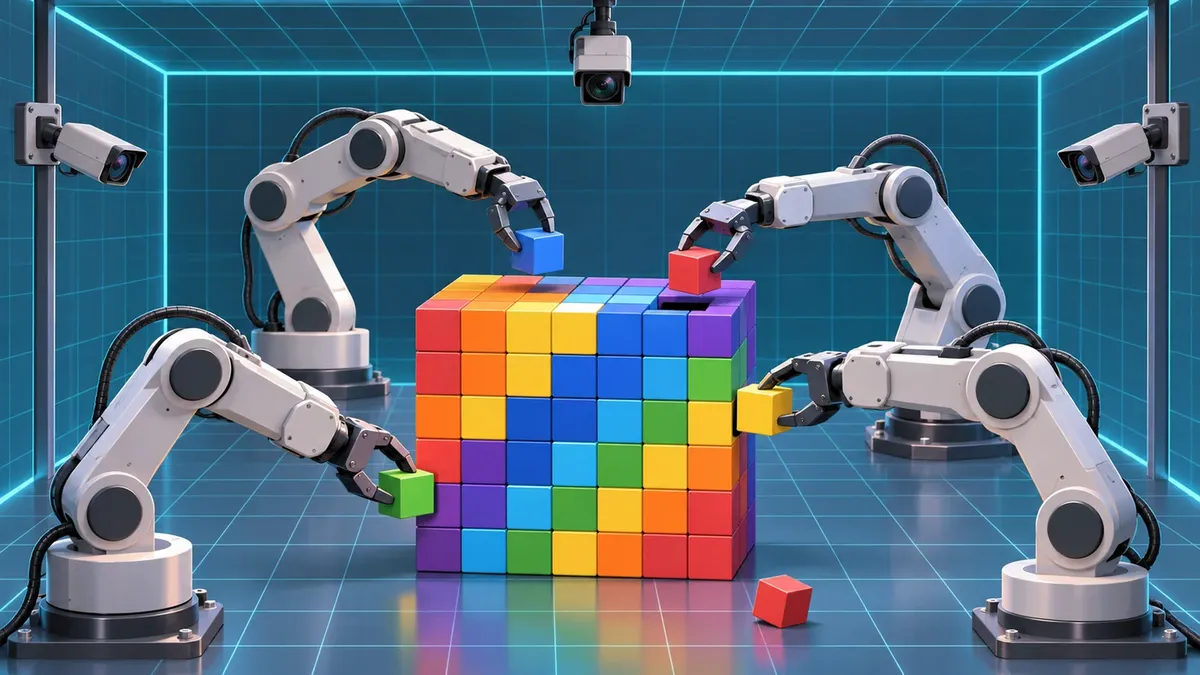
Can AI agents coordinate many robot arms using camera views alone while the work keeps moving? RoboTeam tests that challenge in simulation, with long jobs that include passing timbers and assembling a picture from cubes. Its results show that some agents can finish many tasks, but not yet quickly, cheaply and reliably at once.
In RoboTeam’s simulated tasks, robot arms share workspace, pass objects between one another or work together to hold parts steady. The agents directing them must judge object positions from camera images and act while the simulation continues running. These are challenges the benchmark is designed to measure—not evidence that the tested systems are ready for physical robots.
RoboTeam contains 36 tasks, built from four task types at different team sizes and difficulty levels. In Transport, arms place items on target boards. In Mosaic, they assemble a picture from colored cubes. In Relay, they pass long timbers between arms without dropping them. In Dial, some arms hold modules steady while others turn spring-loaded knobs.
The tasks run in MuJoCo, a physics simulator, with teams of four to 16 arms. Agents receive live RGB camera images and information about the arms, such as their pose and gripper width. They do not receive object positions, depth or contact information. Agents move the arms through a robot-control tool and, in most conditions, can use code tools—for example, to measure object positions in images. A sandbox blocks access to hidden simulator data and the evaluation system.
Comparing ways to organize agents
The researchers compared four arrangements. A single-agent system gives one agent control of all arms. In a hierarchical system, a controller oversees one worker per arm. In a decentralized system, the workers coordinate without a controller. An adaptive system starts with one controller, which can create delegates and hand them arms when it decides that work can be shared.
In tests using the adaptive arrangement, gpt-6.1-sol and opus-5.5—the two best-performing tested models in that setup—completed 28 and 27 of the 36 tasks. Four other models completed three or fewer. For gpt-6.1-sol in the adaptive setup, a typical task took 3.5 hours and used 218 million input tokens. The paper also reports that 34% of its task steps failed at least once and needed a retry.
The four agent arrangements completed similar numbers of tasks in the main comparison, but differed in time and token use. The hierarchical and decentralized systems were faster than the adaptive system, while using 1.9 and 1.7 times as many tokens, respectively. The single-agent system used fewer tokens but took longer; its total time was 1.6 times the adaptive system’s. These results suggest trade-offs rather than one arrangement that is best on every measure.
Turning images into usable positions
When gpt-6.1-sol received true object positions instead of camera images, it completed all 36 tasks. In the adaptive setup with camera images, it completed 28. Removing code tools reduced the total to 13; lowering image resolution reduced it to 14. Together, these tests point to estimating precise positions from images as a major challenge in this benchmark. They do not establish that perception is the only obstacle: actions can fail, objects can fall, and tasks can run out of time.
RoboTeam measures more than whether a task eventually succeeds. It also records time, token use and failed steps, making the cost of retries visible. The researchers caution that small completion differences—such as 28 versus 29 tasks across arrangements—should not be read as reliable evidence of an advantage. Each condition generally ran each task once, and repeated runs showed that outcomes could vary.
The evidence is limited to simulation and four task types; it does not establish that results will transfer to physical robots or other kinds of work. The study tested six models, but most comparisons used one model. It did not test depth images, learned perception systems or a paused-world version of the benchmark. This account is based on the supplied text of an arXiv preprint, which may not have undergone peer review.
For now, RoboTeam shows that some agents can complete demanding simulated work across many arms, but with long runtimes and frequent mistakes along the way. It provides a way to study those limits; it does not yet demonstrate a system that is simultaneously fast, economical and dependable.
- robotics
- AI agents
- multi-agent systems
- robot arms
- robot benchmarks
- computer vision
Related reading
Automatically matched by shared topic keywords. These links do not imply that the sources agree or establish a consensus.
Robots must know not just how to team up, but who is needed
Source published
Shared keywords: robot benchmarks
Robots Need to Know Not Just What to Do, but When
Source published
Shared keywords: robot benchmarks
A robot can finish the task—and still ignore the instructions
Source published
Shared keywords: robot benchmarks
Robot Memory Fails When the World Keeps Moving
Source published
Shared keywords: robot benchmarks
Teaching a robot model to predict what its actions will change
Source published
Shared keywords: robot benchmarks