TRANSMISSION // 2611.22017v2
SkillBuffBench: A proposed test of AI-agent skills
Source published
SkillBuffBench proposes comparing agent skills across specified memory modes, models and software harnesses. Its evaluation is in progress, so the preprint reports a benchmark design, not results on whether skills help.
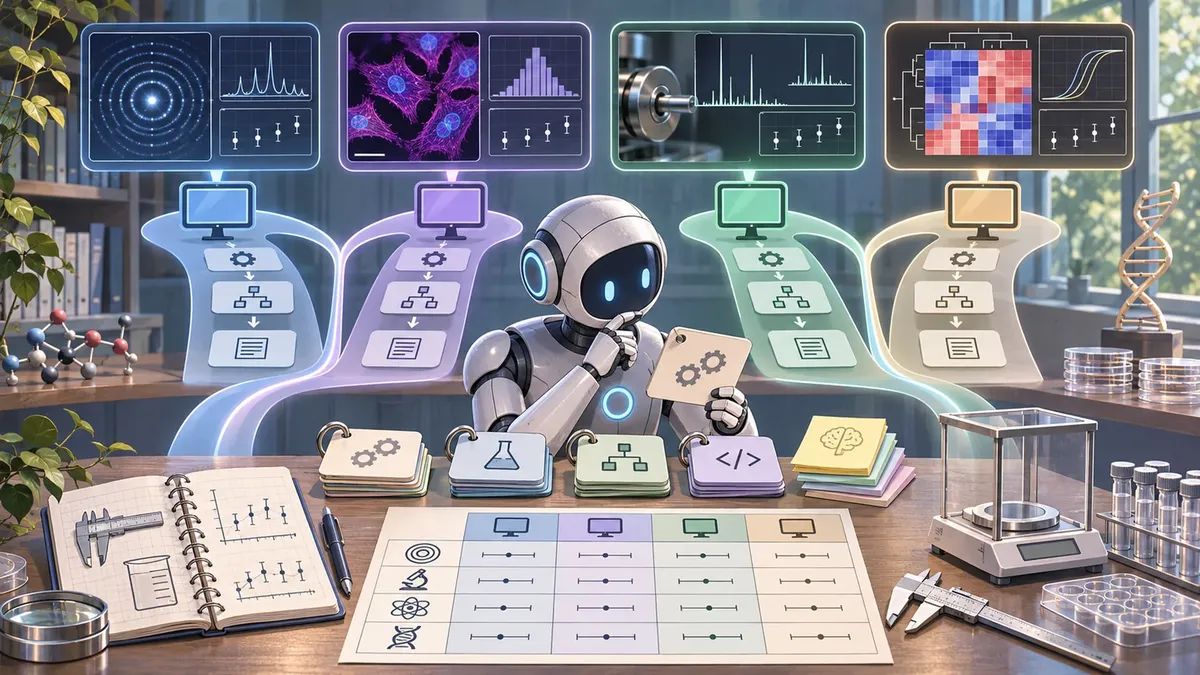
An AI coding agent may have reusable instruction files, but it must recognize when one applies—and memory may also shape its work. SkillBuffBench sets out a way to study those factors across four software harnesses and a small set of specialist tasks. The evaluation is still underway; this preprint does not report performance results.
An AI agent is more than its language model. A software harness manages the agent’s tools and working context, and files called skills can offer reusable procedures for particular kinds of work. A skill may help when a person selects it for the task. In practice, however, an agent may have to decide whether a skill applies and invoke it itself. Memory can also provide useful procedures, making it harder to separate the contribution of a skill from what the agent remembers.
SkillBuffBench proposes a benchmark to examine these questions. It compares different ways of providing skills, specified memory settings, models and harnesses. The paper describes the benchmark’s protocol and current tasks. Its evaluation is in progress, so it reports no results showing whether skills improve performance.
What the benchmark compares
The design has three skill conditions: no skill, a person-selected (“curated”) skill, and automatic invocation from an installed library. Curated access tests what a skill’s content contributes when someone has already chosen it. Automatic invocation also tests whether the agent can identify and select a relevant skill; it may instead select one that does not help.
Each condition is tested with memory off and on. In the memory-off condition, runs start in fresh workspaces without shared histories or memory namespaces. In the memory-on condition, agents may use memories of successful task completions accumulated under the same experimental definition. This distinction lets the researchers examine skill and memory effects separately, as well as how they interact, within the benchmark’s setup.
The design crosses four agent harnesses with a shared pool of models: every model is run under every harness. This allows comparisons between harnesses at a fixed model, and between models at a fixed harness, rather than confounding the two. The current pool has 11 models, from proprietary providers and open-weight providers. The paper says the pool may change as new models are added in later benchmark versions.
The current suite contains four expert-contributed research tasks: two in materials science and two in biology. They involve analysing oxygen-isotope measurements, identifying a crystal phase from diffraction data, ranking candidate gene-regulatory links, and analysing three-dimensional microscopy images of cell spheroids. The microscopy task, for example, asks for a spheroid’s three-dimensional envelope and the locations and distribution of nuclei, while requiring the agent to distinguish measurements the image supports from claims it cannot support. Other tasks have their own checks, such as whether a data fit is trustworthy or a crystal phase is correctly identified. The paper describes each skill’s purpose but does not reproduce its full contents.
Within each model–harness pairing, the conditions use the same task prompts, inputs and permitted tools. Each task-condition pairing is run three times from a reset workspace. Deterministic verifiers—fixed rules rather than judgments from another language model—score the resulting work. The researchers plan to report scores and pass reliability across repeats, alongside skill use, failure types, token use, cost, agent rounds and elapsed time. They estimate uncertainty by resampling tasks, using paired comparisons so the conditions are compared on the same tasks.
What the paper can and cannot tell us
For now, the paper’s contribution is a measurement plan, not a finding about agent performance. It cannot yet say whether automatic skill selection retains the benefit of curated skills, whether memory changes skill effects, or which model–harness combinations perform best. The authors state that results will be added when the runs are complete and that the benchmark will continue to be updated.
The present suite is small and specialized: four tasks from two research fields. Results on it would not, by themselves, establish how skills perform across other domains or everyday deployments. The full skill files are also not included, because some were contributed by collaborators and remain their property. Describing their purpose without publishing their contents limits how fully readers can inspect or reproduce the exact skill materials.
This is an arXiv preprint, and the supplied source does not establish that it has been peer reviewed. Its detailed protocol may help clarify how future results are measured, but a benchmark design is not evidence that skills work. SkillBuffBench should be read as a proposal to test that practical question under controlled conditions, not as an answer to it.
- AI agents
- agent skills
- SkillBuffBench
- agent memory
- AI evaluation
- research benchmarks
- materials science
- biology
Reviewed cross-references
These connections were reviewed by a model, not independently fact-checked by a human. Similarity does not imply agreement; consult the original papers and the evidence below.
AI agents can make the deliverable and still miss the rules
Shared method: Both papers compare agent performance with skill guidance against a condition without skills. SkillBuffBench proposes this comparison alongside curated and automatic skill access, memory settings, and crossed harnesses; SkillForgeBench reports skill-conditioned versus unconditioned evaluations with completion and process rubrics. This is a shared comparison method, not directly comparable evidence of skill effects: SkillBuffBench’s evaluation is in progress, and the benchmarks, tasks, and scoring differ.
Model review: · openai-codex/gpt-6-luna
Evidence and provenance
Selected excerpts, not complete papers. PDF extraction can omit figures or damage equations, tables and reading order; sources may be preprints.
2611.22017v2 — Original paper
Excerpt reference:
static/papers/2611.22017v2.md:159-251
Basis: Paper text
Source SHA-256:d181a06589679ef1f8266e7fc9481805d80f102eec3bd2e2f1107f56f0656a9f2610.14918v2 — Original paper
Excerpt reference:
static/papers/2610.14918v2.md:65-107
Basis: Paper text
Source SHA-256:ecfb0be4cfef446d8a7ca7140bbd05ce4a68a2b29abd927183553a1d70234ff9
Related reading
Automatically matched by shared topic keywords. These links do not imply that the sources agree or establish a consensus.
Why AI-Agent Interventions Help—or Fail
Source published
Shared keywords: agent skills, ai agents, ai evaluation
How should AI agents be tested before they run materials experiments?
Source published
Shared keywords: ai agents, ai evaluation
When AI Agents Change Without Getting Better
Source published
Shared keywords: agent memory, ai evaluation
AI agents can make the deliverable and still miss the rules
Source published
Shared keywords: ai agents, ai evaluation
How closely do LLM agents match human behavior in interactive tasks?
Source published
Shared keywords: agent memory, ai evaluation