TRANSMISSION // 2611.21880v2
A bandit method for constrained controller choice
Source published
A SquareCB-based learner uses current predictions to manage expected-cost budgets without allowing under-budget rounds to cancel later excesses.
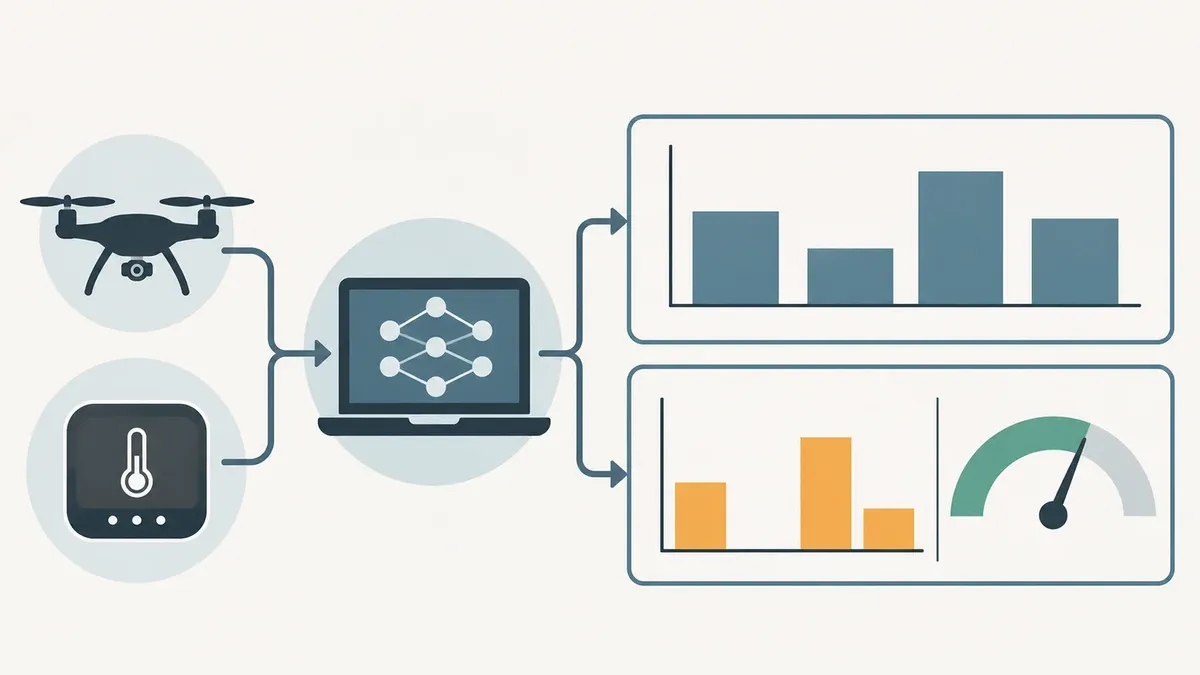
When a learner chooses among controllers, it may need to balance performance against a cost limit—for example, drone overshoot or building discomfort. This study proposes a way to track expected-cost budget excesses without letting under-budget rounds cancel them out.
A controller-selection system must balance performance against cost. The best choice can depend on conditions such as a drone’s starting state or the weather. Since the system initially does not know how each controller will perform, it learns from feedback as it makes decisions.
A common approach adjusts a cost penalty using past differences between costs and the budget. In a signed total, rounds below budget can offset rounds above it. The authors instead study a cancellation-free measure: add up only the positive differences between each round’s expected cost under the policy and the budget. This concerns expected policy costs, not a tally of realized overruns.
The proposed method modifies SquareCB, a contextual-bandit algorithm that uses predictions from online regression models. Each round, it uses current loss and cost estimates to choose a cost weight and form a policy. If the estimated policy cost is within budget, the weight is zero. Otherwise, the method searches for a weight that brings the estimated cost to the budget. Because the policy can change abruptly as the weight changes, it may mix two neighboring policies to reach the estimate. If the estimated cost remains above budget even at the maximum allowed weight, it uses that maximum, and the estimate may still exceed the budget. The weight depends on current estimates, not an accumulated balance of past slack or excess.
The theoretical results rely on assumptions. Realizability means the true loss and cost functions belong to the model classes used by the learner. The analysis also assumes online regression oracles with specified high-probability bounds on cumulative squared prediction error. Slater’s condition requires a policy whose expected cost is below budget by a positive margin. Under these conditions, the paper bounds regret relative to the best budget-feasible policy and bounds cancellation-free violation. The violation rate does not depend on the Slater margin, while the regret rate does. These are theoretical bounds under the assumptions, not guarantees that every realized cost meets the budget.
The paper also analyzes a per-context version for arbitrary, potentially adversarial context sequences. It bounds cumulative positive-part expected-cost violation across contexts; it does not guarantee that every context’s cost stays within budget on every round. The analysis requires a policy that meets the budget with a positive margin in every context. By contrast, the average-context setting assumes contexts are drawn independently from a fixed distribution and the learner can evaluate expectations under it.
For empirical tests, the authors use two control benchmarks. In the safe-control-gym quadrotor task, the learner chooses among six linear-quadratic-regulator controllers based on the drone’s starting state and payload. Tracking error is the loss, and overshoot is the constrained cost. In the BOPTEST building task, it chooses among eight thermostat schedules based on the weather forecast; the building’s starting thermal state is random and unobserved. Energy use is the loss, and thermal discomfort—measured in Kelvin-hours outside 21–25.5 °C—is the cost. Feedback arrives after the selected controller runs for an episode or day.
The authors report cancellation-free violation six to nine times lower than for primal-dual and virtual-queue baselines, with lower or comparable regret. These are results on the tested benchmarks, not evidence of broad superiority. The results section also says the baselines crossed the budget about four times as often on the quadrotor and nine times as often on the building; these figures describe crossing frequency, not cumulative violation. On the quadrotor, the authors report that the baselines took about 10,000 episodes to settle, compared with within 1,000 for their method. The main comparisons average ten runs, with bands of two standard errors. Separate appendix experiments varying the budget or the algorithm’s weight cap use five runs. The benchmark results do not establish performance on physical drones or in occupied buildings.
The scope is limited by the theoretical assumptions and test settings. The authors identify removing the multiplier-bound requirement, handling multiple constraints, and extending the approach to reinforcement learning and longer-horizon control as future work.
The source metadata identifies an arXiv preprint, while the paper text labels itself as a 2027 Proceedings of Machine Learning Research paper with placeholder volume information. This discrepancy is not resolved here. The extracted text also has damaged equation and figure formatting, so technical details may warrant checking against the original document. The central contribution is a method for managing expected-cost budgets—not a certification of physical safety.
- contextual bandits
- constrained controller selection
- SquareCB
- expected-cost budgets
- online regression
- quadrotor control
- building control
Reviewed cross-references
These connections were reviewed by a model, not independently fact-checked by a human. Similarity does not imply agreement; consult the original papers and the evidence below.
Learning when quantum error mitigation is worth the cost
Shared method: Both frame adaptive selection as a contextual-bandit decision: the origin paper uses SquareCB to choose controllers under a cost budget, while Majid et al. use a contextual-bandit controller to choose quantum error-mitigation techniques. The action sets, feedback, objectives, and algorithms differ, so this is a connection in decision-making framework, not evidence of comparable performance.
Model review: · openai-codex/gpt-6-luna
Evidence and provenance
Selected excerpts, not complete papers. PDF extraction can omit figures or damage equations, tables and reading order; sources may be preprints.
2611.21880v2 — Original paper
Excerpt reference:
static/papers/2611.21880v2.md:87-125
Basis: Paper text
Source SHA-256:0d02834ffbc4b920703e25315546295214230996fdb63d3b24174cab4c5481332611.13815v1 — Original paper
Excerpt reference:
static/papers/2611.13815v1.md:13-48
Basis: Paper text
Source SHA-256:969dd05225813f8cd5f91b26e8edc9916dc2f565a9bcba94a9bc3fb433299966
ADEPT lets a depth model help tune its camera
Shared method: Both use contextual bandit methods for sequential, context-dependent selection: Pandit et al. select among controllers subject to an expected-cost budget, whereas Kim et al. use a contextual Gaussian-process controller to choose camera settings. Their algorithms and constraints differ, and the excerpts do not establish comparable outcomes.
Model review: · openai-codex/gpt-6-luna
Evidence and provenance
Selected excerpts, not complete papers. PDF extraction can omit figures or damage equations, tables and reading order; sources may be preprints.
2611.21880v2 — Original paper
Excerpt reference:
static/papers/2611.21880v2.md:87-125
Basis: Paper text
Source SHA-256:0d02834ffbc4b920703e25315546295214230996fdb63d3b24174cab4c5481332611.27423v1 — Original paper
Excerpt reference:
static/papers/2611.27423v1.md:69-167
Basis: Paper text
Source SHA-256:90bddb7260668f45f88350c43a019a13dad7c8c945f28c5225c391f8aede9221
Related reading
Automatically matched by shared topic keywords. These links do not imply that the sources agree or establish a consensus.
When Should a Bandit Trust Its Oscillator Model?
Source published
Shared keywords: online regression
When users’ preferences change, can an AI selector update what it trusts?
Source published
Shared keywords: contextual bandits
Learning when quantum error mitigation is worth the cost
Source published
Shared keywords: contextual bandits
Does an adaptive policy create value—or just choose a good average mix?
Source published
Shared keywords: contextual bandits
A framework for human–AI teamwork that accounts for how advice changes decisions
Source published
Shared keywords: contextual bandits