TRANSMISSION // 2611.21823v2
TUSI-Bench tests retrieval for Persian legal AI
Source published
TUSI-Bench combines Persian legal questions with Iranian legal materials and tests whether graph-guided retrieval finds relevant provisions. Its results apply to the reported experiments.
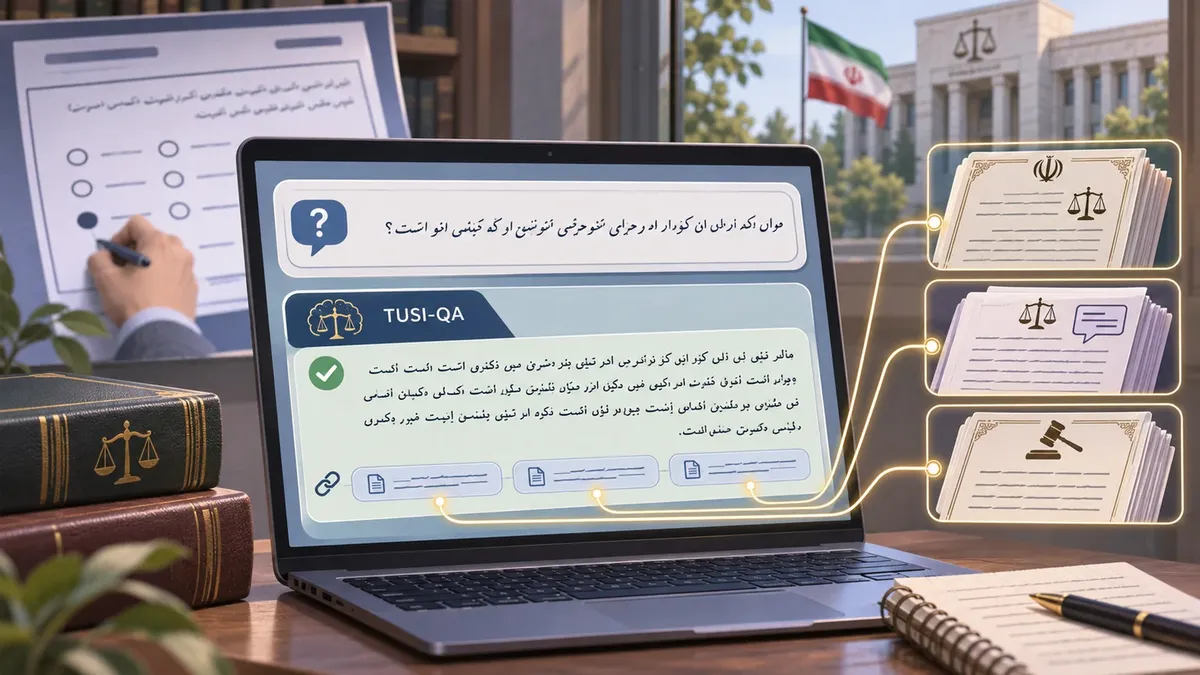
Can an AI system find the Iranian legal materials relevant to a question—and use them to support an answer? TUSI-Bench is a benchmark designed to evaluate retrieval and question answering in Persian legal settings.
Why build a Persian legal benchmark?
Retrieval-augmented generation, or RAG, gives a language model external documents to consult before it answers. In legal question answering, evaluation needs to consider not just the generated response but also whether the system retrieves relevant material and grounds its answer in legal sources.
The authors argue that existing Persian legal question-and-answer resources do not adequately test these capabilities together. Some use questions generated from statutes; others collect informal online exchanges without systematically connecting answers to authoritative legal documents. TUSI-Bench aims to pair more natural questions with legal evidence that can be checked.
What is in TUSI-Bench?
The paper describes a collection of Iranian legal materials covering 7,261 articles from 50 statutes, with expert interpretations and Supreme Court Unification Rulings. A knowledge graph links legal articles, interpretations and rulings. It contains 9,272 nodes and 5,183 cross-references. Coverage is not uniform: the paper reports that 27.7% of articles have associated interpretations, and that the reference network is sparse.
The benchmark has two parts. TUSI-QA contains 1,999 open-ended questions drawn from lawyer–client consultations. Its answers are linked to supporting legal articles, and questions may require one to three articles. The authors describe filtering candidate examples with an automated process and iterative legal-expert review of randomly selected subsets. Examples with citations judged irrelevant or insufficient, or with weak alignment between the question, answer and legal text, were removed.
TUSI-Bar contains four-option questions derived from Iranian bar examinations. The abstract describes the set as approximately 500 questions. Unlike TUSI-QA, TUSI-Bar’s source annotations identify the relevant law, not the individual article. It is therefore a separate exam-style task, not an article-level citation benchmark.
How was retrieval tested?
The researchers compared conventional retrieval approaches, including BM25 keyword search and dense retrieval, with a structure-aware method. That method first retrieves likely matches through dense search, then adds their directly connected neighbours in the legal knowledge graph. The aim is to recover related provisions or interpretations that may not closely match a question’s wording.
Retrieval was assessed using standard ranking measures, including Recall@5: whether relevant provisions appear among the first five results. The researchers also evaluated generated answers with an AI judge, DeepSeek-V4-Pro, across correctness, effectiveness, objectiveness, clarity and completeness. Bar-exam performance was measured by multiple-choice accuracy.
What did the researchers find?
The structure-aware method improved Recall@5 by up to eight percentage points over its dense-retrieval counterpart in the tested configurations. The result did not extend to every retrieval approach: when graph expansion was paired with BM25, the paper reports declines of 0.6 percentage points in Precision@5 and 0.3 points in Recall@5.
For open-ended answers, Gemma 3 27B in 8-bit precision scored higher with structure-aware RAG on four of the five judge-rated dimensions than without retrieval. Correctness rose from 1.947 to 2.420, effectiveness from 2.092 to 2.540, objectiveness changed modestly from 3.314 to 3.487, and completeness from 1.782 to 2.206. Clarity fell from 3.827 to 3.644.
On TUSI-Bar, the same Gemma model’s accuracy was 33.0% without retrieval, 36.8% with standard RAG and 37.7% with structure-aware RAG. These are results for the reported models, benchmark and experimental setup; they do not establish how the method would perform in other legal systems or real legal practice.
What remains uncertain?
The authors note that graph construction requires careful curation: incorrect or incomplete links can introduce noise. The current graph is unweighted, so links are not assigned different strengths, and one-hop expansion includes connected neighbours rather than ranking them. The authors specifically warn that this can add noise around highly connected hub articles. They identify expanding beyond the current 50 statutes and adding other legal materials as future work.
Open-ended legal answers are also difficult to score. The study uses DeepSeek-V4-Pro as an automatic judge; its ratings should be understood as the paper’s evaluation method, not as a direct measure of legal correctness established through a separate full review of every answer. TUSI-Bar’s law-level annotations also provide less precise source labels than TUSI-QA’s article-level links.
The paper labels itself a preprint submitted to Elsevier, so it should not be taken as evidence of peer-reviewed consensus. The authors report that the dataset is publicly available, which allows further study but does not itself validate the annotations or results independently.
- Persian legal AI
- retrieval-augmented generation
- TUSI-Bench
- knowledge graphs
- legal question answering
- Iranian law
Related reading
Automatically matched by shared topic keywords. These links do not imply that the sources agree or establish a consensus.
ArcRAG Tests Whether AI Can Search Differently Built Knowledge Graphs
Source published
Shared keywords: knowledge graphs, retrieval augmented generation
Protecting the relationships an AI search system can reveal
Source published
Shared keywords: knowledge graphs, retrieval augmented generation
DotRAG narrows graph searches by reasoning along likely paths
Source published
Shared keywords: knowledge graphs, retrieval augmented generation
A Graph-RAG Trial on a Bosch Production Line
Source published
Shared keywords: knowledge graphs, retrieval augmented generation
A More Connected Memory for AI Agents
Source published
Shared keywords: knowledge graphs, retrieval augmented generation