TRANSMISSION // 2611.21797v2
What Coding Agents Can—and Can’t—Do With Tests
Source published
An abstract reports high traditional coverage from coding agents, alongside weaker quality on larger projects and unreliable test translation.
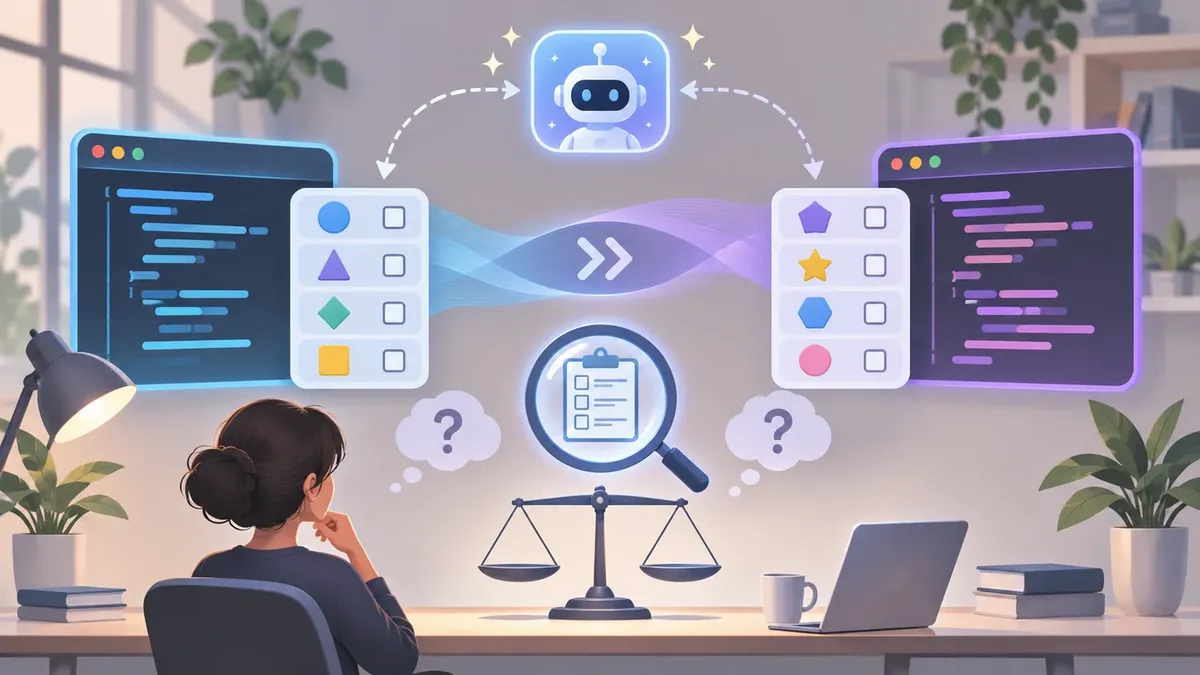
Coding agents are increasingly asked to write software, and tests can be part of that work. A study examines whether agents can write unit tests and translate them between programming languages. Its abstract reports strong coverage results, but also substantial limitations.
Testing agents’ test-writing
In Can Coding Agents Write and Transpile Unit Tests, Gil Pasternak, AJ Langley, Tom Yotam and Ellie Kitanidis examine two tasks: writing unit tests and translating tests between programming languages. The authors benchmark three popular coding agents, each evaluated with a native frontier model and high reasoning effort. They say they assessed performance using a broad suite of metrics.
The evidence available for this article is the paper’s abstract. It does not specify the agents, models, programming languages, projects, metric definitions or detailed evaluation procedures. Those missing details limit how precisely the results can be interpreted.
Strong coverage, with qualifications
The authors report that coding agents exceeded human-written test suites on traditional measures of coverage. But they stress that the advantage was uneven: test quality declined sharply with project size, and much of the coverage advantage came from the agents writing more tests.
That distinction matters to the paper’s central question. A strong result on traditional coverage measures does not, by itself, establish that an agent’s tests are reliable in every respect. The abstract does not give numerical results or explain how test quality was measured, so readers cannot judge the scale of the differences or exactly what the quality decline captures.
The authors also describe test translation as seemingly strong in aggregate but inconsistent and unreliable. The abstract does not report success rates, identify the languages involved or explain how translation quality was assessed. It therefore supports a broad caution about reliability, but not a more detailed account of where or why translations fall short.
What remains uncertain
The findings are about the evaluated agents and benchmark conditions. The abstract does not say how the projects or human-written test suites were selected, or whether the results extend to other agents, codebases or development settings. It also does not establish what effect agent-written tests have on software outcomes in day-to-day use.
These limits make the results difficult to apply directly to a particular team or project. The abstract supports the conclusion that agents can score highly on traditional coverage measures in this evaluation, while their test quality declines as project size grows and translation remains unreliable. It does not support a general claim that agent-written tests are better than human-written tests, or that they can be relied on without further evaluation.
The supplied material identifies the work as an arXiv paper, but does not establish its peer-review or publication status. Because only the abstract is available here, the methods and detailed results could not be checked against the full paper. The findings should be understood within those evidence limits.
- coding agents
- software testing
- unit tests
- test coverage
- test translation
- large language models
Reviewed cross-references
These connections were reviewed by a model, not independently fact-checked by a human. Similarity does not imply agreement; consult the original papers and the evidence below.
Testing AI coding agents on branching clinical rules
Shared method: Both studies use mutation testing to assess test adequacy: the test-generation study measures suites against injected mutants, while TEA-Bench-BR reports hidden cases that kill all 1,955 non-equivalent reference mutants. This is a methodological connection, not a direct performance comparison: one evaluates agent-written tests on real repositories, the other validates benchmark tests for synthetic clinical-rule tasks.
Model review: · openai-codex/gpt-6-luna
Evidence and provenance
Selected excerpts, not complete papers. PDF extraction can omit figures or damage equations, tables and reading order; sources may be preprints.
2611.21797v2 — Original paper
Excerpt reference:
static/papers/2611.21797v2.md:115-202
Basis: Paper text
Source SHA-256:27817845766c353bbac4766cdffccbb1e64958561f8d60e0637f9b31e34430d42611.21797v2 — Original paper
Excerpt reference:
static/papers/2611.21797v2.md:301-369
Basis: Paper text
Source SHA-256:27817845766c353bbac4766cdffccbb1e64958561f8d60e0637f9b31e34430d42611.27895v1 — Original paper
Excerpt reference:
static/papers/2611.27895v1.md:156-231
Basis: Paper text
Source SHA-256:b4f131ab69d4fc577576fb478096a3337ae9a2623786b04e53780a404e3ac9f8
Related reading
Automatically matched by shared topic keywords. These links do not imply that the sources agree or establish a consensus.
Testing AI coding agents on branching clinical rules
Source published
Shared keywords: coding agents, software testing
A Proposed Way to Secure Coding-Agent Benchmarks
Source published
Shared keywords: software testing
What makes a software repair hard for an AI coding agent?
Source published
Shared keywords: coding agents, software testing
When Coding Tests Reward the Wrong Fix
Source published
Shared keywords: coding agents, software testing
Can AI scripting agents learn from their own EDA mistakes?
Source published
Shared keywords: large language models, software testing