TRANSMISSION // 2611.21575v1
Why some wind-blown ripples may move against the wind
Source published
Simulations link impact-ripple size to transport intensity and find that ripple speed and direction depend on grain size, fluid density and wind speed. Upwind motion remains an untested prediction.
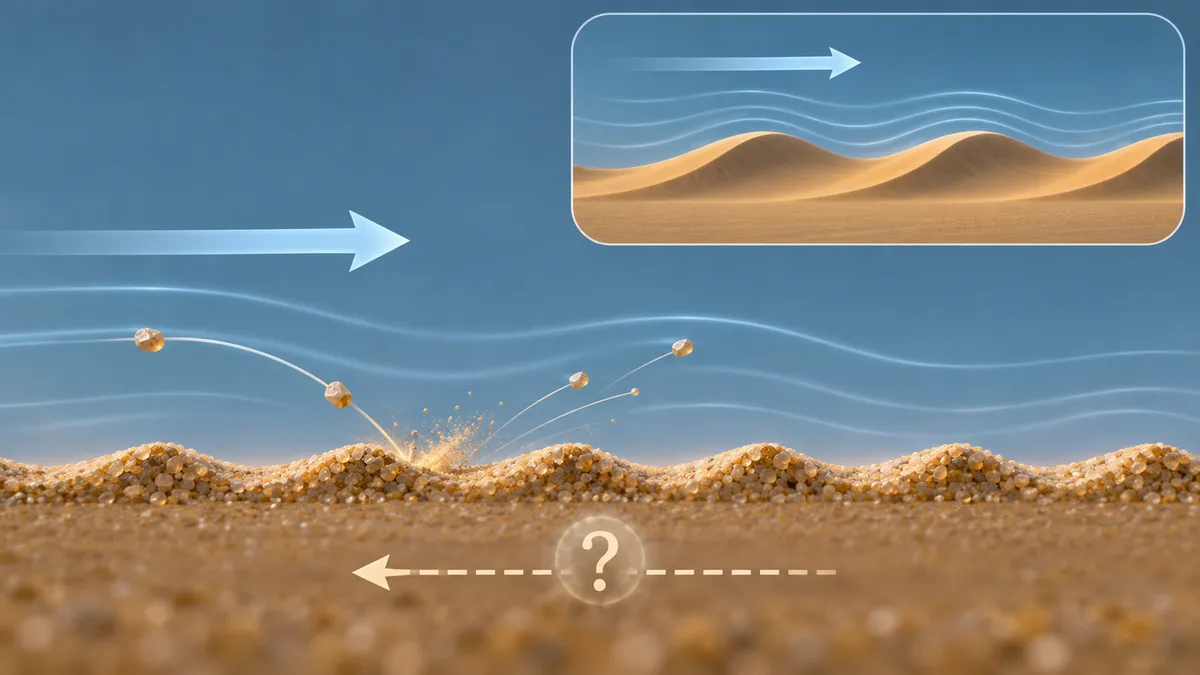
Wind-blown sand forms ripples on Earth and Mars, but a ripple’s size alone may not reveal how it formed. A study isolates impact-driven ripples in simulations and compares their predicted patterns with observations—while suggesting that, under some conditions, they could move against the wind.
Wind-blown sand can form more than one kind of ripple. Smaller “impact ripples” are thought to emerge when moving grains strike the bed and eject other grains. Larger ripples may instead arise as airflow changes over an uneven surface. Because observations can be ambiguous, it is not always clear which process formed a particular bedform.
In a manuscript submitted to JGR: Planets, C. W. Lester, O. Duran and A. B. Murray investigate how impact ripples change across planetary conditions. They ask whether ripple size and motion follow consistent patterns as grain size, transport intensity and atmospheric conditions vary.
Simulating impact ripples
The researchers used a discrete element method (DEM) model to simulate individual grains and their collisions, coupled to a simplified model of airflow near the bed. Starting with a flat surface, they examined how ripples developed once sand transport became sustained. The model can generate impact ripples, but it does not represent the airflow-related instability needed to produce hydrodynamic ripples. This isolates impact-ripple behavior; it does not simulate both ripple types together.
The simulations covered a broad range of grain–fluid density ratios, grain sizes and transport intensities. The researchers compared the results with published wind-tunnel and field observations. That comparison can show which observations are compatible with impact-ripple predictions, but cannot establish the origin of every observed ripple.
Two regimes for ripple size
The simulations identify two regimes, distinguished by a rescaled measure of transport rate. Near the threshold for sustained transport, in the low-intensity “saltation” regime, impact-ripple wavelength scales with grain diameter. In the simulations, wavelengths were around 200 times the grain diameter across a wide range of fluid densities. The proposed explanation is a spatial lag between where grains hit the bed and where they eject other grains; the lag is of the order of a grain diameter.
At higher transport intensity, in the “collisional” regime, wavelength instead scales with the average hoplength—the distance grains travel between hops. In this regime, that length, and therefore ripple wavelength, tends to increase with fluid velocity. This is not a universal rule for all impact ripples: it applies to the higher-intensity regime. The physical mechanism selecting wavelength there remains poorly understood, the authors note.
The distinction suggests that grain-size-based and hoplength-based explanations may apply under different transport conditions. In comparisons with observations reporting two ripple scales, the simulations reproduce the smaller ripples, while the larger ones are consistent with a separate hydrodynamic interpretation. More experiments are needed to test that interpretation, especially across different grain sizes and wind speeds.
A prediction about ripple direction
The simulations indicate that ripple migration speed depends strongly on grain–fluid density ratio, grain size and wind speed. Under some modeled conditions, impact ripples slow to a halt and then move against the wind as “antiripples.” The predicted transition depends on both density ratio and grain size. For Earth-like density ratios, it occurs around millimeter-sized grains; for lighter grains, the predicted transition is around half a millimeter.
These are predictions, not observed planetary phenomena. The paper says available observations do not reach density ratios low enough to test the antiripple prediction directly. Experiments and field measurements are needed to determine whether upwind-moving forms occur.
What the results can—and cannot—show
This study combines simulations, analytical predictions and existing observations; it is not a direct survey of ripple formation on other planets. Planetary conditions are approximated primarily by changing the grain-to-fluid density ratio, rather than by comprehensively reproducing every condition on each world. The airflow representation is simplified, and real observations may include both impact and hydrodynamic bedforms. Some fine-grain observations have wavelengths larger than the simulated impact ripples; the authors suggest these could reflect hydrodynamic ripples.
The manuscript is described as submitted to a journal, so the source does not establish that it has completed peer review. The authors say simulation data are available through Zenodo, while model code is available from a co-author on request. Until predictions—especially antiripple motion—are tested directly, the findings are best treated as a framework for interpreting ripples and guiding experiments, not confirmation of every ripple’s origin.
- aeolian ripples
- impact ripples
- sand transport
- planetary science
- antiripples
- numerical simulations
Related reading
Automatically matched by shared topic keywords. These links do not imply that the sources agree or establish a consensus.