TRANSMISSION // 2611.21534v1
Two lithium-rich dwarfs pose a puzzle in M 4
Source published
Two newly identified lithium-rich stars in M 4 show no detectable present-day rapid rotation or strong activity. Their origin is unknown; several explanations, including past interactions, remain possible.
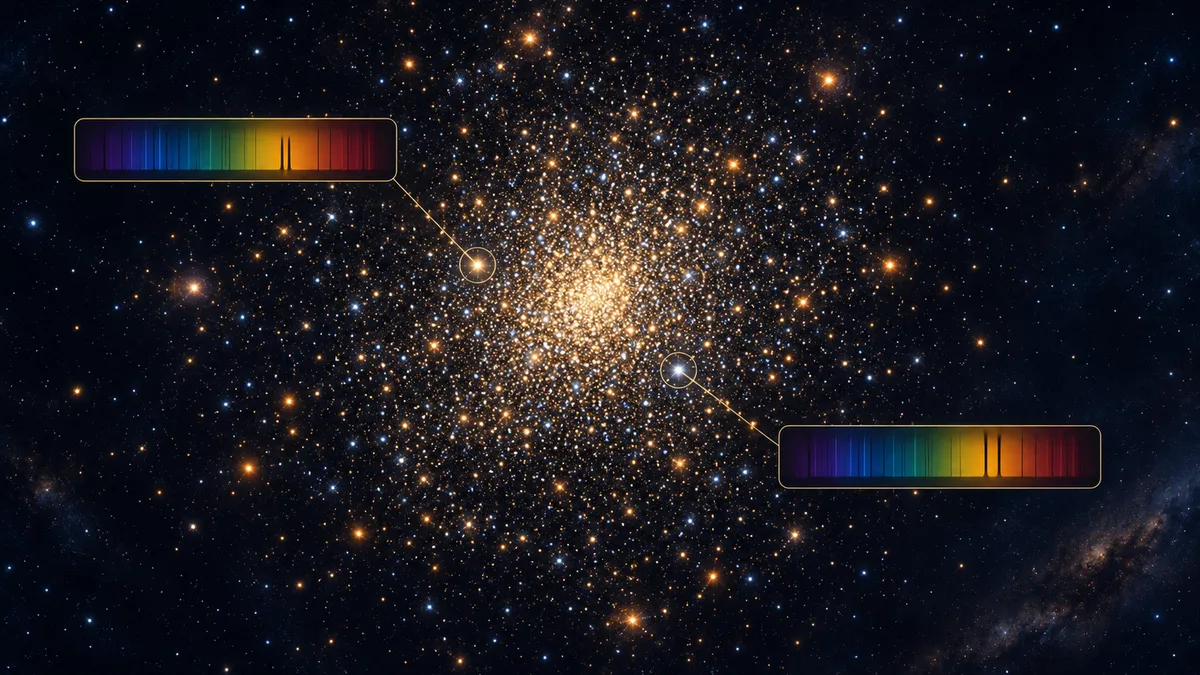
Lithium is readily destroyed inside stars, so unusually high surface levels raise a question: how did the lithium get there? A study of two newly identified dwarf stars in the globular cluster M 4, alongside a re-analysis of a known lithium-rich star, narrows some possibilities but does not identify a cause.
Lithium is a fragile element: ordinary stellar processes can destroy it, leaving many stars with less at their surfaces than they began with. When a star has unusually abundant lithium, astronomers must ask whether it made the element, acquired it from elsewhere, or had its surface chemistry altered by an interaction.
A new study examines that puzzle in M 4, an old, dense globular cluster. The researchers report two newly identified lithium-rich dwarf stars, numbered 44606 and 58195, and re-analyze a previously known lithium-rich star, 37934. These unevolved stars offer a way to test explanations that may differ from those proposed for lithium-rich stars at later stages of life.
Reading the stars’ light
The team used UVES, a high-resolution spectrograph on the European Southern Observatory’s Very Large Telescope. They analyzed the spectra with computer-generated stellar models, using absorption features and other spectral information to estimate abundances. Their abundance analysis covers 24 species, including lithium and different ionization stages of some elements. They also examined the lithium feature and molecular bands, among other measurements.
The researchers searched for signs of rapid rotation, which can broaden spectral lines, and for indicators of chromospheric activity in the stars’ outer atmospheres. Such evidence could help assess proposed processes that might enhance or preserve lithium.
The two newly identified stars have reported lithium abundances, A(Li), of 2.58 and 2.51. These differ from the distribution measured for ordinary M 4 dwarfs in an earlier study. For the previously known star 37934, the team finds A(Li) = 3.01, consistent with earlier work. In this notation, a higher A(Li) means more lithium relative to hydrogen.
None of the three stars shows detectable rotational broadening at the study’s sensitivity, around 6–7 kilometres per second, or clear evidence of enhanced chromospheric activity. The researchers found no companion in the available Gaia astrometry or in the literature. That is not proof the stars are single: a faint or compact companion, an orbit not covered by existing observations, or a companion lost through interactions in the cluster could go undetected.
Several possibilities, no verdict
Because the stars are unevolved, the authors rule out lithium production inside these stars as the explanation for their enrichment. They consider planet engulfment very unlikely in a globular cluster, where planets are rarely found. Separately, they note that engulfing a brown dwarf would not be expected to supply enough lithium to reach the observed levels. The observations show no present-day rapid rotation or strong activity, though a star could have been spun up by an interaction in the past and since slowed down.
The remaining ideas are possibilities, not a demonstrated answer. Material might have been transferred from a companion, perhaps one that produced lithium. Nova ejecta—material expelled in a thermonuclear explosion on a white dwarf—could also pollute a star; proposed configurations may involve a companion, but the study does not establish that such a companion exists. Interactions or mergers are other scenarios discussed by the authors.
The abundance patterns do not settle the matter. Mildly elevated abundances of some slow neutron-capture elements could be relevant to mass transfer, but M 4 itself is enriched in some of these elements, making their significance difficult to isolate. Some measurements also rely on just one or a few spectral lines, so those particular abundance estimates warrant caution.
The study analyzes three target stars in one cluster. Its comparisons with earlier M 4 observations and other literature samples provide context, but differing data and analysis methods can complicate direct comparisons. The main analysis uses one-dimensional stellar-atmosphere models in local thermodynamic equilibrium (LTE). The paper discusses corrections for particular measurements, including effects relevant to oxygen and potassium; these should not be taken as a general correction applied uniformly to every abundance.
The manuscript states that it was accepted by Astronomy & Astrophysics in November 2026, and the cited arXiv version is a preprint. Acceptance is not evidence that the proposed origin has been confirmed: the authors themselves leave it unresolved. They suggest follow-up such as long-term radial-velocity monitoring for companions and additional measurements, including beryllium, nitrogen, and the helium line at 1083 nanometres. For now, the stars’ lithium is clear; its history is not.
- lithium-rich stars
- M 4 globular cluster
- stellar abundances
- UVES spectroscopy
- stellar evolution
- binary interactions
Related reading
Automatically matched by shared topic keywords. These links do not imply that the sources agree or establish a consensus.
Rocky planets may look iron-rich because other ingredients are missing
Source published
Shared keywords: stellar abundances
Low-resolution starlight reveals 133 candidate chemical families in the Milky Way
Source published
Shared keywords: stellar abundances
Could nova explosions explain the chemistry of phosphorus-rich stars?
Source published
Shared keywords: stellar abundances
Measuring the stars behind JWST’s planet spectra
Source published
Shared keywords: stellar abundances
A rare Sculptor star points to enrichment by two early stellar explosions
Source published
Shared keywords: stellar abundances