TRANSMISSION // 2611.21517v1
A lazier search helps robots plan complex retrieval tasks
Source published
Lazy-MOSAIC uses a fast learned model to shortlist robot skills, then checks promising steps in simulation. Shelf-task tests found faster planning with fewer simulator queries, while returned plans remained simulator-validated.
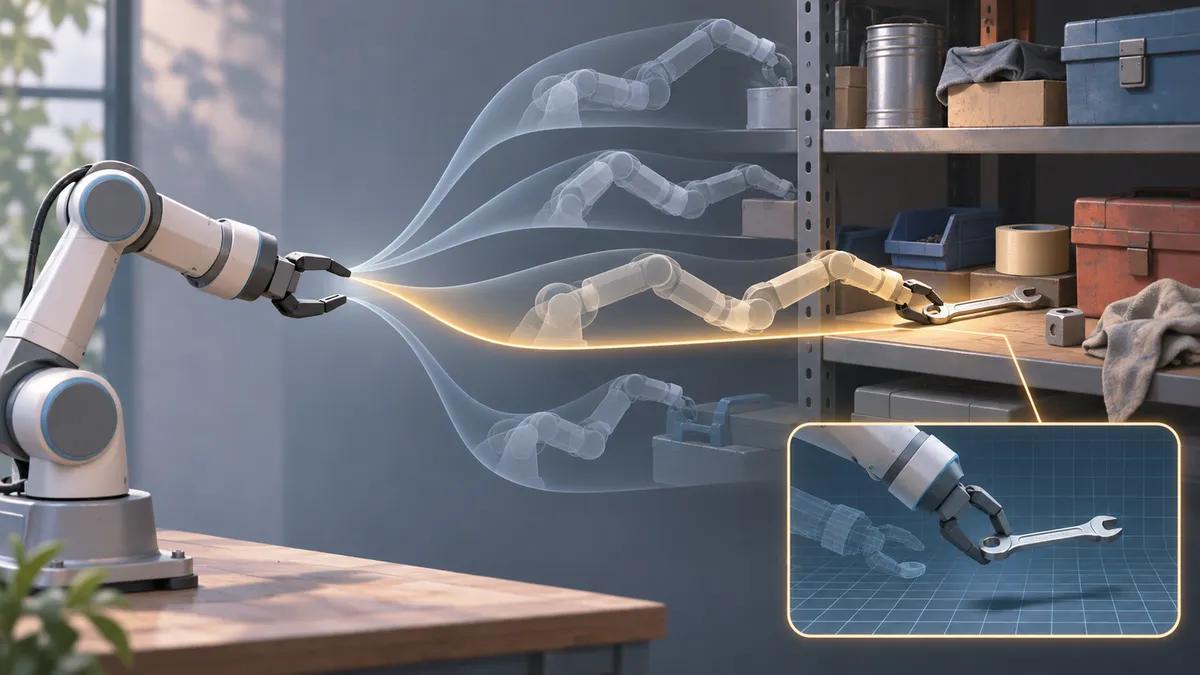
A robot retrieving an object from a cluttered shelf may need to move obstacles before it can grasp its target. Lazy-MOSAIC aims to make planning such sequences faster by using a learned model to guide the search, while reserving physics simulation to verify the steps that matter.
A robot reaching for a wrench behind clutter may first need to push another object aside, reposition the wrench, and only then grasp it. Planning this kind of task means choosing both a sequence of actions and the parameters for each one. Testing every possibility in a physics simulator can be costly, but trusting a learned model’s predictions outright risks producing a plan that fails in the physical world.
Lazy-MOSAIC, introduced in an arXiv preprint by Itamar Mishani, Mukund Krishnakumar, Oren Salzman and Maxim Likhachev, takes a middle path: use a fast learned model to suggest promising skill sequences, then simulate candidate steps before accepting them into a plan.
Predict first, verify selectively
The system works with a library of robot skills, such as pushing, pulling, picking up and placing objects. Each skill can have different parameters—for example, where to push an object. The planner’s challenge is to connect the robot’s starting state to a goal through a sequence of feasible, properly linked skills.
Earlier MOSAIC planning simulated every candidate skill it considered. Lazy-MOSAIC instead first asks a learned “skill-effect” model to estimate whether a skill will work and what the scene will look like afterward. The model processes batches of proposals quickly: the authors report that scoring 128 proposals takes about 0.7 milliseconds on a GPU.
Those predictions create a provisional search graph. The planner looks for a promising route through it, then checks the skills along that route in a physics simulator. A skill enters the certified graph only after it succeeds in simulation. If the result differs from the prediction, the planner removes or repairs only proposals that depend on the incorrect predicted state, retaining other parts of its search. A returned plan consists entirely of simulated, certified skills—not unverified predictions.
Tests on cluttered shelves
The authors evaluated the method in simulation on three shelf-manipulation tasks, with easy, medium and hard versions where applicable. The tasks included retrieving objects amid clutter, manipulating a bin to reach an object, and retrieving a wrench that had to be repositioned first. Each planner was tested on 20 randomized configurations per setting, with a 600-second planning timeout. The team also demonstrated the approach on a physical robot, though the abstract does not provide a count or detailed success rate for those demonstrations.
Across the eight simulated settings, Lazy-MOSAIC solved 104 of 160 trials, compared with 81 for MOSAIC. It matched or exceeded MOSAIC’s success rate in each setting. In settings both methods solved, the paper reports planning speedups ranging from 2.1 to 6.6 times. Lazy-MOSAIC also used fewer simulator queries: the reported averages were 16.9, 21.7 and 41.3 per trial for easy, medium and hard settings, respectively, compared with 46.4, 67.9 and 134.5 for MOSAIC.
The learned model was useful for prioritizing candidates, but was not reliable enough to replace simulation. In a comparison that executed predicted plans without certification, only 33 of 160 plans reached the goal, versus 104 for Lazy-MOSAIC. The results support the paper’s central design choice: predictions can help decide what to test, while simulation checks whether the steps actually work.
What the results do—and do not—show
The evaluation is focused on semi-structured settings: the workspace and object types are known in advance, while the objects present and their poses vary. The learned model was trained offline for this environment using data from planner runs. The authors identify generalizing across workspaces as a next step. They also note that model accuracy limits the benefit of delaying simulation, and that managing and repairing a large provisional graph adds computational cost—especially relevant in the hardest settings.
These findings are therefore not evidence that the method will work equally well in unfamiliar homes, with different objects, or under every kind of contact. Nor does simulator certification establish real-world safety: it establishes validity relative to the simulator used. The physical-robot demonstration is encouraging, but the supplied paper text does not give enough detail to treat it as a broad real-world evaluation.
The source is an arXiv preprint, not a peer-reviewed journal article in the materials provided. Its reported comparisons are from the authors’ experiments, and independent replication would help clarify how robust the gains are beyond these tasks. The paper’s narrower contribution is a planning strategy: let a cheap model guide the search, but require high-fidelity simulation to validate every skill in the final plan.
- robotics
- robot manipulation
- motion planning
- world models
- simulation
- Lazy-MOSAIC
Related reading
Automatically matched by shared topic keywords. These links do not imply that the sources agree or establish a consensus.
Can AI-generated worlds keep up with robots and self-driving cars?
Source published
Shared keywords: world models
Robot-coding agents need better failure diagnosis, not just more feedback
Source published
Shared keywords: robot manipulation
A robot's-eye view, generated from outside video
Source published
Shared keywords: robot manipulation, world models
Robots may learn more from human corrections when they do not copy them exactly
Source published
Shared keywords: robot manipulation
Choosing Robot Policies Without Testing Every Checkpoint
Source published
Shared keywords: robot manipulation