TRANSMISSION // 2611.21445v1
A spin chain turns many-body localization into a tree problem
Source published
A specially constrained spin-1 chain maps domain-wall motion onto an exact binary tree. The authors prove bounds at strong disorder and use numerical recursion to estimate a localization transition, while noting that the transition is not yet rigorously established.
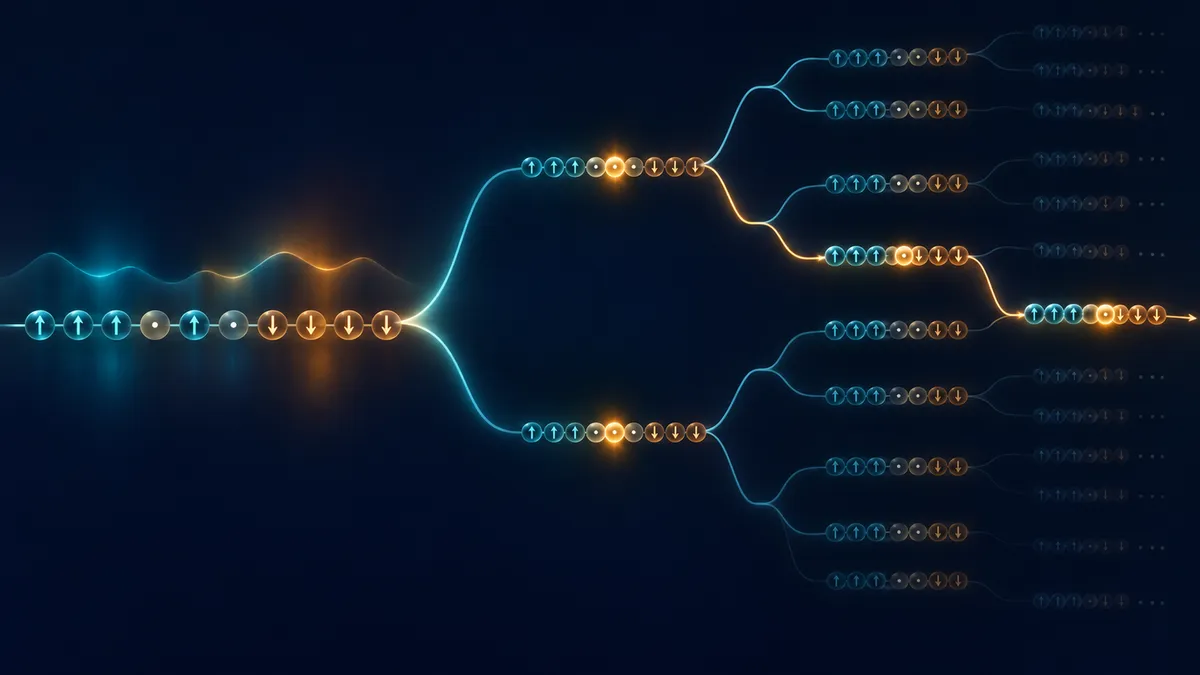
Many-body systems can have an enormous number of possible configurations, linked by a complicated web of transitions. A theoretical study designs a spin chain whose accessible configurations form a loop-free tree, making it possible to study how disorder affects a moving domain wall. Its numerical results point to a transition at finite disorder, but the proof covers only sufficiently strong disorder.
Many-body localization describes a regime in which disorder can prevent an interacting quantum system from spreading and settling into ordinary thermal equilibrium. One way to picture the problem is to treat each possible many-body configuration as a point on a graph, with the Hamiltonian connecting configurations that can transform into one another. In realistic systems, that graph is huge, its disorder is correlated, and it contains loops—features that make analysis difficult.
Bernhard Jobst, Simone Warzel, Alexander Altland and Frank Pollmann present a spin-1 chain designed to simplify this picture without discarding all its complexity. For a particular initial state, the dynamics reduces to a single domain wall moving through configurations arranged as an exact binary tree. This is a theoretical study, not an experimental demonstration.
A moving wall on a configuration tree
Each site in the chain has three possible spin states. The model’s constrained spin flips let the wall advance or retreat, but only at its boundary. Starting from the all-zero state, reachable configurations can be described as strings of plus and minus spins followed by zeros. Each step deeper into the tree adds another plus-or-minus choice. Because the wall is the only part of the chain that moves in this sector, the configuration graph has no loops.
Random magnetic fields on the physical chain create a distinctive kind of disorder on the tree. A configuration’s energy is the sum of fields along its branch. Neighboring configurations therefore have related energies: siblings differ through a shared field contribution rather than receiving independent random energies. The tree preserves this correlated disorder, a feature relevant to broader many-body localization problems, while avoiding loops.
Without disorder, the wall propagates freely and spreads ballistically. With disorder, the question is how strongly that motion is suppressed—and whether disorder can overcome the exponentially growing number of branches to produce localization.
Proofs and numerical recursion
For the rigorous part, the authors adapt the fractional-moment method to the tree’s correlated random potential. They use it to bound Green’s functions, mathematical quantities that describe propagation between configurations. The result implies that, above a sufficiently large disorder strength, the disorder-averaged probability of finding the wall far from its starting point is suppressed exponentially with distance. The bound still allows the confinement scale to grow logarithmically with observation time and system size. It does not show that the wall stays within a fixed distance forever.
The authors also develop a cavity recursion, which calculates how a subtree responds by working back from its leaves toward the root. The tree’s repeated structure makes this calculation efficient: instead of listing exponentially many configurations, the researchers evaluate the recursion for each random-field realization and track how propagation changes with disorder.
Their numerical criterion estimates the transition near disorder strength 7.13 in the paper’s units. This value comes from extrapolating numerical results to vanishing broadening; it is not a rigorously proven critical value. The survival probability of the initial state shows a finite plateau above the estimated transition on the times accessible to the simulations. Below the estimate, the probability decays very slowly. The authors caution that slow dynamics can make a delocalized regime appear localized over finite observation times.
What the result does—and does not—establish
The strong-disorder theorem and the numerically estimated transition are distinct results. The proof guarantees a localization bound only above a much more conservative threshold, about 67 in the model’s units. This is a sufficient threshold for the proof, not an estimate of the transition. Establishing mathematically that the delocalized phase survives weak disorder—and thus proving the full transition—remains an open problem.
The model also differs from generic interacting chains. Its tree has a fixed branching structure and no loops; loops arise in ordinary many-body configuration graphs when separate parts of a system can rearrange in different orders. The authors expect a similar mechanism may apply to other sectors of their fragmented model, but do not establish that here. Whether entanglement grows in expected ways across the estimated transition, and whether states in the delocalized regime have a multifractal structure, are also open questions.
The study’s contribution is methodological as well as physical: it constructs a local spin model where correlated disorder and rapid growth of configuration space can be studied with unusually direct tools. Its findings concern this carefully constrained setting and do not by themselves settle localization in generic many-body systems. This article is based on an arXiv preprint, which may not have undergone peer review.
- many-body localization
- spin chain
- quantum disorder
- Fock-space tree
- domain wall
- localization transition
Reviewed cross-references
These connections were reviewed by a model, not independently fact-checked by a human. Similarity does not imply agreement; consult the original papers and the evidence below.
Quantum states that spread out—but remain uneven
Shared method: Both studies use cavity methods on tree structures: Jobst and colleagues evaluate a cavity recursion for domain-wall propagation on an exact Fock-space tree, while Vanoni and colleagues use a band-center cavity equation for a disordered Cayley tree. The models, disorder, and localization diagnostics differ, so this is a methodological connection, not evidence that their findings corroborate one another.
Model review: · openai-codex/gpt-6-luna
Evidence and provenance
Selected excerpts, not complete papers. PDF extraction can omit figures or damage equations, tables and reading order; sources may be preprints.
2611.21445v1 — Original paper
Excerpt reference:
static/papers/2611.21445v1.md:644-713
Basis: Paper text
Source SHA-256:a0aca2fdb6f03bda436b9dc1b9dbdd234de63ddc2a8b12e5a3f0125df88763f62607.18179v3 — Original paper
Excerpt reference:
static/papers/2607.18179v3.md:126-181
Basis: Paper text
Source SHA-256:8a81190261882882666177b29568bd1f3f02b72883b8a77ee07652b481592caf