TRANSMISSION // 2611.20881v2
When boundaries amplify non-Hermitian waves
Source published
A theoretical study proposes edge accretion: under specific conditions, repeated encounters with boundaries can amplify states in non-Hermitian systems.
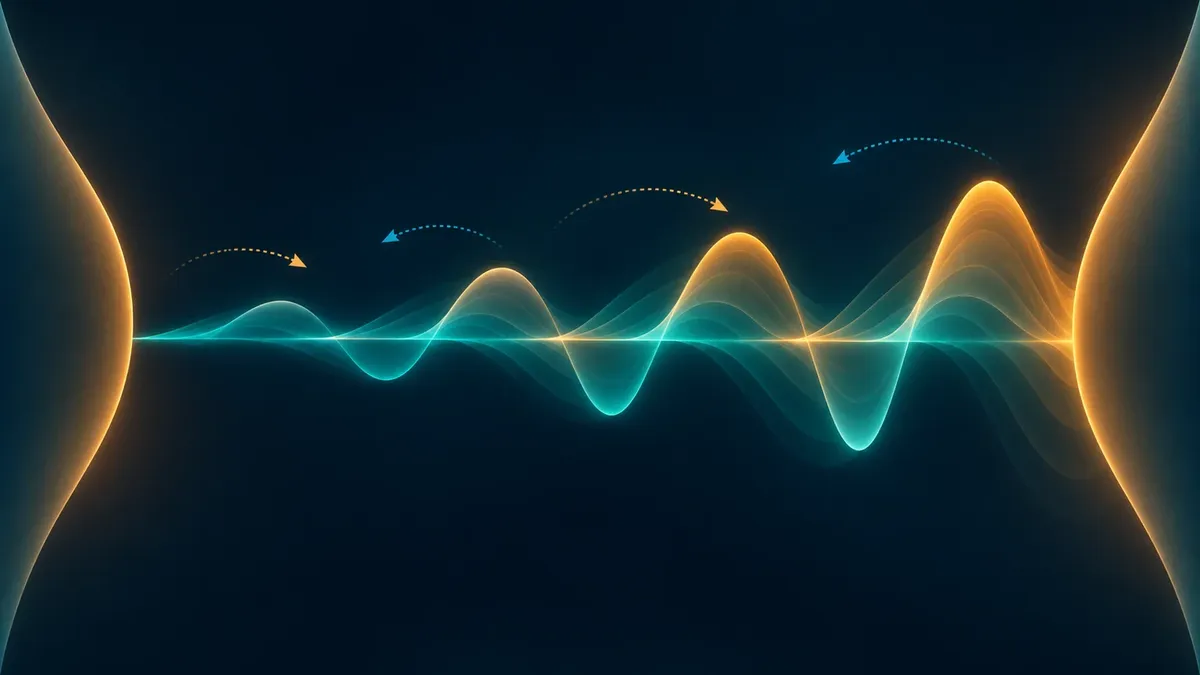
The non-Hermitian skin effect can cause many states to accumulate near a system’s edge. Wei Li, Ching Hua Lee and Fuxiang Li ask whether boundaries always suppress amplification—and describe a theoretical mechanism by which they may instead intensify it.
When a wave returns stronger
In non-Hermitian systems, the mathematical description allows effects such as amplification or attenuation. One notable example is the non-Hermitian skin effect (NHSE), in which many states accumulate near a boundary when a system has open ends. A common expectation is that the spectrum under open boundary conditions is encircled by the spectrum under periodic boundary conditions. The authors argue that this familiar scenario can be dramatically violated in some systems.
They call the proposed phenomenon non-Hermitian edge accretion (NHEA). In it, strongly coupled, competing NHSE channels can combine so that a state is amplified when it bounces off an edge, rather than attenuated. The paper’s abstract reports analytical and numerical support for this claim.
What the authors say drives it
The proposed mechanism depends on what the authors describe as underappreciated consequences of non-Bloch eigenspinor orthogonality. In broad terms, these are mathematical relationships between modes used to describe the system. According to the abstract, this orthogonality controls reflection coefficients and the balance between propagating and evanescent waves. Together, these features can produce repeated amplification at the edges. The abstract describes periodically growing edge bounces but gives no growth rate or specific measured example.
The authors distinguish NHEA from conventional critical NHSE scaling by the source of the amplification feedback. They characterize conventional scaling as arising from feedback in the bulk, whereas NHEA involves amplification at edges. This is a distinction between mechanisms, not a claim that one behavior replaces the other in all systems.
Possible tests—and open questions
The authors say NHEA requires strongly coupled antagonistic NHSE chains with suitable mode orthogonality. They suggest looking for periodically growing edge bounces in non-Hermitian metamaterials and quantum simulators, and describe the mechanism as platform-agnostic. That does not mean it should occur in every such platform; the stated conditions matter.
The available evidence for this account is the paper’s abstract, not its full text. It does not give model details, parameter ranges, or the numerical results needed to assess how broadly the prediction applies. The abstract proposes a possible signature; it does not report an experimental observation.
The work is an arXiv preprint, and the supplied information does not establish whether it has been peer-reviewed. Its claims should therefore be read as a theoretical proposal supported by the authors’ analytical and numerical work, rather than as settled consensus. Assessing its scope requires the full paper, while confirming the suggested signature would require experimental or independent follow-up evidence.
- non-Hermitian physics
- non-Hermitian skin effect
- edge accretion
- wave amplification
- quantum physics
Reviewed cross-references
These connections were reviewed by a model, not independently fact-checked by a human. Similarity does not imply agreement; consult the original papers and the evidence below.
How one quantum boundary can create nonunitary critical behavior
Supporting evidence: Both papers report boundary-associated amplification in non-Hermitian settings: Li et al. describe states gaining intensity at edges in strongly coupled competing skin-effect chains, while Zhou and Ye relate amplified single-particle reflection at the Fermi level to boundary-induced critical correlations in a Hermitian bulk with a non-Hermitian boundary. These are distinct models and outcomes, so the comparison supports only the bounded point that boundary processes can amplify non-Hermitian responses; it does not establish a shared mechanism.
Model review: · openai-codex/gpt-6-luna
Evidence and provenance
Selected excerpts, not complete papers. PDF extraction can omit figures or damage equations, tables and reading order; sources may be preprints.
2611.20881v2 — Original paper
Excerpt reference:
static/papers/2611.20881v2.md:58-223
Basis: Paper text
Source SHA-256:1d475471c512c3c4fe599c71e0d719340e09c1ab48b97da1dad12b64da5999fc2510.15370v2 — Original paper
Excerpt reference:
static/papers/2510.15370v2.md:63-151
Basis: Paper text
Source SHA-256:2cc0b46836802235bb446347d66bf6614689b8cd18d915987f3fe535641ebc05
Related reading
Automatically matched by shared topic keywords. These links do not imply that the sources agree or establish a consensus.
How patterned quantum lattices could sharpen sensing
Source published
Shared keywords: non hermitian physics
When a wave gets trapped, but not in the usual way
Source published
Shared keywords: non hermitian physics
When Gain and Loss Don’t Break T Symmetry
Source published
Shared keywords: non hermitian physics
How one quantum boundary can create nonunitary critical behavior
Source published
Shared keywords: non hermitian physics
A frequency-comb sensor separates a weak signal from measured noise
Source published
Shared keywords: non hermitian physics