TRANSMISSION // 2611.20622v2
How noise changes the best stopping point for quantum search
Source published
A theoretical framework uses observable oscillations to assess when noisy quantum search should stop, recalibrate or choose a safer iteration window.
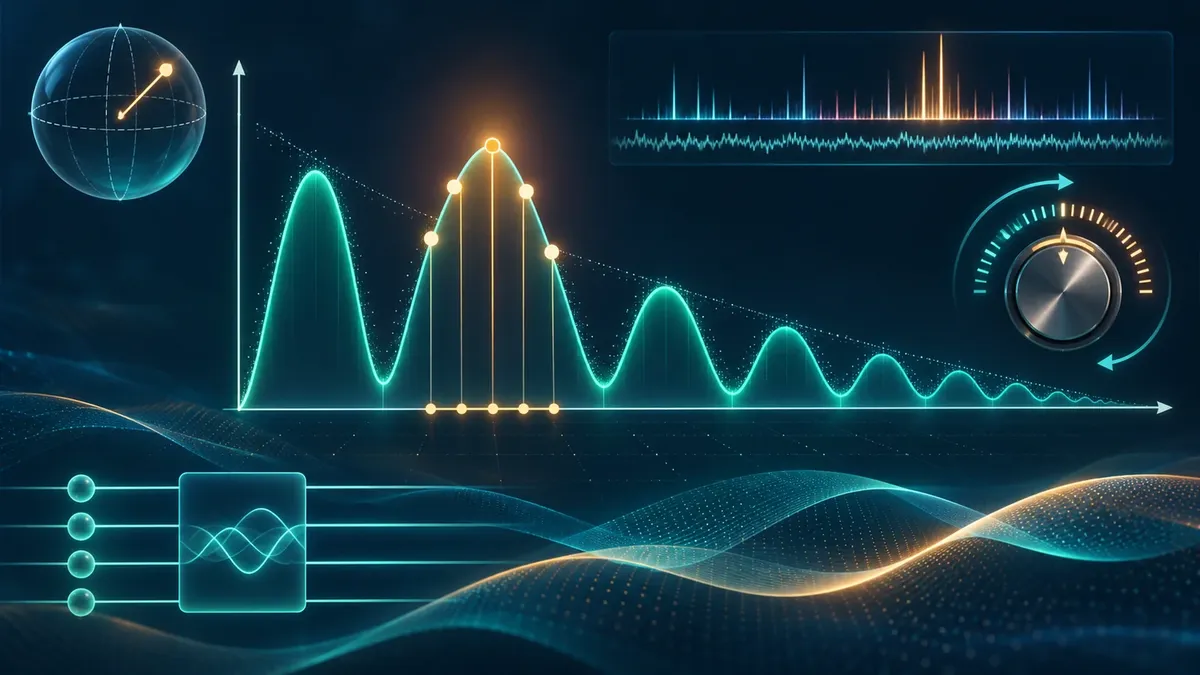
Quantum search works by repeatedly amplifying the chance of finding a target—but noise can shift the best moment to stop. A new theoretical preprint proposes a way to estimate that shift from observable patterns in the search signal, with conditions that spell out when its recommendations are reliable.
In ideal Grover search, repeated operations raise the probability of measuring a target, then eventually lower it again. The probability traces a series of peaks, and stopping near the first peak is a natural strategy. Noise complicates the choice: it can damp the oscillations, shift their frequency, or alter their phase. Even a small shift may change which whole-number count of iterations gives the best result.
The paper, Observable Spectral Framework for Noisy Amplitude Amplification: Stopping Stability and Correction, asks whether a stopping rule can be built from the observable shape of this signal, rather than from a separate detailed formula for each noise mechanism. The authors focus on stationary noisy versions of standard amplitude amplification when the ideal success fraction is known. Their approach is conditional: it assumes the observed dynamics have a dominant oscillatory component, that this component is spectrally separated from others, and that the remaining contributions can be bounded.
Reading the search signal
The central idea is to describe the measured success probability as a leading damped oscillation plus a bounded remainder. In everyday terms, the leading component captures the main rise-and-fall pattern, while the remainder accounts for other influences that the simple pattern does not explain.
The authors analyze how three properties of that leading oscillation—its frequency, damping and phase offset—move its predicted peak. They then derive criteria based on the values sampled at integer iteration counts. Those criteria distinguish among three practical situations: the ideal stopping count remains justified; recalibration is warranted; or it is better to choose a robust candidate window rather than trust one precise stopping point.
This is not a universal recipe for every noisy quantum circuit. The framework applies only when its stated assumptions and residual bounds hold. And the authors note that the leftover modes can matter in their own right: they may reverse which of two neighboring iteration counts performs better. A smooth-looking main oscillation, by itself, is therefore not enough to guarantee that the closest predicted peak is the best sampled choice.
What the examples show
The authors examine their predictions using analytical constructions, circuit simulations, finite-shot inference and trajectories derived from calibration to resemble device behavior. The abstract does not provide detailed sample sizes or a full account of these tests, so it is not possible to assess those aspects from the available source alone.
One reported example is a 64-element search. An after-the-fact check of the sampled candidates selects five amplification iterations instead of six. In that example, the success probability rises from 0.595 to 0.626. This illustrates the proposed selection procedure in a particular case; it is not evidence that the same improvement will occur across devices or search problems.
The paper also describes how stopping errors scale in single-target Grover search. Frequency and damping errors have sensitivities proportional to the size of the search space, while phase offsets scale with its square root. These are theoretical sensitivities under the framework, not measurements of error rates on a general-purpose quantum computer.
A conditional tool, not a device guarantee
The work’s contribution is a shared way to reason about noisy stopping decisions using observable spectral behavior, without solving a microscopic noise-channel model separately for every case. But its guarantees depend on the leading-mode, spectral-separation and residual-control conditions. If those conditions are not met—or if the remainder is not adequately bounded—the recommended stopping depth may not be dependable.
The available evidence here is the paper’s abstract, not its full text. That limits what can be said about the derivations, experimental setup, calibration procedure and scope of the simulations. The work is an arXiv preprint, and the source record does not establish peer review. Its results should therefore be read as a proposed theoretical framework and illustrative tests, not as a validated operating rule for current quantum hardware.
- quantum computing
- Grover search
- amplitude amplification
- quantum noise
- stopping rules
- spectral analysis
Reviewed cross-references
These connections were reviewed by a model, not independently fact-checked by a human. Similarity does not imply agreement; consult the original papers and the evidence below.
Quantum amplitude estimation tests a proton-transport model, but clinical speedup remains out of reach
Shared method: Both studies use Grover-style amplitude amplification: Zhong et al. analyze stopping depths for noisy amplitude-amplification trajectories, while Chung applies Grover iterations in maximum-likelihood amplitude estimation of a proton-range statistic. This is a methodological connection; the excerpts describe different settings and results, not a shared stopping guarantee.
Model review: · openai-codex/gpt-6-luna
Evidence and provenance
Selected excerpts, not complete papers. PDF extraction can omit figures or damage equations, tables and reading order; sources may be preprints.
2611.20622v2 — Original paper
Excerpt reference:
static/papers/2611.20622v2.md:13-42
Basis: Paper text
Source SHA-256:ca20dc8eb75b1b1432bcef8e2afc147dbe2f4bda81e6a84e5e96ffcf7c2997682611.13475v1 — Original paper
Excerpt reference:
static/papers/2611.13475v1.md:13-53
Basis: Paper text
Source SHA-256:3c1b16cb04f7480d5bb4b44e89dff295a1fc617893fb0a835b49d5ba170a3c942611.13475v1 — Original paper
Excerpt reference:
static/papers/2611.13475v1.md:1425-1686
Basis: Paper text
Source SHA-256:3c1b16cb04f7480d5bb4b44e89dff295a1fc617893fb0a835b49d5ba170a3c94
Related reading
Automatically matched by shared topic keywords. These links do not imply that the sources agree or establish a consensus.
A tunable middle ground for quantum spatial search
Source published
Shared keywords: quantum computing
Quantum oracles count edges to find cliques and hitting sets
Source published
Shared keywords: grover search
An exact quantum result exposes a limit of black-box verification proofs
Source published
Shared keywords: quantum computing
Repeated measurements enable rational quantum spectral filters
Source published
Shared keywords: quantum computing
Dicke states from every qubit, with no extras
Source published
Shared keywords: amplitude amplification