TRANSMISSION // 2611.20136v2
A Hadamard matrix that is isolated—but has a defect
Source published
An order-13 mathematical example shows that a matrix can be isolated from nearby inequivalent examples even when its linearized equations have a one-dimensional solution space.
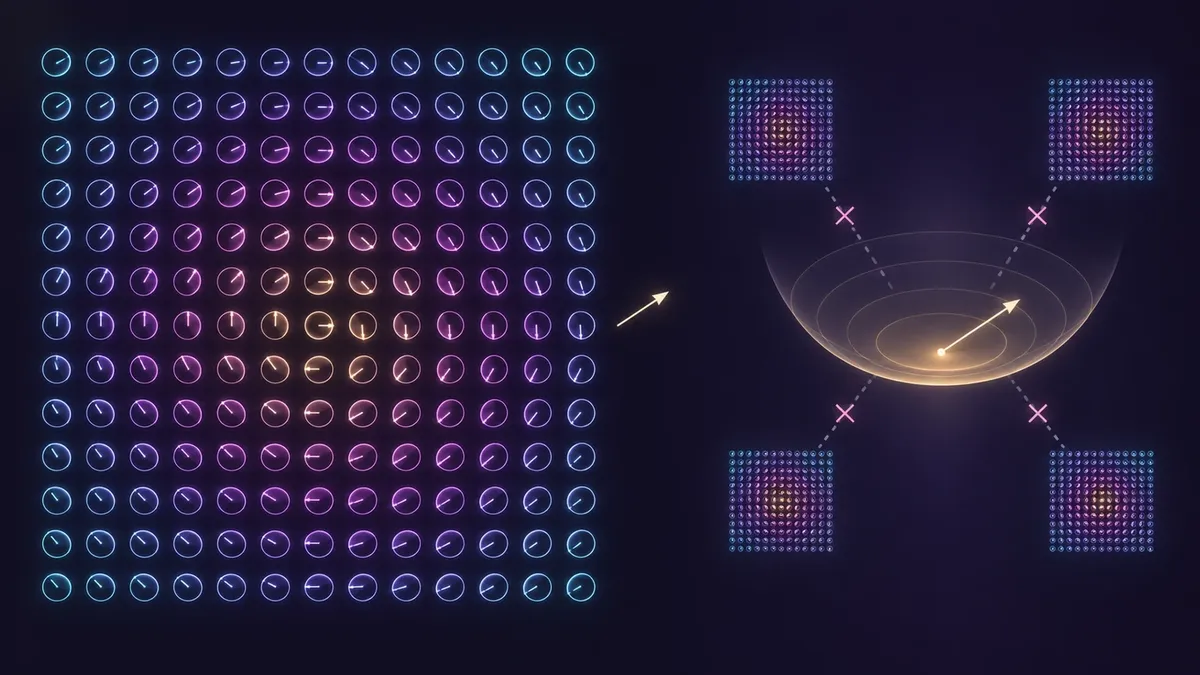
A zero-dimensional first-order test guarantees that a complex Hadamard matrix is isolated. But is it necessary? Shannon Hall and Remus Nicoara report a counterexample: an order-13 matrix that is isolated up to equivalence yet has defect one.
The puzzle: when is a matrix truly alone?
A complex Hadamard matrix is a square array of complex numbers whose entries all have absolute value 1 and whose rows are mutually orthogonal. These matrices appear in areas including quantum information and harmonic analysis. Researchers often study them up to Hadamard equivalence: operations such as reordering rows or columns, or multiplying them by phases, that preserve the essential structure.
A matrix is isolated if every sufficiently close Hadamard matrix is equivalent to it. One way to investigate isolation is to make small changes to the phases of its entries and linearize the equations that enforce row orthogonality. After fixing the first row and column, the real dimension of the solutions to these linearized equations is called the matrix’s defect.
Defect zero guarantees isolation. The open question was whether the reverse also holds: must every isolated matrix have defect zero? The authors’ answer is no.
A first-order direction that does not yield a nearby family
The paper presents a complex Hadamard matrix of order 13 whose entries are sixth roots of unity. It has defect one: the linearized equations allow one independent direction of phase change. Yet the matrix is isolated up to equivalence.
The distinction is between passing a linearized test and belonging to an actual family of nearby matrices. A first-order calculation identifies a candidate direction of change; it does not establish that a finite, nontrivial change is possible. The authors show that the sole nonzero first-order direction fails an additional condition that any direction arising from a sequence of nearby Hadamard matrices must satisfy.
That condition comes from a second-order analysis. In broad terms, it adds a constraint beyond the linear approximation on directions that could describe convergence toward the matrix. Because the defect space is one-dimensional, every nonzero candidate direction is a multiple of the same one. The authors’ exact calculations show that this direction fails the second-order condition. They conclude that no sequence of inequivalent Hadamard matrices can approach the example, establishing its isolation.
The proof also connects the problem to commuting squares, a framework involving pairs of subalgebras of matrix algebras. In that language, a “span condition” was known as a sufficient test for isolation. The example shows that this condition is not necessary: the associated commuting square is isolated even though it fails the span condition.
What the result changes—and what it does not
The counterexample answers the stated square-matrix question negatively: isolation does not always imply zero defect. It also clarifies what defect measures. A nonzero value identifies a direction allowed by the linearized equations, not necessarily a genuine nearby family of matrices.
This is a theorem about mathematical structure, not evidence that a particular physical device or quantum-information protocol performs differently. Although complex Hadamard matrices have applications in several fields, the paper’s central result concerns local isolation and the limits of a first-order criterion—not an experiment.
The authors say the example was already included in a published dataset of Butson-type Hadamard matrices; their contribution is proving its isolation and defect. They report using exact arithmetic for the finite calculations supporting the proof. The paper also discloses that an AI model helped search databases for candidate examples, verify finite computations, and edit the manuscript; the authors take responsibility for the mathematical content.
Uncertainty and source limits
The source is an arXiv preprint, not, on the evidence available here, a peer-reviewed publication. Its findings should be understood as the authors’ reported mathematical result, not as independent confirmation. This article summarizes the source’s proof rather than independently checking every calculation. The conclusion concerns one specific order-13 example; it does not classify complex Hadamard matrices in general.
- complex Hadamard matrices
- matrix defect
- mathematical isolation
- linearization
- commuting squares
- preprint