TRANSMISSION // 2611.20030v1
Modeling Hidden Factors in Complex Time Series
Source published
A proposed factor model uses principal components and score-driven dynamics, with theory for estimation and prediction intervals under changing factor representations.
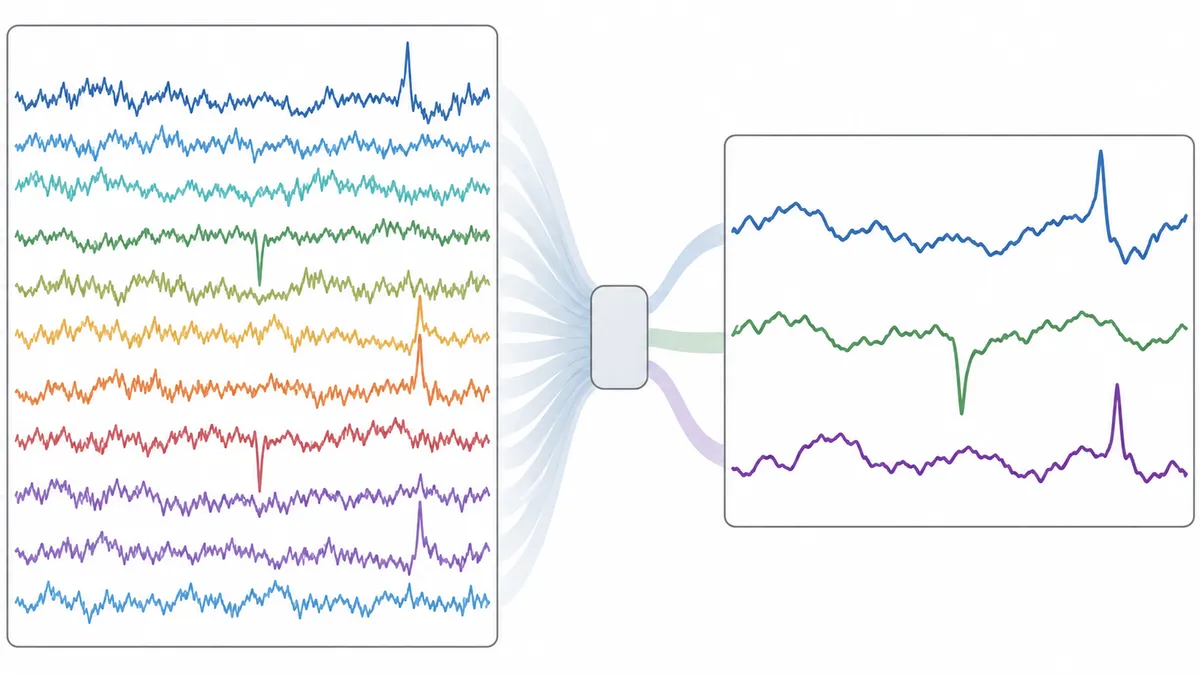
Many datasets contain more measurements than can be modeled one by one. Factor models summarize such data with a smaller set of latent variables. Matteo Barigozzi and Enzo D’Innocenzo propose a way to model how those factors evolve over time, allowing for nonlinearities and heavy tails in both conditional means and variances.
The question: how can hidden factors change over time?
A factor model represents a large collection of observed time series using a smaller number of unobserved factors. The factors are statistical summaries, not directly measured quantities. A central challenge is describing their dynamics: a useful model may need to allow more than simple linear changes and to accommodate data with heavy tails, where extreme values are more prevalent than in thin-tailed distributions.
In this paper, Barigozzi and D’Innocenzo propose a high-dimensional approximate factor model in which latent-factor dynamics follow a multivariate score-driven model. According to the abstract, this setup allows nonlinearities and heavy tails in both the conditional mean and conditional variance. The paper focuses on how to estimate the model and conduct inference despite the factors’ lack of a unique representation.
Two steps: extract factors, then model their dynamics
The estimation procedure has two stages. First, the researchers use principal component analysis (PCA) to extract factors from the observed time series. PCA is a standard way to summarize patterns in many variables with a smaller number of components.
Second, they estimate the parameters governing the extracted factors’ dynamics using quasi-maximum likelihood (QML). The abstract specifies that this estimation is based on the estimated factors. It does not provide enough detail to explain the particular likelihood specification or what role the quasi-likelihood plays here, so those details cannot be assessed from the abstract alone.
Inference when factors are not uniquely defined
Latent factors are not identified: different representations can describe the same underlying factor structure. This creates a challenge for inference, because estimates or predictions should not depend arbitrarily on the convention used to represent the factors.
The authors report theoretical results as both the number of time series and the sample size grow. They establish set-consistency and asymptotic normality for estimated parameters governing the factor dynamics. Broadly, these results characterize how the estimates behave in a large-sample setting while accounting for the factors’ non-unique representation.
They also construct asymptotic prediction intervals that, according to the abstract, do not depend on the identifying constraints chosen for the factors. Prediction intervals express uncertainty around a forecast; the abstract does not provide their exact construction or report numerical coverage rates.
What the findings do—and do not—show
The abstract says numerical results confirm the “goodness” of the estimator. It does not describe the experiments, datasets, evaluation measures, or comparisons. On this evidence, it is not possible to determine how the method performs in particular settings or whether it outperforms alternatives.
The theory concerns large-sample behavior under assumptions that the abstract does not specify. Such results do not by themselves establish how accurate predictions will be in a finite dataset or how well the assumptions fit a real application. The abstract reports no empirical case study or finding about a specific field or dataset.
The paper’s stated contribution is methodological: a two-step factor-estimation approach, theoretical results for its dynamic parameters, and asymptotic prediction intervals designed to be independent of factor-identifying constraints. Assessing the scope of those claims requires details beyond the abstract.
Evidence and source limits
This account is based on the abstract of the arXiv preprint, rather than a full examination of the paper. The available evidence does not establish whether the preprint has undergone peer review. The abstract also omits the assumptions, proof details, numerical-study design, and results needed to evaluate the method more fully. Those limits make it inappropriate to draw conclusions about its practical performance from the abstract alone.
- factor models
- time series
- principal component analysis
- score-driven dynamics
- statistical inference
- prediction intervals
Reviewed cross-references
These connections were reviewed by a model, not independently fact-checked by a human. Similarity does not imply agreement; consult the original papers and the evidence below.
When machine learning misses hidden forces in economic data
Shared method: Both papers use principal components to estimate latent factors from panel data: the first extracts factors before fitting score-driven dynamics, while FA-DML applies PCA to first-stage residuals to estimate treatment and outcome factor spaces. This is a shared estimation step, not evidence that their estimators or inferential results are interchangeable; they target different questions and rely on different assumptions.
Model review: · openai-codex/gpt-6-luna
Evidence and provenance
Selected excerpts, not complete papers. PDF extraction can omit figures or damage equations, tables and reading order; sources may be preprints.
2611.20030v1 — Original paper
Excerpt reference:
static/papers/2611.20030v1.md:54-163
Basis: Paper text
Source SHA-256:ed9a0bfccf0590d00585bce2513d9dd339b5a54e8edc7626b1a69ed65d29add62611.14385v1 — Original paper
Excerpt reference:
static/papers/2611.14385v1.md:79-189
Basis: Paper text
Source SHA-256:32177fe1c022736eb7442ce6e55cf020bfd8a025cb96a4eedd177da4688779b0
Related reading
Automatically matched by shared topic keywords. These links do not imply that the sources agree or establish a consensus.
What Long-Memory Patterns Reveal in Climate Data
Source published
Shared keywords: factor models, principal component analysis
Separating shared economic movements from conditional links
Source published
Shared keywords: time series
When machine learning misses hidden forces in economic data
Source published
Shared keywords: statistical inference
Testing economic signals when extreme values and long memory collide
Source published
Shared keywords: statistical inference
Better volatility forecasts still need honest uncertainty ranges
Source published
Shared keywords: prediction intervals