TRANSMISSION // 2611.20020v2
What Can Graph Neural Networks Represent?
Source published
Yonatan Sverdlov’s thesis examines how neural networks can capture geometric, symmetry, containment and metric structure, with four proposed contributions.
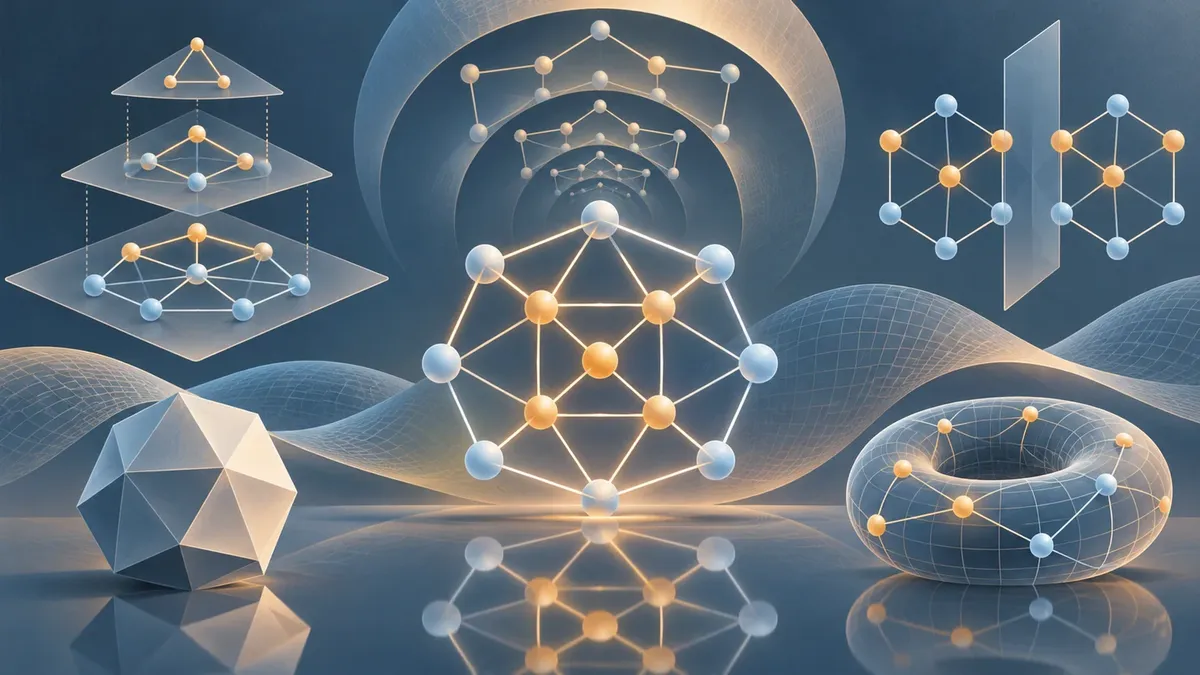
How much structure can a neural network preserve when learning from graphs and sets? Yonatan Sverdlov’s thesis explores that question through theoretical analyses and proposed architectures. Its abstract outlines four contributions, while leaving many details of the methods and evaluations unspecified.
The expressive power of a neural network describes which distinctions or patterns it can represent. In work on structured data, that question includes whether a model can account for geometry, symmetries, relationships between sets, or distances between inputs.
Yonatan Sverdlov’s thesis, Improving fine-grained expressivity of graph neural networks, presents four contributions addressing these issues. The available source is the arXiv abstract, so it gives an overview rather than enough detail to evaluate proofs or experiments.
Four contributions
First, the thesis characterizes the generic expressive power of geometric message-passing neural networks on sparse graphs. It also introduces EGenNet, an architecture intended to achieve the corresponding guarantees. The abstract does not state the characterization’s precise conditions or explain the guarantees in detail.
Second, the work uses representation theory to characterize linear layers that are equivariant to multiple permutations, including wreath-product symmetries. Equivariance means that a permitted transformation of the input corresponds to a matching transformation of the output. The abstract identifies the kind of symmetry considered, but does not provide the characterization’s formulas or examples.
Third, the thesis studies permutation-invariant set representations that preserve containment. Permutation invariance means that reordering a set’s elements does not change its representation. The work reports dimensional bounds and impossibility results, and proposes MASNet. The abstract does not specify the assumptions behind these results or the exact limits they establish.
Finally, it proposes FSW-GNN, a message-passing architecture described as combining strong expressivity with bi-Lipschitz stability guarantees. Informally, bi-Lipschitz conditions constrain how distances between inputs relate to distances between their representations. The abstract also reports strong empirical performance on long-range graph-learning tasks, but gives no datasets, metrics, baselines or numerical results. That claim therefore cannot be assessed or compared from the abstract alone.
What remains uncertain
These contributions concern distinct properties and types of evidence: theoretical characterizations, bounds and impossibility results, proposed architectures, stability guarantees, and empirical performance. The abstract does not show how the proofs are established, how the experiments were conducted, or how broadly the findings apply. It also does not demonstrate that any one architecture addresses every graph-learning task.
This account is based only on the thesis abstract, not a full-text review. The source is an arXiv preprint, and the available information does not establish its peer-review status. Readers should treat the described results as claims made in the abstract, with their technical scope and evidence requiring examination in the full thesis.
- graph neural networks
- expressive power
- geometric message passing
- permutation symmetry
- set representations
- bi-Lipschitz stability
- graph learning
Reviewed cross-references
These connections were reviewed by a model, not independently fact-checked by a human. Similarity does not imply agreement; consult the original papers and the evidence below.
A graph-learning method updates its view as connections appear
Shared method: Both works use message passing to update graph-node representations: the thesis studies message-passing networks on sparse geometric graphs, while MGP updates node embeddings along graph filtrations. Their findings address different questions and are not directly comparable: the thesis characterizes generic geometric identification, whereas MGP reports graph-isomorphism invariance and greater expressivity than the persistence descriptors it extends.
Model review: · openai-codex/gpt-6-luna
Evidence and provenance
Selected excerpts, not complete papers. PDF extraction can omit figures or damage equations, tables and reading order; sources may be preprints.
2611.20020v2 — Original paper
Excerpt reference:
static/papers/2611.20020v2.md:1574-1712
Basis: Paper text
Source SHA-256:2fa5d2b0bc8d6a508714b68537bc978bd8728a989a5bb58a30a9b493423d91cf2611.06801v1 — Original paper
Excerpt reference:
static/papers/2611.06801v1.md:13-35
Basis: Paper text
Source SHA-256:7bc4fbe5aa1019553079733898f6483d19e5b1c1ba33c2f558f7f12a662264f8
Related reading
Automatically matched by shared topic keywords. These links do not imply that the sources agree or establish a consensus.
A graph-learning method updates its view as connections appear
Source published
Shared keywords: graph neural networks
Seizure-detection AI learns to handle different electrode layouts
Source published
Shared keywords: graph neural networks
Forecasting a changing network by predicting its shape first
Source published
Shared keywords: graph neural networks
Forecasting Hurricane Evacuation Traffic
Source published
Shared keywords: graph neural networks
Can a Virtual Node Help AI Spot Rumors?
Source published
Shared keywords: graph neural networks