TRANSMISSION // 2611.19631v2
JWST Reveals a Nearby Dwarf Galaxy in Deep Cluster Images
Source published
Deep JWST images revealed Orion I, a nucleated dwarf galaxy estimated to be about 60 megaparsecs away. Its distance and possible group membership remain uncertain.
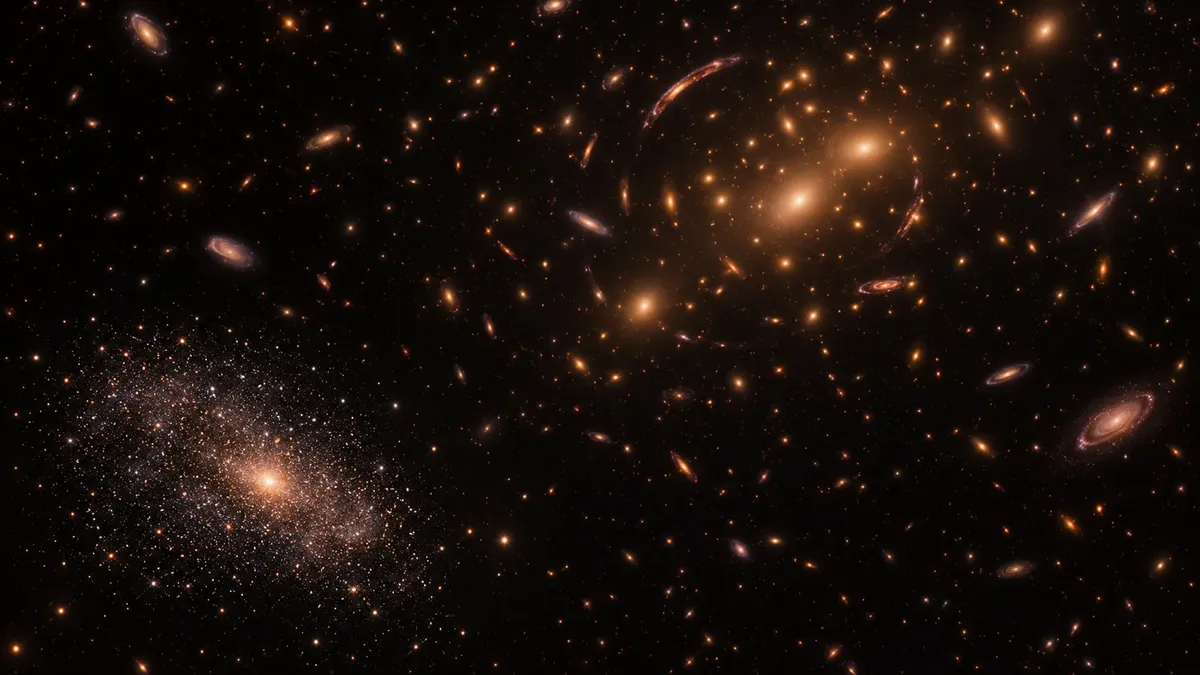
A deep view of a distant galaxy cluster turned up something much closer: a compact galaxy whose individual stars JWST could resolve. Researchers identify it as Orion I, a nucleated dwarf galaxy, while noting that its distance—and whether it belongs to a nearby group—are not yet settled.
A foreground find in a distant field
The James Webb Space Telescope often observes massive galaxy clusters because their gravity can magnify objects far behind them. While examining deep images of the cluster MACS J0454.1-0300, astronomers noticed a different kind of target: a compact, symmetric stellar system in the foreground, resolved into many individual stars.
The team calls it Orion I. The study asks what kind of object it is, how far away it lies, and whether it is isolated or part of a nearby galaxy group. The discovery also raises the possibility that deep observations designed to study distant objects may reveal small, relatively nearby systems that were not previously recognized.
Reading the stars and the galaxy’s shape
The researchers analyzed JWST’s NIRCam images in two near-infrared filters, F115W and F150W. They used point-spread-function photometry to identify and measure starlike sources, then plotted them in color–magnitude diagrams. These diagrams organize stars by brightness and color, helping reveal patterns associated with an old stellar population.
They also measured how Orion I’s light changes with distance from its center. A fit to the radial profile separated the diffuse body of the galaxy from its dense central component. The stellar population and two-part light profile support classifying Orion I as a nucleated dwarf early-type galaxy: a small, smooth-looking galaxy with a compact nucleus.
To estimate distance, the team used two approaches. The first was the tip of the red-giant branch (TRGB), a feature in the brightness distribution of evolved stars that can serve as a distance marker. The second was surface-brightness fluctuations (SBF), which uses the graininess of a galaxy’s unresolved light. The researchers adopted the TRGB estimate for their main discussion and used SBF as a complementary estimate.
A nearby dwarf, with a distance caveat
The TRGB method gives a distance of about 60 megaparsecs—roughly 196 million light-years—with an estimated uncertainty of 8 megaparsecs. The paper reports an effective radius of about 1.3 kiloparsecs and an estimated stellar mass of about 73 million Suns. The authors describe its measured structure and luminosity as typical of dwarf elliptical galaxies.
The distance is not precisely pinned down. The team says the apparent TRGB level is uncertain because relatively few stars define the bright end of the measurements. Possible contamination by brighter asymptotic-giant-branch stars and variation in the stellar population add further uncertainty. The SBF analysis suggests a distance range of about 82 to 131 megaparsecs. Its calibration is less secure and more sensitive to stellar-population differences than the TRGB method. The paper says the estimates are not in strong disagreement: the lower end of the SBF range is close to the upper end of the TRGB estimate. A more definitive distance remains desirable.
That uncertainty also affects the question of Orion I’s surroundings. At the adopted distance, it could be an outlying member of a previously cataloged small galaxy group; alternatively, it may be an isolated field galaxy. The paper identifies a possible group association but says a direct measurement of Orion I’s radial velocity would help clarify membership. The study does not establish that the galaxy is isolated.
What the discovery does—and does not—show
Orion I was found by inspecting deep JWST imaging, not through a dedicated survey designed to count nearby dwarf galaxies. Its detection shows that such images can reveal resolved stellar systems in the nearby universe, even when observations target a much more distant cluster. The authors suggest searching other deep JWST fields, but this single discovery does not establish how common such galaxies are or how many remain to be found.
This account is based on a research manuscript that acknowledges an anonymous referee and describes the review as rapid and positive. The manuscript’s review statement does not, by itself, establish its publication status. The reported photometry and profile analysis support the classification, while the precise distance and environmental membership remain uncertain. Radial-velocity observations could help settle whether Orion I belongs to a group.
- JWST
- dwarf galaxies
- Orion I
- galaxy distance
- TRGB
- surface-brightness fluctuations
- NIRCam
Reviewed cross-references
These connections were reviewed by a model, not independently fact-checked by a human. Similarity does not imply agreement; consult the original papers and the evidence below.
Red giant stars refine the distances to Andromeda’s dwarf companions
Shared method: Both studies locate the tip of the red giant branch from a break in a stellar luminosity function to estimate distance. Orion I uses JWST F115W photometry and an edge-response filter, while the Andromeda satellite study uses INT Sloan i-band photometry and a Sobel filter; this is a shared-method connection, not a direct comparison of distance results for these different galaxy samples.
Model review: · openai-codex/gpt-6-luna
Evidence and provenance
Selected excerpts, not complete papers. PDF extraction can omit figures or damage equations, tables and reading order; sources may be preprints.
2611.19631v2 — Original paper
Excerpt reference:
static/papers/2611.19631v2.md:278-383
Basis: Paper text
Source SHA-256:7c61852704866736f341f81bb7875313ea89c12849228855242ce6e9e7414da02611.08648v1 — Original paper
Excerpt reference:
static/papers/2611.08648v1.md:16-49
Basis: Paper text
Source SHA-256:b92b5b335a0514a22ef74c72f002216394031682e4281c46fe031e8a9b9f46f2
Related reading
Automatically matched by shared topic keywords. These links do not imply that the sources agree or establish a consensus.
Red giant stars refine the distances to Andromeda’s dwarf companions
Source published
Shared keywords: dwarf galaxies
Why missing radio signals do not rule out black holes in dwarf galaxies
Source published
Shared keywords: dwarf galaxies
GetGaia 2.0 sorts distant stellar systems from the Milky Way foreground
Source published
Shared keywords: dwarf galaxies
Dwarf-galaxy simulations find supernova energy matters more than failure rates
Source published
Shared keywords: dwarf galaxies