TRANSMISSION // 2611.18718v2
Can video AIs edit their own memory efficiently?
Source published
A cache-reuse method speeds up edits to long-video context, but the model often fails to choose the segment containing the answer.
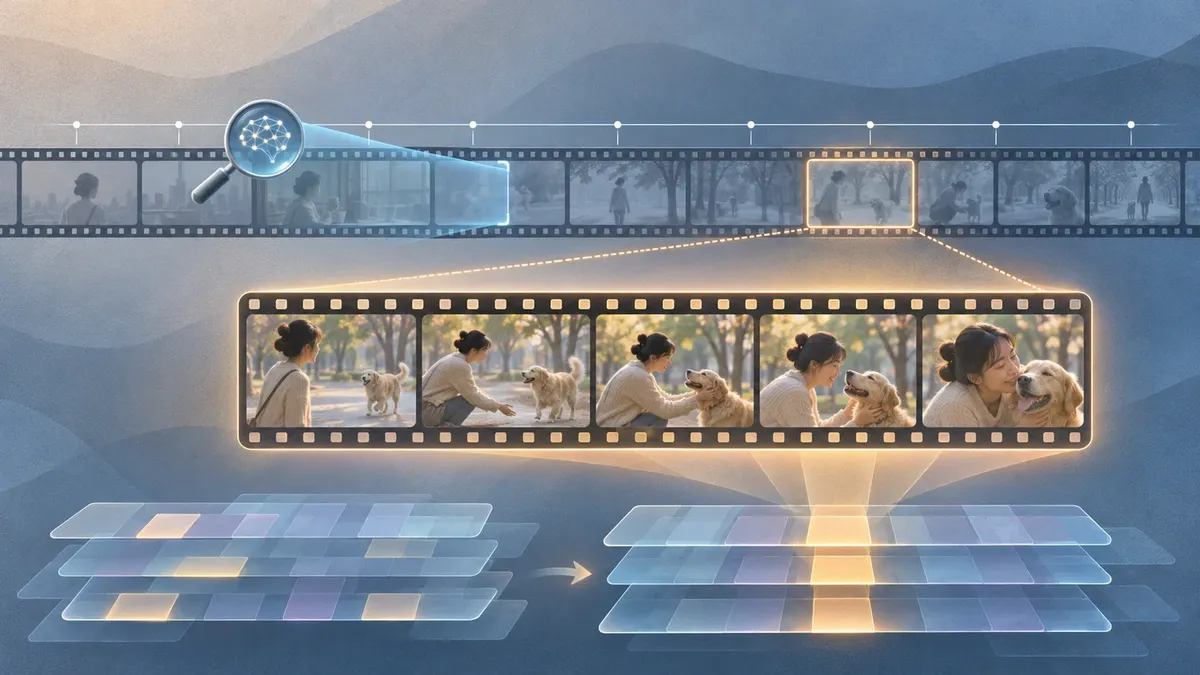
Long videos can overwhelm a vision-language model’s context. A new preprint tests whether the model can first scan sparsely, then revisit selected segments at higher detail without rebuilding all of its computational memory. The shortcut saves work in the tested setup; finding the right segments remains the harder problem.
A two-step approach to long videos
A model answering questions about a long video faces a trade-off: sample frames sparsely to fit the video into its input, or use more frames and risk exceeding its context or spending more time processing them. Sparse sampling can miss a brief event entirely.
In this preprint, Dayu Wang and Shasha Xu explore a two-step strategy. A vision-language model (VLM) first sees a sparse version of the video and selects segments that may contain relevant information. The system then increases the frame rate in those segments and removes other segments before asking the model to answer. The key question is whether it can make that mid-context edit without recomputing the model’s entire internal cache for the edited video.
That cache, called a key-value (KV) cache, stores intermediate information used as a model processes its input. Reusing it can avoid repeated computation. But when a segment is removed or moved, the positions of later segments change, and ordinary prefix reuse cannot simply reuse all their cached information.
Reusing the cache after an edit
The authors introduce SCR-VL, a method for rebuilding the cache after an edit. The video is divided into timestamped segments, each handled as a separate block. When an unchanged segment shifts position, SCR-VL rotates its cached keys to account for the new position. This relies on a property of Qwen’s multimodal rotary position encoding (M-RoPE): in the tested setup, moving a segment shifts the temporal and two spatial position components by the same amount. A content-hashed cache also lets the system reuse the vision encoder’s output for unchanged segments.
The position adjustment is exact for the first model layer, but reuse deeper in the network is approximate: cached information there reflects the segment’s earlier context. The authors compare SCR-VL with full recomputation and a prefix-reuse method, using Qwen2.5-VL-7B on synthetic questions about brief title cards inserted into public-domain films. They also test long-video questions from Video-MME and LongVideoBench.
Faster rebuilding, but not better selection
On the synthetic benchmark, SCR-VL reduced the number of tokens that had to be prefilled by 30% and cut end-to-end rebuild latency by 41% compared with full recomputation. Its answer matched full recomputation on 97.4% of questions. Those figures describe the cache-rebuilding step, not a general improvement in video-question answering.
Results on real-video benchmarks were similar in one important respect: SCR-VL tracked full recomputation closely while reducing prefill work. On LongVideoBench, for example, it agreed with full recomputation on 97.1% of questions and reduced rebuild latency by about 1.8 times. The authors report that these real-video samples were small and had wide confidence intervals, so they treat them as checks on the synthetic results rather than definitive evidence of broad performance.
The larger obstacle was choosing what to revisit. When the system was told which segment contained the synthetic title card, densifying that segment raised accuracy from 52.2% to 96.9%. But when the model chose segments itself, editing did not improve accuracy over the initial sparse input. Its selection usually missed the title card when the sparse pass had not already sampled it. This separates two questions: the cache method can make a correct edit cheaper, but it does not ensure the model makes a useful edit.
There is also a practical caveat. In the authors’ setup, simply appending the detailed segments rather than editing the context in place was both cheaper and more accurate than in-place editing. The authors say the case for deleting and relocating segments therefore depends on situations where content must be removed to stay within a context budget; their experiments did not test that constraint, because the appended version fit within the tested budget.
What remains uncertain
These are preliminary experiments, not a broad deployment evaluation. The main test uses artificial title cards, three models from one model family, and one editing rule. The real-video evaluations cover limited samples, and the work does not measure the effect of approximate cache reuse on long generations. Latency was measured in a Hugging Face implementation rather than a production serving system; with one attention implementation, the LLM portion of SCR-VL was not faster than full recomputation, and much of the total saving came from reusing vision-encoder work.
The results suggest that mid-context cache reuse may help make video-context edits less expensive under particular conditions. They do not show that current models reliably find the important moment in a long video. The paper is a preprint, so its claims have not necessarily undergone peer review.
- video language models
- KV cache
- long-video understanding
- M-RoPE
- artificial intelligence
Related reading
Automatically matched by shared topic keywords. These links do not imply that the sources agree or establish a consensus.
A Tokenizer-Aware Approach to Faster Video AI
Source published
Shared keywords: long video understanding, video language models
How VMSA Helps AI Search Hours of Video
Source published
Shared keywords: long video understanding
How VTree builds a reusable memory of long videos
Source published
Shared keywords: long video understanding
LoopSeek separates video search from answering
Source published
Shared keywords: long video understanding
AdaAlloc helps video AI decide where to look closely
Source published
Shared keywords: long video understanding