TRANSMISSION // 2611.18359v2
What Should an Agentic Robot Be Expected to Do?
Source published
A paper proposes a way to define agentic robotics and evaluate both foundation-model abilities and the performance of complete systems acting in physical environments.
The authors contrast policies designed for particular task families with systems that apply a foundation model to a broader range of embodied tasks. They ask what should count as agentic robotics—and how to evaluate whether such systems can act reliably in the physical world.
In Envisioning Agentic Robotics: A New Era of Robotic Systems, the authors argue that robotics needs a shared definition of agentic systems, a more reliable evaluation framework and a research roadmap. Their proposal centers on a system that uses a foundation model for open-world embodied tasks rather than relying only on a policy trained for a particular family of tasks.
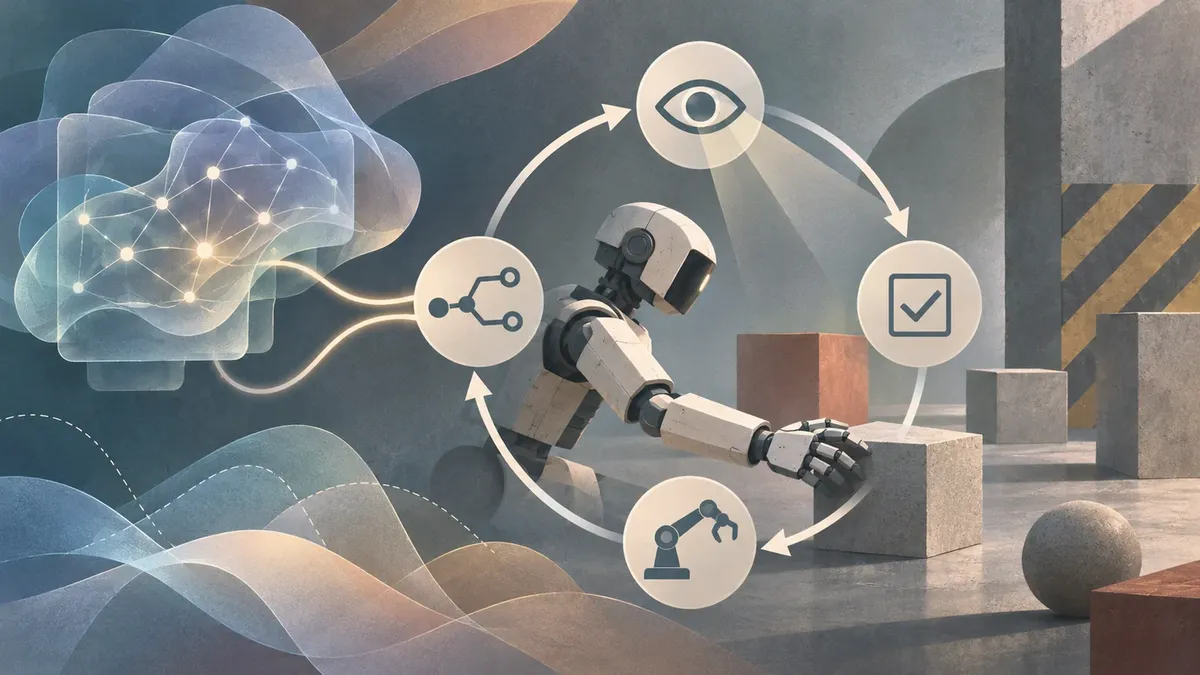
The authors describe agentic robotics as a feedback loop. A system observes its surroundings, interprets what a user wants, reasons about the task, calls on skills or tools, checks what happened and adjusts its next move. They call the combination of a foundation model and an “embodied harness” Embodied System 2, and propose it as the decision-making core of agentic robotics.
That framing emphasizes that a plausible plan is not enough. A robot has to turn general-purpose reasoning into actions that work under physical constraints: it may have limited time to react, mechanical limits on what it can do, and an environment that changes unpredictably. Some actions may also have irreversible consequences. The authors identify the challenge as making actions both effective and verifiable under these conditions.
To help evaluate progress, they propose a framework that measures two things: model capabilities and closed-loop system performance. In other words, evaluation should consider what the model can do as well as how the complete system performs while acting, observing results and adapting. The authors also identify principles they believe transfer from digital agents to physical ones, alongside challenges that remain for reliable autonomy.
The paper’s stated longer-term destination is sustained autonomy: systems that can work safely and reliably while taking on progressively broader responsibility. The authors describe a path from executing individual action primitives to fulfilling standing roles. This is a proposed research direction, not evidence that robots already meet that standard.
The abstract also says that frontier models paired with agentic harnesses matched or exceeded task-specific policies on many embodied benchmarks. It gives no benchmark names, measurements or study details, so that comparison cannot be assessed from the abstract alone. More broadly, the supplied source is only the abstract. It does not explain the harness’s components or give the proposed evaluation framework’s measures. Those details may appear in the full paper, but they cannot be established from the material available here.
Accordingly, the claims in this article are limited to what the abstract states: the authors’ framing, proposed evaluation approach and roadmap. The source provided does not establish the paper’s publication or peer-review status. Readers should treat the framework and roadmap as proposals described in the abstract, rather than as evidence that reliable physical autonomy has been demonstrated.
- agentic robotics
- robot autonomy
- foundation models
- robot evaluation
- closed-loop systems
- embodied tasks
Reviewed cross-references
These connections were reviewed by a model, not independently fact-checked by a human. Similarity does not imply agreement; consult the original papers and the evidence below.
A robotic laboratory links experiment planning with hands-on chemistry
Supporting evidence: The vision paper argues that physical autonomy requires reasoning and execution to operate in a verifiable, adaptive loop. Chen et al. report a bounded real-laboratory example: their system iteratively selected and ran Electro-Fenton experiments, improving transmittance over 15 rounds. This illustrates feasibility for one chemistry and setup, not sustained autonomy across tasks or laboratories.
Model review: · openai-codex/gpt-6-luna
Evidence and provenance
Selected excerpts, not complete papers. PDF extraction can omit figures or damage equations, tables and reading order; sources may be preprints.
2611.18359v2 — Original paper
Excerpt reference:
static/papers/2611.18359v2.md:4009-4062
Basis: Paper text
Source SHA-256:0824e06d54f15de33db2ccb8ffec595046323b6d2329e4a608dddca9143a8b5a2611.12958v1 — Original paper
Excerpt reference:
static/papers/2611.12958v1.md:191-248
Basis: Paper text
Source SHA-256:0ec36552bf3dbe1a03e63f8dd56685725471d786f59ed5b4be9a22c210f253f1
Robots Build and Realign a Laser Cavity
Supporting evidence: The vision paper identifies adaptation and verification under physical constraints as central to embodied autonomy. Choi et al. report a specialized optical system that constructs and aligns a laser cavity and recovers from induced misalignment or disturbance, a concrete closed-loop demonstration. The result is limited to the described optics framework and does not establish broader robot autonomy.
Model review: · openai-codex/gpt-6-luna
Evidence and provenance
Selected excerpts, not complete papers. PDF extraction can omit figures or damage equations, tables and reading order; sources may be preprints.
2611.18359v2 — Original paper
Excerpt reference:
static/papers/2611.18359v2.md:4009-4062
Basis: Paper text
Source SHA-256:0824e06d54f15de33db2ccb8ffec595046323b6d2329e4a608dddca9143a8b5a2603.21496v2 — Original paper
Excerpt reference:
static/papers/2603.21496v2.md:13-63
Basis: Paper text
Source SHA-256:f7015ccc048552a3cdda8da79ae7dc878b8d17fdc584735cfdf1441a8ac905d4
Related reading
Automatically matched by shared topic keywords. These links do not imply that the sources agree or establish a consensus.
Why a dexterous robot hand needs more than a powerful AI model
Source published
Shared keywords: foundation models, robot evaluation
Robot-coding agents need better failure diagnosis, not just more feedback
Source published
Shared keywords: agentic robotics
A robot can succeed—and still be fragile
Source published
Shared keywords: robot evaluation
When Reflections Challenge Robot Policies
Source published
Shared keywords: robot evaluation
Does fine-tuning give AI new abilities—or reveal what was already there?
Source published
Shared keywords: foundation models