TRANSMISSION // 2611.17658v2
Why Robot Policies Discount Noisy Position Readings
Source published
Robot policies can use their own state as a clue to an object’s location. A simulation study finds this learned anchor predicts responses to noisy position readings, but offers less protection when the robot acts on its own.
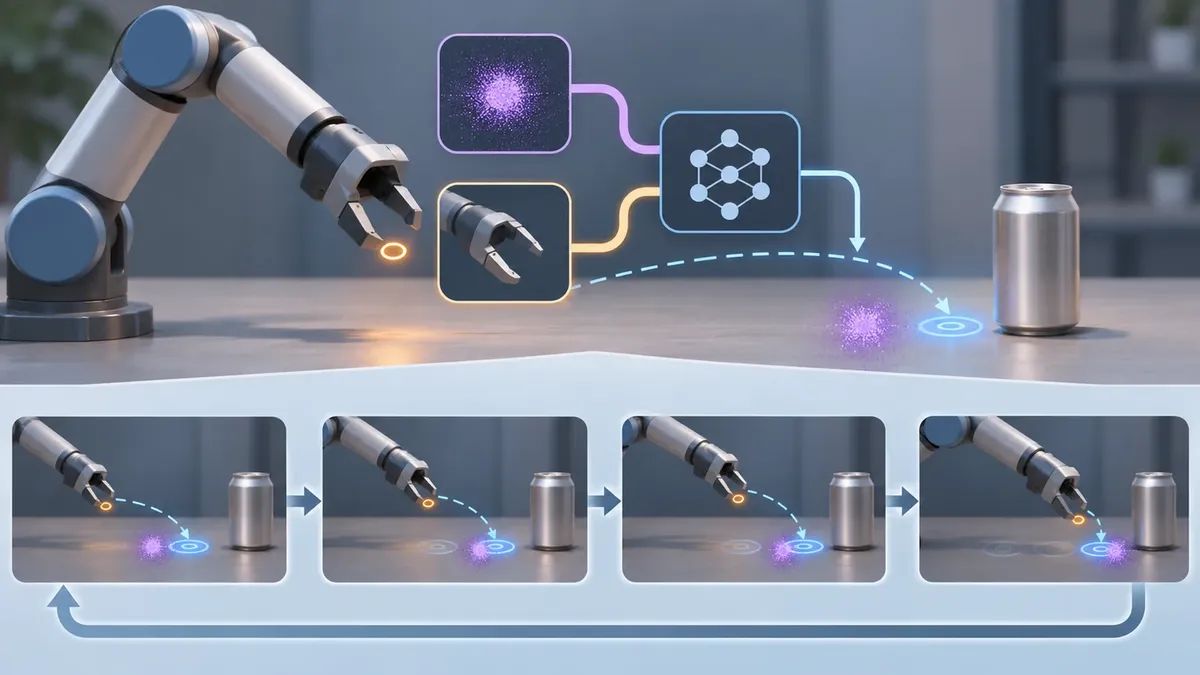
When a robot learns from demonstrations, its own state can provide a clue about where the target is. A preprint tests how that clue affects imitation policies’ responses to noisy object positions—and whether the apparent protection persists when the robot controls its own movements.
A robot reaching for an object may receive an imperfect estimate of its location. If it was trained to imitate demonstrations, how much should it trust that reading? A simulation study argues that the answer depends partly on what the robot can infer from its own state, such as its end-effector position and orientation.
The paper calls this clue a “proprioceptive anchor.” Proprioception is information about the robot’s own body. In demonstrations, people steer the robot toward an object, so the robot’s state can carry information about where the object is. A trained policy may combine that information with the noisy position reading, relying less on the reading when it is less reliable.
The authors describe the reading’s weight as α = V / (V + s²). Here, s² is the variance of the position-reading noise, and V is the error variance of the object position inferred from the robot’s state. A smaller α means the policy’s action is less sensitive to changes in the reading. The paper’s central point is that V belongs to the trained learner: a simple model of the demonstrations does not capture how accurately the policy uses its state as an anchor.
Testing the prediction
The experiments used two simulated robomimic tasks: nut assembly and can pickup. The researchers trained two imitation learners, a multilayer perceptron (MLP) and a diffusion policy, on 200 human demonstrations per task. They added synthetic Gaussian noise to object positions during training, then measured how much the policies’ actions changed when the position reading was nudged.
The study compared two ways to predict this sensitivity. Classical errors-in-variables regression estimates how noisy inputs weaken a response using the spread of object positions in the demonstrations. The proposed anchor method instead measures V from a policy trained at one noise level, then predicts its sensitivity at other levels.
Across ten registered, held-out predictions spanning both tasks, both learners and new noise levels, the anchor method’s mean absolute error was 0.025. The classical estimate’s error was 0.37, and none of its ten predictions met the registered tolerance. The authors attribute the difference to the policies’ inferred anchors being more accurate than estimates derived from the demonstration data alone. A separate test found that the measured bias was much smaller than expected if the policies merely acted as though the sensor noise were larger. This supports the anchor explanation, but does not establish every detail of how the policies represent that information.
Why acting changes the picture
Testing sensitivity at a fixed state differs from letting a robot act, observe the result and act again. During deployment, the policy produces the robot’s state. If a position reading has a persistent offset, the robot may move toward what appears to be a displaced object; its later state then reflects that movement. The state-based clue may reinforce the mistaken estimate instead of correcting it.
In closed-loop tests, sensitivity to a persistent reading offset exceeded open-loop α in all 15 policies that passed the registered gates. The stricter prediction—that every policy would follow the offset fully—held for 8 of those 15; the other 7 were intermediate. The results therefore indicate that open-loop protection did not persist, but not that every policy fully tracked the error.
In post hoc analyses, lower α was associated with lower success, particularly for diffusion policies. A registered follow-up tested diffusion policies on the Can task at two new noise levels. Before rollout, measured α was used to predict success with perfect readings. At each level, the predicted success rate differed from the observed rate by less than 0.03 in absolute terms. The reported 95% Wilson intervals, ±0.08, describe uncertainty around the observed success rates, not the prediction errors. The study also found that training noise predicted success equally well, so these findings do not show that α caused the success differences.
What remains uncertain
The findings are limited to simulation, low-dimensional observations and synthetic position noise. Real perception errors can depend on viewpoint, occlusion and object pose; the paper does not test image-based policies or physical robots. Each training configuration used two random seeds, and some closed-loop estimates had wide uncertainty. The authors also report unresolved deviations from the proposed law, including cases where the effective anchor changed with training noise.
This is an arXiv preprint, not evidence of peer review. Its pre-registration record helps distinguish predictions made in advance from post hoc analyses and includes tests that failed or produced mixed results. The results still need independent testing with more realistic sensing and deployment. For now, the study offers a specific explanation and a way to predict how two simulated imitation learners respond to noisy positions—not a general guarantee that robots can compensate safely for faulty perception.
- robotics
- imitation learning
- proprioception
- perception noise
- robot manipulation
- simulation
Related reading
Automatically matched by shared topic keywords. These links do not imply that the sources agree or establish a consensus.
A robot policy that starts with what it sees
Source published
Shared keywords: imitation learning, robot manipulation
Robots’ Spatial Puzzle Test Reveals a Perception Gap
Source published
Shared keywords: robot manipulation
How uncertainty can help robots adapt their movements
Source published
Shared keywords: imitation learning, robot manipulation
DexWAC: Teaching robots to act, predict and evaluate
Source published
Shared keywords: robot manipulation
Choosing Robot Policies Without Testing Every Checkpoint
Source published
Shared keywords: imitation learning, robot manipulation