TRANSMISSION // 2611.17411v2
A Fuller Map of Plasma Flows Around Cosmic Bubbles
Source published
HydróDex classifies possible fluid profiles around expanding bubbles in early-Universe phase transitions. The authors report a new mixed-hybrid profile and show how simplified inputs can permit multiple solutions.
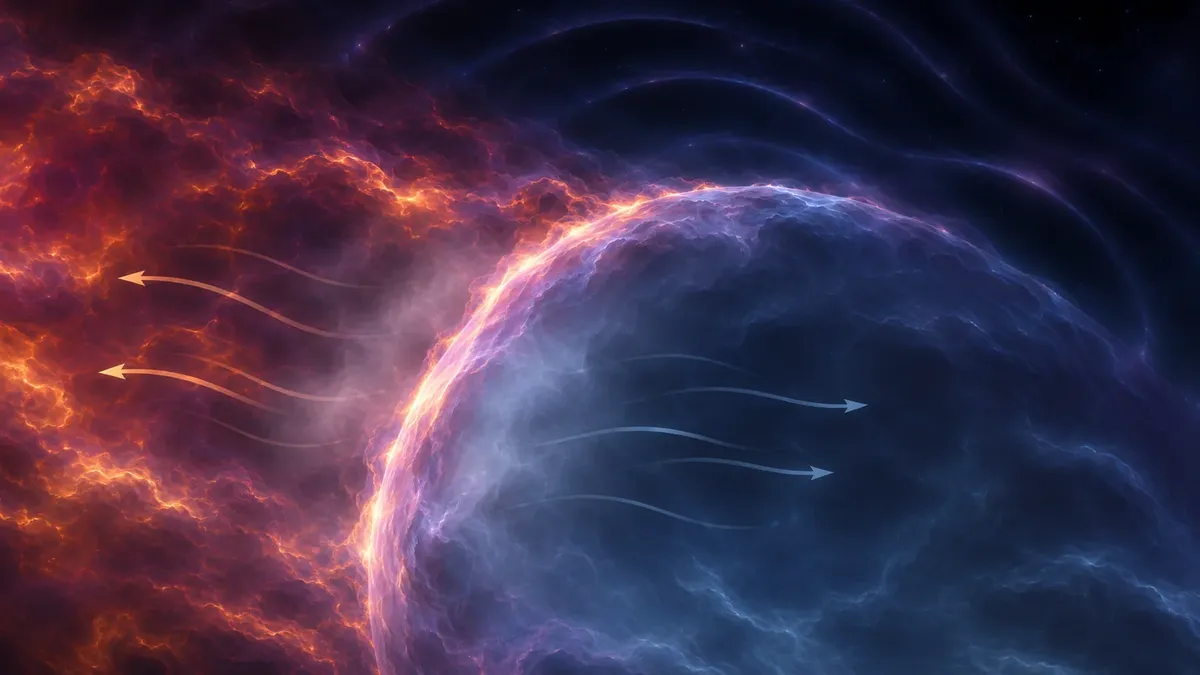
Could different patterns of moving plasma produce similar gravitational-wave predictions? A new classification and public code explore that question for bubbles formed during first-order phase transitions in the early Universe.
Why bubble flows matter
Some theories predict that the early Universe underwent a first-order phase transition, in which bubbles of a new phase expand into their surroundings. Fluid motion around those bubble walls can generate gravitational waves. Predicting the signal requires working out the fluid’s stationary profiles—the patterns of motion around an expanding wall.
In HydróDex: gotta match ’em all!, Giulio Barni and Eric Madge classify these profiles in a constant-sound-speed model. The model generalizes the familiar bag model by allowing the sound speed to differ in front of and behind the wall.
Mapping possible flows
The authors report matching fluid conditions at the wall and evolving the surrounding plasma to construct profiles. Their classification recovers known types, including detonations, deflagrations and hybrids, as well as inverse versions. It also identifies a new type, called a mixed hybrid: rarefaction waves occur on both sides of the wall, and fluid flows in opposite directions on the two sides.
The abstract does not provide the numerical or computational details of the classification. The findings described here therefore reflect the authors’ abstract-level report, rather than an independent assessment of their calculations.
One set of inputs, multiple profiles
In some cases, the same wall speed and far-from-the-wall transition-strength parameter correspond to more than one stationary profile. The authors report this non-uniqueness when the sound speed ahead of the wall is sufficiently greater than the sound speed behind it.
They attribute the ambiguity to missing thermodynamic information in this parametrization. According to the abstract, specifying the underlying microphysics resolves it. Thus, within this model, wall speed and transition strength alone may not determine a unique fluid profile.
The authors also calculate the fluid’s kinetic-energy budget and gravitational-wave spectra using the sound-shell model. They report that mixed hybrids introduce no additional spectral feature in these calculations. Their predicted spectra can be mimicked by ordinary direct or inverse hybrids, even though the fluid profiles differ substantially. A distinct flow pattern, in other words, need not produce a uniquely distinguishable predicted spectrum in this analysis.
What the work establishes
The researchers present HydróDex as a public code for classifying and constructing profiles, calculating energy budgets, and predicting gravitational-wave signals. These are model-based predictions, not observations: the abstract does not establish that any particular profile occurs in nature or that its signal will be detected.
This account is based on the abstract, not the full paper. It cannot assess details such as parameter ranges, validation checks, or implementation choices. The source is an arXiv preprint, and the supplied information does not establish whether it has undergone peer review. The findings should be read with those limitations in mind.
- gravitational waves
- early Universe
- phase transitions
- plasma flows
- HydróDex
- LISA
Reviewed cross-references
These connections were reviewed by a model, not independently fact-checked by a human. Similarity does not imply agreement; consult the original papers and the evidence below.
Cosmic phase-transition simulations reveal a two-scale gravitational-wave signal
Supporting evidence: Both papers identify plasma sound waves as an important gravitational-wave source: Barni and Madge say sound waves typically dominate for non-runaway thermal transitions, while Zou et al. report sound-wave contributions exceeding bubble-collision contributions in their simulated slow, strong transitions. The simulation result is limited to its modeled cases and does not independently establish the broader claim or test HydróDex’s profiles.
Model review: · openai-codex/gpt-6-luna
Evidence and provenance
Selected excerpts, not complete papers. PDF extraction can omit figures or damage equations, tables and reading order; sources may be preprints.
2611.17411v2 — Original paper
Excerpt reference:
static/papers/2611.17411v2.md:20-92
Basis: Paper text
Source SHA-256:cad3f8476be4583b5083e04055c7b500c450a2922dee11a812ce507457d21fed2610.14806v2 — Original paper
Excerpt reference:
static/papers/2610.14806v2.md:12-58
Basis: Paper text
Source SHA-256:29aa378a7a4d5a80f1f838c5653fbaf564b4417272e563997d8222a09e506879
Related reading
Automatically matched by shared topic keywords. These links do not imply that the sources agree or establish a consensus.
How the early Universe’s changing particle soup could reshape gravitational waves
Source published
Shared keywords: early universe, gravitational waves
Cosmic phase-transition simulations reveal a two-scale gravitational-wave signal
Source published
Shared keywords: early universe, gravitational waves
How a cosmic phase transition could shape dark matter
Source published
Shared keywords: early universe, gravitational waves
Could daily pulsar observations probe a gravitational-wave blind spot?
Source published
Shared keywords: gravitational waves
A sharper model for gravitational waves from triples
Source published
Shared keywords: gravitational waves