TRANSMISSION // 2611.16494v2
How Euclid is refining its image-blur models
Source published
Euclid researchers report that updated models of NISP-P’s image blur improve on those used with Q1 data, while further refinements remain planned.
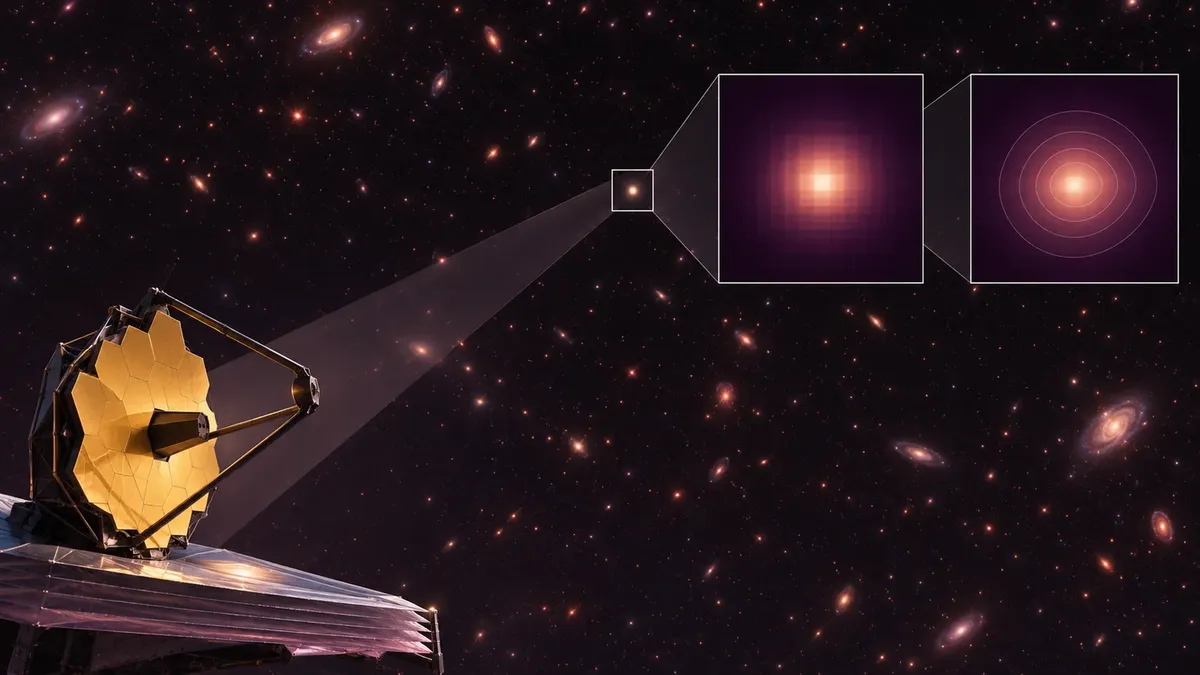
A telescope records distant stars and galaxies as patterns of light, not perfect points. To model selected sources in Euclid’s near-infrared photometric images, astronomers need to account for how the instrument spreads light. A Euclid Collaboration study tests updated models for that pattern.
A telescope does not record a distant star as a perfect point. Its optics and detector spread the light into a pattern called the point-spread function, or PSF. Modelling that pattern helps astronomers interpret images and estimate the light from sources.
The Euclid Collaboration’s study examines PSF modelling for NISP-P, the photometric channel of Euclid’s Near-Infrared Spectrometer and Photometer. The researchers ask whether updated models describe selected sources in NISP-P images better than the models provided with Euclid’s Quick Data Release (Q1).
The team used Q1 and Data Release 1 (DR1) data to model selected sources detected in individual images and combined frames. They explored methods for assessing model quality and considered possible variations with a source’s position in the focal plane, the wavelength of observation, and the time the image was taken. The abstract does not specify the sample selection, evaluation procedures, or the size of measured changes.
The researchers report that fitting the PSF profile indicates the updated models are better than those provided with Q1 images. They discuss this procedure alongside other ways to estimate flux, including aperture photometry, which sums light within a selected region around a source. The reported improvement is between the updated and Q1 PSF models; the abstract does not describe a direct performance comparison between PSF fitting and aperture photometry.
The authors say the results are consistent with several key mission requirements. That is encouraging, but it does not mean the models are complete or equally accurate under every observing condition. The abstract gives no numerical performance measures, so the scale of improvement—and how it varies across focal-plane positions, wavelengths, or observing times—cannot be determined from the available source material.
The team says there is room for further improvement and plans to investigate and implement refinements in future releases. The finding concerns the development of NISP-P PSF models for the selected sources and frames studied; it is not a general assessment of all Euclid data products or applications.
This account is based on the paper’s abstract rather than its full text. The work is posted as an arXiv preprint; the supplied source does not establish whether it has undergone peer review. Details beyond the abstract should be checked against the full paper and later pipeline documentation.
- Euclid
- point-spread function
- NISP-P
- astronomical imaging
- photometry
Reviewed cross-references
These connections were reviewed by a model, not independently fact-checked by a human. Similarity does not imply agreement; consult the original papers and the evidence below.
Euclid images reveal fainter stars in a remote Milky Way cluster
Shared method: Both studies use PSF-based photometry: the DR1 pipeline paper evaluates fitting PSF profiles against aperture photometry, while the AM-1 study uses DOLPHOT PSF photometry. They concern different pipelines, data releases, and targets, so their performance results are not directly comparable.
Model review: · openai-codex/gpt-6-luna
Evidence and provenance
Selected excerpts, not complete papers. PDF extraction can omit figures or damage equations, tables and reading order; sources may be preprints.
2611.16494v2 — Original paper
Excerpt reference:
static/papers/2611.16494v2.md:1702-1775
Basis: Paper text
Source SHA-256:30b7ba6ba60614b46594d6dcc0a05b6cec45b06a4a8ce2f47e2072fdb288e1362611.10127v1 — Original paper
Excerpt reference:
static/papers/2611.10127v1.md:12-59
Basis: Paper text
Source SHA-256:09a8392a682f0f9cbc42143cf724c0518d0d3534fe59ed8da0bb0c63557508b4
Related reading
Automatically matched by shared topic keywords. These links do not imply that the sources agree or establish a consensus.
Euclid images reveal fainter stars in a remote Milky Way cluster
Source published
Shared keywords: point spread function
Separating faint light between galaxies from telescope-scattered glow
Source published
Shared keywords: point spread function
Can brightness gradients reveal subtle distortions in distant galaxies?
Source published
Shared keywords: point spread function