TRANSMISSION // 2611.16237v2
When slower noise means fewer quantum defects
Source published
A theoretical study of a quantum Ising chain finds that two noises with the same power spectrum can affect defect formation differently. With dichotomous Markov noise, the noise-induced defects peak at an intermediate correlation time, a pattern the authors call generalized stochastic resonance.
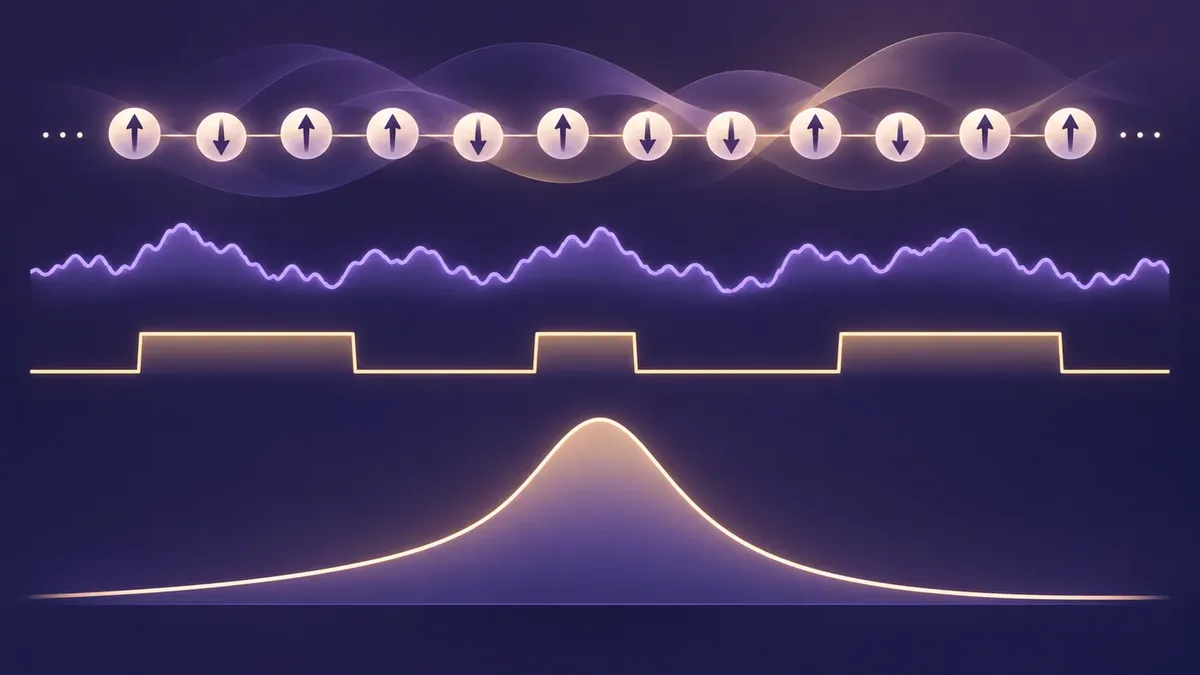
When a quantum system is driven through a critical point, slowing the drive usually reduces the defects it creates. Noise can complicate that picture. A theoretical study of a one-dimensional quantum Ising chain finds that the outcome depends not just on how much noise occurs at each frequency, but also on the noise’s statistics.
Why look beyond the noise spectrum?
As a system passes through a phase transition, it may not adjust quickly enough to stay in its lowest-energy state. The Kibble–Zurek mechanism describes how this failure can leave defects behind. In the usual picture, a slower passage through the transition produces fewer defects. Noise can add an extra contribution, however, and in some settings that contribution makes defect numbers rise as the drive slows—a departure known as anti-Kibble–Zurek (AKZ) behavior.
Mingwei Yang and Peng Li ask whether this noise-driven behavior is always captured by a noise’s power spectrum. A spectrum describes how a noise signal’s strength is distributed across frequencies. The authors compare Gaussian colored noise with dichotomous Markov noise (DMN), a simple model that switches randomly between two values. The two noise models can have the same correlation function and Lorentzian power spectrum, yet differ in their detailed statistics.
A model of a noisy quantum quench
The researchers study a transverse-field quantum Ising chain whose control parameter is ramped linearly across a critical point. They map the chain’s dynamics onto independent two-level processes, each associated with a momentum mode. The paper sets out noise-averaged master equations for Gaussian colored noise and DMN, then numerically solves the equations for the model. From the final state, the authors calculate the defect density and identify the contribution induced by noise.
The comparison varies the noise correlation time: roughly, how long the noise tends to persist before changing. The paper also analyzes limiting cases. In the slow-noise regime, it considers the probability of zero, one, or multiple sign switches during the interval when a given mode is most likely to make a transition. This analysis links the DMN result to the chance of rare switching events.
A peak at an intermediate correlation time
For Gaussian colored noise, the authors report that the noise-induced defect contribution increases monotonically with correlation time, approaching saturation in the slow-noise limit. DMN behaves differently. Its noise-induced contribution first grows as correlation time increases, reaches a maximum, and then declines as the noise becomes slower. The authors describe this nonmonotonic response as generalized stochastic resonance, with correlation time as the varied noise parameter and defect contribution as the response.
The proposed explanation is the sparse switching of DMN when its correlation time is long. During the transition interval for a mode, the noise will usually not switch at all; occasional realizations contain a switch. The authors’ analysis finds that these rare events dominate the noise-induced transitions in this regime. In the paper’s reported scaling, the contribution is proportional to noise power times quench time divided by correlation time, so it decreases as correlation time grows. In the fast-noise regime, DMN instead follows a scaling similar to the Gaussian case.
The key point is not that the spectrum is irrelevant. Rather, the spectrum alone does not encode all the information in non-Gaussian noise. Gaussian noise is specified by its second-order statistics, but a two-state switching process also has distinctive event statistics. Those details can matter for how the system responds, even when the compared noises share a power spectrum.
What the result does—and does not—show
This is a theoretical and numerical study of a particular model: a one-dimensional transverse-field Ising chain driven through a critical point with specified noise acting on its control parameter. It does not establish that every non-Gaussian noise source, quantum system, or experimental quench will show the same peak. Nor does the comparison demonstrate that the result has already been observed in a device. The paper’s discussion of two-level charge traps motivates DMN as a noise model, but the reported findings come from analysis of the model rather than a new experiment.
The authors state that the data and software supporting the manuscript are not publicly available. That limits independent inspection of the calculations from the supplied material. The source is an arXiv preprint, which may not have undergone peer review; readers should treat its conclusions as research claims rather than settled consensus. The broader lesson is a useful question for modeling: when noise is non-Gaussian, is its spectrum enough, or do the timing and rarity of individual events also need to be represented?
- Kibble–Zurek mechanism
- anti-Kibble–Zurek behavior
- dichotomous Markov noise
- quantum Ising chain
- stochastic resonance
- quantum dynamics
Related reading
Automatically matched by shared topic keywords. These links do not imply that the sources agree or establish a consensus.
When can interacting quantum dynamics look free?
Source published
Shared keywords: quantum dynamics
A world model reads quantum dynamics to infer hidden interactions
Source published
Shared keywords: quantum dynamics
Quantum fluctuations can remember how a system began
Source published
Shared keywords: quantum dynamics
One Quantum Measurement Sends Out Many Different Fronts
Source published
Shared keywords: quantum dynamics