TRANSMISSION // 2611.15968v2
DuoJEPA: A Bridge Between Embedding Spaces
Source published
DuoJEPA tests whether a learned translator can connect paired modalities without directly aligning the encoders’ original embedding spaces.
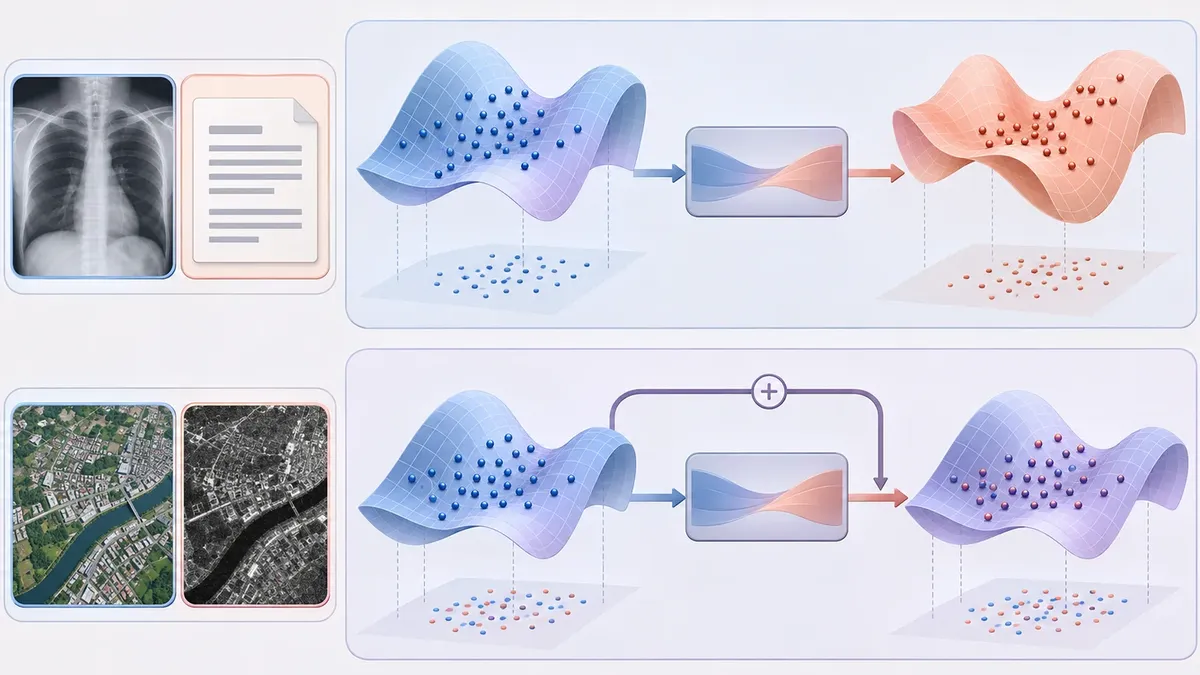
A radiograph and its report describe related information in very different forms. DuoJEPA asks whether AI can connect such paired data with a learned translator, rather than directly aligning the original representation spaces of the two encoders. The study also tests optical and radar satellite imagery.
A bridge between representation spaces
When AI models learn from paired data, a common approach is to train each modality’s encoder so matching examples share a mathematical space. DuoJEPA explores a different setup: can a separate component translate between two encoders’ spaces without directly aligning those spaces?
The paper describes one encoder per modality, each trained with the self-supervised LeJEPA objective. A single transformer layer is added to each encoder to translate its embedding into the other encoder’s space. A contrastive objective supervises the translation within that destination space. The authors say there is no loss term that directly compares the encoders’ original spaces, although joint optimization still connects their training.
The role of residual connections
The authors report that the translator’s residual connections influence where cross-modal training pressure is absorbed. With a residual translator, the two encoders become directly aligned. With a residual-free translator, a paired-cosine test detects no alignment in the final models and at most weak alignment in ablations. The authors report comparable cross-modal performance for these versions.
They also find that translation of the class token is well approximated by a single scaled rotation of the source space. The abstract does not provide further detail about how consistently this geometric description applies across settings.
Tests on two modality pairs
The evaluations cover chest radiographs paired with reports in CheXpert Plus, and Sentinel-2 optical imagery paired with Sentinel-1 radar imagery. These are two distinct tests, not a general evaluation of every kind of image-to-text translation.
For radiographs and reports, DuoJEPA reports a zero-shot AUC of 86.6 and a cross-modal retrieval score of 78.5. The abstract compares these with 60.0 and 64.2, respectively, for the authors’ reimplementation of LeVLJEPA using the same encoders and data.
For optical and radar imagery, the abstract says the frozen encoders fall within the range of published Sentinel foundation models under the authors’ reproduction of the Copernicus-Bench linear-probe protocol. The translator retrieves the paired image from the other sensor among 4,000 candidates in 77–79% of cases. A patch-level extension transfers the within-image similarity structure of a scene, according to the authors.
Together, the reported results show that the approach supports cross-modal tasks in these two settings. The abstract reports that the original spaces remain unaligned in the residual-free version, but become aligned with a residual translator. The findings do not establish that the approach will work equally well for other modality pairs or tasks.
What the evidence can—and cannot—say
This account is based on the paper’s abstract, not a full review of its methods, tables, or limitations. The supplied evidence does not give details such as dataset splits, uncertainty estimates, or precise definitions of the reported retrieval scores. The performance figures and comparisons are the authors’ reported results, not an independent assessment.
The source is an arXiv preprint, and the supplied material does not establish its peer-review status. A full paper review would be needed to assess the experimental details and the scope of the findings more closely.
- DuoJEPA
- multimodal AI
- self-supervised learning
- embedding spaces
- cross-modal retrieval
- medical imaging
- remote sensing
Related reading
Automatically matched by shared topic keywords. These links do not imply that the sources agree or establish a consensus.
MADJEPA: Three Training Stages for Medical Anomaly Detection
Source published
Shared keywords: medical imaging, self supervised learning
A GAN-based route to learning from full 3D brain MRI
Source published
Shared keywords: self supervised learning
Can Rotating an Image Help a Multimodal AI Answer Better?
Source published
Shared keywords: multimodal ai, self supervised learning
Reconstruction Alignment: Teaching Models to Rebuild Images
Source published
Shared keywords: multimodal ai, self supervised learning
Why Cross-Modal AI Alignment Needs More Than Similarity
Source published
Shared keywords: medical imaging, multimodal ai