TRANSMISSION // 2611.15004v2
A broader foundation model for bedside waveforms
Source published
CARMEN learns from ten cardiovascular and respiratory signals, including invasive pressure waveforms. In retrospective tests, its frozen representation performed well across 19 tasks, but clinical usefulness remains unproven.
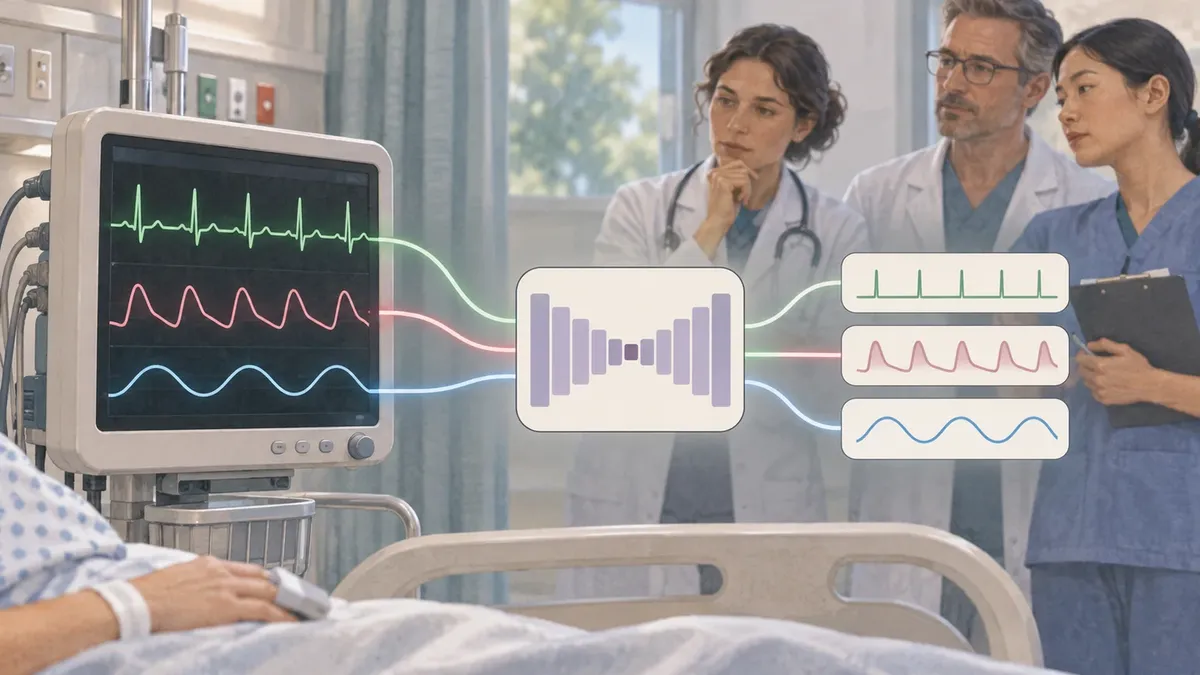
Many hospital AI models focus on a few familiar signals, such as ECG and pulse readings. CARMEN was designed to learn from a wider mix of operating-room and intensive-care waveforms, even when the available signals vary between patients.
Why build a model for more than heart rhythms?
Operating rooms and intensive-care units record more than electrocardiograms (ECGs) and pulse signals. Monitors can also capture arterial and venous pressure, pressure in the pulmonary artery or skull, and signals related to breathing. These waveforms may help describe a patient’s condition, but machine-learning models often focus on a single signal or task. That makes it harder to reuse a model when the available sensors differ or when researchers want to study a new clinical question.
A team led by Cheol-Hui Lee developed CARMEN, short for CArdio-Respiratory Multi-modal ENcoder. The researchers asked whether one model, trained on many kinds of hospital waveforms without task labels, could provide useful representations for a range of later prediction and estimation tasks. A “representation” is a compressed pattern the model learns from data; a simpler task-specific layer can then use it to make predictions.
Ten signals, one encoder
CARMEN was pretrained on ten signals: ECG, photoplethysmography (PPG, a pulse-related optical signal), arterial blood pressure, central venous pressure, pulmonary artery pressure, intracranial pressure, capnography, airway pressure, respiratory flow and impedance respiration. The pretraining data came from three cohorts at Seoul National University Hospital, including operating-room and ICU monitor recordings and a registry of deceased ICU patients. The authors report 2.27 million modality-hours of data—the total recording time summed across signal types.
The model learned from the waveforms without labels. Its training included reconstructing hidden portions of a signal and predicting later portions. A second phase encouraged it to learn relationships between signals recorded at the same time. CARMEN can process different combinations of co-recorded signals and variable-length windows, rather than requiring every patient to have the same set of channels.
One design choice addressed a clinical detail that ordinary normalization can obscure. Normalization rescales a signal to make it easier to compare, but can also remove its absolute level. For blood pressure, that level matters: a waveform’s shape alone may not distinguish a low pressure from a normal one. CARMEN’s LSCNorm method feeds the removed mean and variation back into the model as conditioning information. In an ablation—a comparison that changes one design element—the standard-normalization version performed worse on tasks defined by absolute thresholds, including intraoperative hypotension.
What the tests found
The researchers evaluated CARMEN on 19 tasks using Korean and US cohorts that were not part of pretraining. Tasks included detecting events, predicting events minutes ahead, estimating physiological measurements and predicting some admission outcomes. They froze the pretrained encoder and trained a simple linear layer for each task, a setup intended to test the usefulness of the learned representation rather than extensive task-specific fine-tuning.
On 12 of the 15 tasks with supervised comparison models, CARMEN significantly outperformed both supervised models. It also significantly outperformed three pretrained comparison models on 14 to 17 of the 19 tasks; none significantly outperformed CARMEN on any task. Results varied by task, however. For example, a supervised model had lower error for estimating mean arterial pressure, and the authors describe admission-outcome prediction as a weaker part of the evaluation. Some of those outcome tasks had small samples and wide confidence intervals.
In tests using ECG or PPG alone, CARMEN matched or exceeded dedicated signal-specific models in most comparisons. The paper also reports that removing channels often had little effect when the removed signal was not central to the task. Removing the task-defining signal, by contrast, could substantially reduce performance. These findings suggest that a multi-signal model can still be useful when only some channels are available; they do not show that every channel is interchangeable.
What remains uncertain
These are retrospective model evaluations, not trials of a clinical system. The results do not establish that CARMEN improves treatment decisions or patient outcomes. The authors identify important limits: pretraining came from one institution; external testing was limited, with most US ICU tasks drawn from one older database; some labels may be noisy or mistimed; and two tasks involving invasive signals had few patients. The study tested frozen representations with linear probes, not whether fine-tuning or deployment would improve performance.
The work is an arXiv preprint, so its claims should be treated as provisional rather than as settled clinical evidence. Comparisons also depend on the tasks, datasets and evaluation setups used; they are not a universal ranking of medical AI models. CARMEN offers a way to study a broader range of bedside signals, but further validation across hospitals and in real clinical workflows would be needed before judging its practical value.
- CARMEN
- physiological waveforms
- clinical AI
- foundation models
- intensive care
- perioperative monitoring
Related reading
Automatically matched by shared topic keywords. These links do not imply that the sources agree or establish a consensus.
Testing whether AI can follow a changing ICU patient
Source published
Shared keywords: clinical ai, intensive care
A benchmark asks when waveform AI choices matter
Source published
Shared keywords: clinical ai
A model that tracks changing ICU physiology
Source published
Shared keywords: clinical ai
Can an AI’s clinical decisions be audited step by step?
Source published
Shared keywords: clinical ai
ICare-DT improves ICU forecasts with new data—but treatment prediction remains unproven
Source published
Shared keywords: intensive care