TRANSMISSION // 2611.14949v2
Can AI agents identify the equation behind the data?
Source published
A benchmark tests whether language-model agents can infer hidden partial differential equations, estimate parameters and build accurate solvers—and whether structured feedback helps.
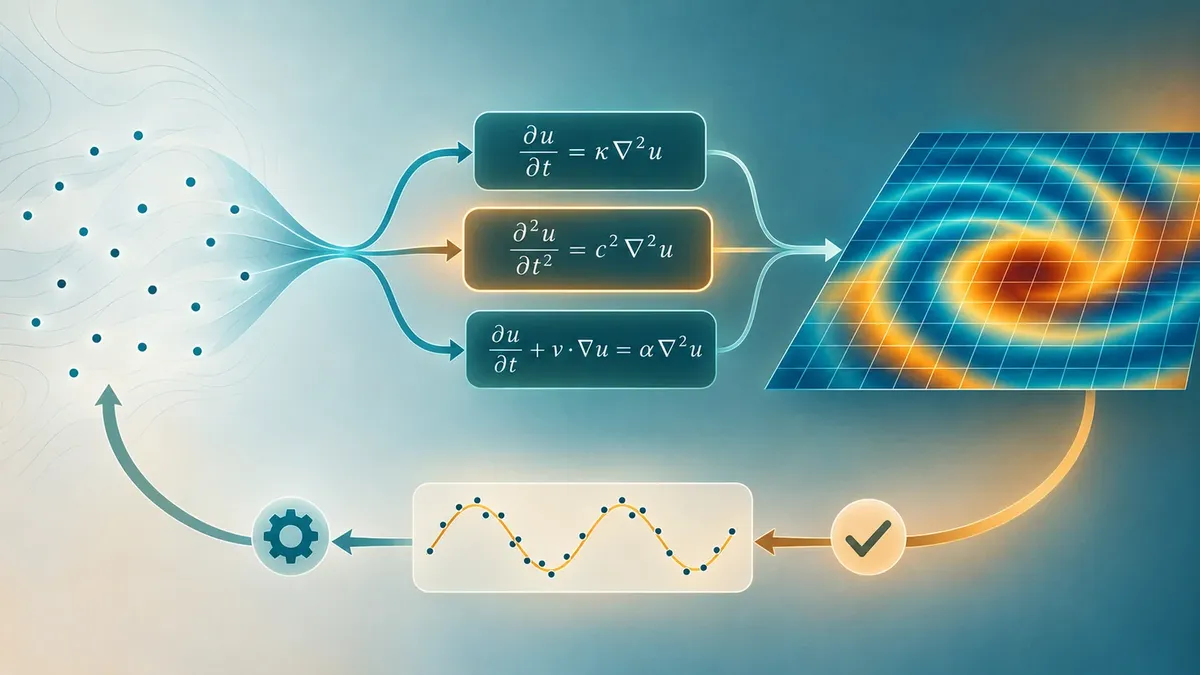
A solver can be precise and still be wrong if it starts from the wrong physical equation. RSI-PDEbench tests whether AI coding agents can identify equations from data and solve them, including under noise and distribution shifts.
Partial differential equations, or PDEs, describe how quantities such as heat, fluid velocity and electromagnetic fields change across space and time. Often, scientists start with an equation and calculate its consequences. But sometimes they have measurements and must work backward: Which equation fits the data? What are its coefficients? And how can they calculate a reliable solution?
A paper introducing RSI-PDEbench asks whether large language model (LLM) agents can automate this identify-and-solve workflow. The benchmark contains 1,001 cases across 42 equation templates, including classical and fractional PDEs. For each case, an agent receives 256 solution samples and information such as the forcing, initial and boundary conditions, plus a library of candidate equations. The specific equation family and its coefficients are hidden.
This is a bounded challenge, not unrestricted discovery of any physical law: agents choose from a supplied library, estimate parameters and return code for a numerical solver. They are scored on whether the resulting solution is accurate enough, not merely whether the code runs or the equation label is right.
Three kinds of test
Full uses noise-free observations and tests new cases from represented templates. Noisy adds Gaussian noise with an RMS level equal to 50% of the clean signal’s RMS. Hard-OOD tests cases from templates absent during development and cases with coefficients shifted beyond development ranges. “Unseen” templates remain in the supplied library; they are unfamiliar from training and validation, not outside the candidate set.
The researchers also introduce RSI-PDE, a harness that organizes repeated attempts to improve a solver. It evaluates how well candidate equations fit an approximate solution, using a measure called residual loss, and keeps up to five promising candidates. The agent then builds or revises solvers and uses relative L2 error feedback on public development cases to refine equation choices, coefficients and numerical methods. A validation gate determines whether changes to solver code, instructions and memory are retained. The model weights and executable supervisor remain fixed.
These feedback types do different jobs. Residuals help rank candidate equations, but a low residual does not establish that an equation is correct. Reference-based error checks assess solutions during development; the agent does not receive hidden test references when solving test cases.
Higher average pass rates, with caveats
The team compared RSI-PDE with one-shot programs and native agent tools such as Claude Code or Codex, using four language models. Averaged across the models, RSI-PDE’s pass rate was higher than the one-shot baseline by 181.9% in Full, 140.2% in Noisy and 106.5% in Hard-OOD. Compared with native harnesses, the relative gains were 3.0%, 19.6% and 5.4%. These are relative changes in average pass rate, not percentage-point increases.
Across 12 model-setting comparisons, recorded model calls totaled 1,884 for RSI-PDE and 3,547 for native harnesses, a 46.9% reduction. That does not mean RSI-PDE used fewer calls in every comparison: it used more in several, including some Noisy runs. Fewer calls also do not guarantee lower dollar costs, which depend on token use and caching.
Results differed by model and test. In Hard-OOD, one model’s RSI-PDE and native harness both passed 261 of 278 cases. On the 90 shifted-coefficient cases, RSI-PDE was no worse than the native harness for each displayed model; results on unseen templates were less uniform. These reported comparisons do not show that performance will carry over to every equation or scientific problem.
What remains uncertain
The cases are mostly synthetic, cover one- and two-dimensional domains and draw from a finite candidate library. Noisy cases were selected from the public release using fixed calibration probes, and Hard-OOD cases were subject to a feasibility filter. The authors caution that these choices limit how broadly the results generalize.
Most model-setting comparisons have only one run. The study does not isolate residual-based shortlisting in a dedicated ablation, measure how often the correct equation survives the shortlist, or report a general parameter-recovery rate. The results therefore support the complete workflow on this benchmark—not the claim that residual guidance alone caused the gains, or that agents reliably recover the true physics. The authors identify repeated, paired experiments and fresh hidden evaluations as useful next steps.
The work is an arXiv preprint. The reported results should be understood in that context: they describe the authors’ benchmark and experiments, rather than establishing performance across scientific practice. The contribution is a concrete test of a demanding task—choosing what equation to solve, building a solver and checking the resulting answer.
- partial differential equations
- AI agents
- scientific computing
- equation identification
- RSI-PDEbench
- large language models
Related reading
Automatically matched by shared topic keywords. These links do not imply that the sources agree or establish a consensus.
AI Agents Search for Better PDE Solvers
Source published
Shared keywords: ai agents, partial differential equations, scientific computing
Can a language model build a neural network from physical laws?
Source published
Shared keywords: large language models, partial differential equations, scientific computing
Teaching Monte Carlo estimates to correct themselves
Source published
Shared keywords: partial differential equations, scientific computing
Why scientific computing needs human-guided AI proofs
Source published
Shared keywords: ai agents, scientific computing
QuASAR tests whether AI agents can turn scientific ideas into quantum prototypes
Source published
Shared keywords: ai agents, large language models, scientific computing