TRANSMISSION // 2611.14458v1
A quantum heat transistor gets its leverage from two-at-a-time exchanges
Source published
A theoretical study finds that a harmonic oscillator can amplify changes in heat flow when its contacts exchange energy in pairs. The work models three thermal reservoirs, solves for the oscillator’s steady state, and proposes—but does not experimentally demonstrate—a way to engineer the required interactions.
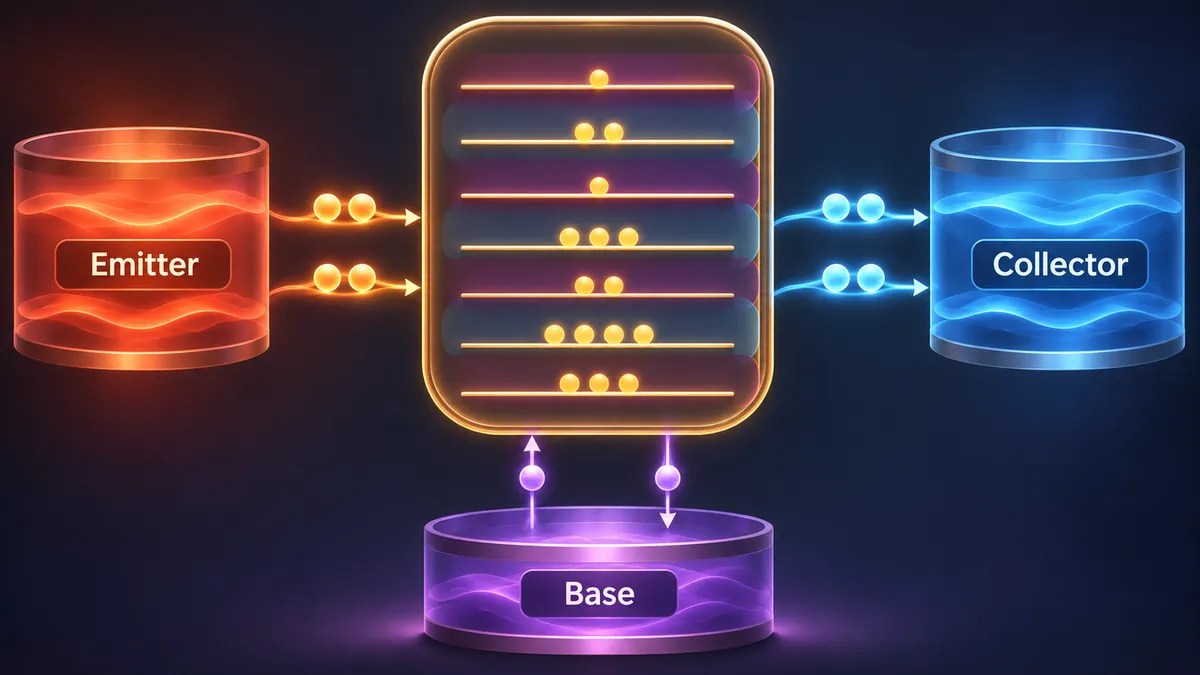
Can a small change in one temperature produce a much larger change in heat flowing elsewhere? In a proposed quantum thermal transistor, the answer depends on how the device exchanges energy with its surroundings. A new theoretical study finds that allowing an oscillator’s contacts to exchange pairs of quanta can make this kind of thermal amplification possible, even when the oscillator itself remains harmonic.
A transistor is usually imagined as a device in which a small control signal regulates a larger current. A thermal transistor applies a similar idea to heat: changing the temperature of a third contact—the base—can alter heat flow between two other contacts, called the emitter and collector. Thermal amplification occurs when the resulting change in a transport current is larger than the change in the base current.
In a study posted as an arXiv preprint, Laiba Hayat and M. Tahir Naseem ask whether a quantum device can amplify heat flow through the way it exchanges energy with its reservoirs, rather than through nonlinearity inside the device itself. Their model’s working element is a harmonic oscillator, a standard idealized system with evenly spaced energy levels. It is connected to three thermal reservoirs: emitter, collector and base.
The key distinction is between exchanging energy one quantum at a time and exchanging it in pairs. In the model, all three reservoirs can exchange single quanta with the oscillator. The emitter and collector can also exchange two quanta at once; the base has only the single-quantum channel. The oscillator remains harmonic throughout, letting the authors examine the role of nonlinear coupling at the contacts separately from any intrinsic anharmonicity of the working element.
The researchers describe the oscillator and reservoirs with a Lindblad master equation, a mathematical framework for modeling an open quantum system interacting with its environment. They derive heat currents for each reservoir and assess how those currents respond when the base temperature changes, while holding the other temperatures and coupling rates fixed. For the purely single-quantum case, they recover the established result that this static harmonic setup does not show differential thermal amplification.
Next, they add a two-quantum exchange channel at the emitter. A controlled expansion for weak nonlinear coupling predicts when amplification should begin. The authors compare that prediction with numerical solutions of the steady-state population equations and report close agreement over the range shown. In this configuration, the collector can become amplified, even though its coupling to the oscillator remains linear. The onset depends on operating conditions: the paper’s threshold estimate is not a universal value that applies to every set of temperatures and coupling strengths.
The authors also examine two-quantum exchange at both transport contacts. In the regimes they study, sufficiently strong pair exchange can produce large amplification. The proposed mechanism involves the oscillator’s even and odd energy-level populations. Pair transitions change the excitation number by two, so they keep the oscillator within either the even-numbered or odd-numbered levels. The base’s single-quantum transitions can move the oscillator between those two groups. Changing the base temperature can therefore shift their relative populations, changing the transport currents.
When the pair-exchange channels dominate, this population reshuffling can account for most of the oscillator’s temperature response in the regime examined. Because the pair-transition rates depend on which levels are occupied, changes in those populations affect emitter and collector currents. The transport currents can respond strongly and in opposite directions, while their sum is constrained by energy conservation and the base-current response. Restoring single-quantum exchange at the transport contacts weakens amplification in the matched cases considered, because it reduces the base’s control over the even–odd population balance.
The study is theoretical, not a report of a working heat transistor. To outline a possible implementation, the authors propose coupling the oscillator longitudinally to an auxiliary two-level system and using frequency-selective reservoirs to favor particular exchange channels. Their analysis specifies conditions needed for this construction, including spectral filtering and a sufficiently fast relaxation of the auxiliary system. These are design requirements, not evidence that the full device has been built or that it will achieve the modeled performance in an experiment.
The conclusions also rely on approximations used to derive the reduced dynamics, including Born–Markov and secular approximations, and on numerical steady-state calculations with a truncated oscillator basis that must be checked for convergence. The weak-nonlinearity expansion has a limited range of validity; the authors use numerical solutions to study regimes beyond that expansion. As an arXiv preprint, the work should be read as research that has not necessarily undergone peer review. Its results establish a mechanism within the stated model, not a demonstrated technology or a guarantee of practical heat-control applications.
- quantum thermodynamics
- thermal transistor
- heat amplification
- nonlinear system-reservoir coupling
- harmonic oscillator
- reservoir engineering
Reviewed cross-references
These connections were reviewed by a model, not independently fact-checked by a human. Similarity does not imply agreement; consult the original papers and the evidence below.
Engineered reservoirs help a tiny quantum refrigerator stay colder
Shared method: Both papers describe Markovian master-equation treatments using the Born–Markov and secular approximations. The oscillator-transistor study examines nonlinear exchange with three reservoirs; Ray et al. study a three-qubit refrigerator with Kerr-athermal bath occupations. This is a limited methodological overlap, not evidence of matching physical effects; the comparison is based on selected preprint excerpts.
Model review: · openai-codex/gpt-6-luna
Evidence and provenance
Selected excerpts, not complete papers. PDF extraction can omit figures or damage equations, tables and reading order; sources may be preprints.
2611.14458v1 — Original paper
Excerpt reference:
static/papers/2611.14458v1.md:57-111
Basis: Paper text
Source SHA-256:4ed589b5d7424c15e074c21f256ab46af14d4c875cafb890ed7f0eb00c5a11e22311.10499v2 — Original paper
Excerpt reference:
static/papers/2311.10499v2.md:150-217
Basis: Paper text
Source SHA-256:181e52ad91f076849bb54d0dbfbb5f990e6dd1f9cee880756c27d5ca662c72a12311.10499v2 — Original paper
Excerpt reference:
static/papers/2311.10499v2.md:82-149
Basis: Paper text
Source SHA-256:181e52ad91f076849bb54d0dbfbb5f990e6dd1f9cee880756c27d5ca662c72a1
Related reading
Automatically matched by shared topic keywords. These links do not imply that the sources agree or establish a consensus.
Engineered reservoirs help a tiny quantum refrigerator stay colder
Source published
Shared keywords: quantum thermodynamics, reservoir engineering
A geometric measure of extractable energy
Source published
Shared keywords: harmonic oscillator, quantum thermodynamics
A quantum work-extraction proposal puts complementary measurements to work
Source published
Shared keywords: quantum thermodynamics
How a noisy photon counter can hide infinite microscopic irreversibility
Source published
Shared keywords: quantum thermodynamics