TRANSMISSION // 2611.14456v1
Why Galaxy Bias Depends on How You Measure It
Source published
Galaxy surveys use clustering patterns to learn about cosmic structure, but estimates of galaxy bias can differ between analysis methods and spatial scales. A new preprint uses renormalization-group calculations to connect measurements made at finite resolution with large-scale, n-point statistics. Tests on simulated galaxy fields and halo catalogs support the predicted scale dependence, within stated systematic errors. The work is a methodological bridge, not a new cosmological measurement, and the evidence available here is limited to the abstract.
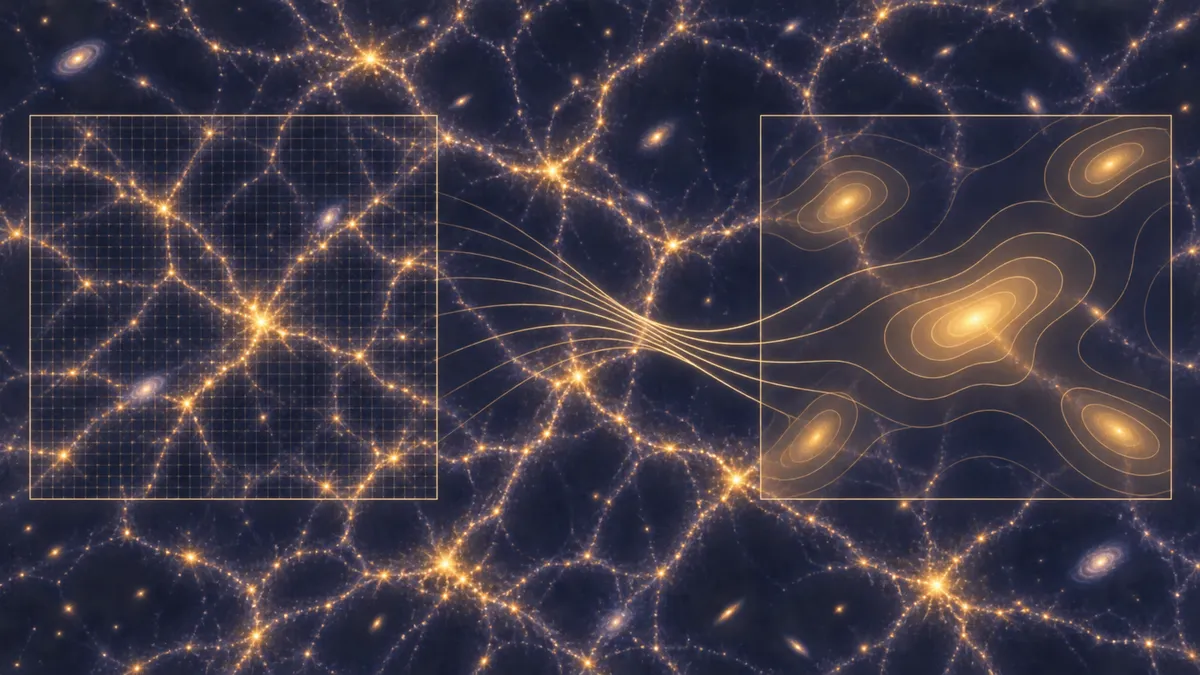
Galaxies do not trace the matter of the Universe perfectly: some regions host more galaxies than others, and that relationship is described by galaxy bias. Getting bias parameters right matters because researchers use galaxy clustering to infer the growth and composition of cosmic structure. A new study asks how to compare bias estimates produced by two different styles of analysis.
A mismatch of scales and methods
A galaxy survey offers more than one way to describe the cosmic pattern. In a field-level analysis, researchers model the galaxy-density field itself, often on a grid. The grid has a finite resolution, represented by a cutoff: structures smaller than that scale are not explicitly resolved. The inferred bias coefficients can therefore depend on the cutoff.
Another approach measures n-point statistics—quantities such as the two-point correlation or three-point correlations that summarize how galaxies cluster at different separations. In the study described here, those analyses typically define their bias parameters in the low-wavenumber, or large-scale, limit.
The resulting values need not be directly interchangeable. The paper’s central question is whether a systematic framework can translate between estimates made at different cutoffs and connect finite-resolution field measurements to large-scale statistical measurements.
Following the parameters as resolution changes
Hsiang-Ming Huang, Henrique Rubira and Fabian Schmidt use the renormalization group (RG), a framework for tracking how descriptions of a system change with scale. Here, the idea is to follow how galaxy-bias parameters “run” as the cutoff changes, then use that scale dependence to relate measurement schemes.
The researchers first generated mock galaxy fields using a forward model based on Lagrangian perturbation theory and a galaxy-bias expansion. They measured the bias parameters at a range of cutoffs and compared the measured changes with the RG predictions. They also examined halo catalogs drawn from full N-body simulations, which numerically model the evolution of cosmic matter under gravity.
These are tests of a proposed connection using simulated data, not measurements from an observed galaxy survey. The abstract does not provide details such as sample sizes, numerical parameter values or the precise cutoff range, so those cannot be assessed from the available source information.
What the comparison found
For the mock fields, the authors report that the RG predictions describe how the measured bias parameters vary with cutoff. They also report that, as the cutoff tends toward zero, the results agree with tree-level n-point-function measurements for the first-order density-bias parameter, bδ, and the second-order parameters bδ² and bG₂. “Tree-level” refers to a leading-order approximation in perturbation theory, rather than a complete description of all nonlinear effects.
In the halo catalogs from full N-body simulations, the predicted scale dependence also describes the measurements well within the systematic errors estimated by the authors. That qualification matters: the result is not a claim of exact agreement, and the abstract does not quantify the size or sources of those errors.
The broader contribution is a way to express the relationship between field-level and n-point analyses as a scale-dependent flow of parameters. If developed and tested further, such a common framework could help researchers compare results that otherwise use different resolutions and definitions. The abstract does not demonstrate improved constraints on cosmological parameters, nor does it report a new discovery about the contents or history of the Universe.
What remains uncertain
The evidence available for this account is the paper’s abstract, not the full article. It therefore supports the broad description of the models, tests and reported findings, but not a detailed evaluation of the calculations, systematics, parameter choices or robustness checks. The preprint record alone also does not establish that the work has undergone peer review.
The tests are based on generated fields and simulated halo catalogs. How well the proposed connection performs on real survey data, with observational selection effects and other practical complications, is not established by the abstract. The authors’ conclusion is appropriately methodological: RG flow offers a natural formulation for relating these bias-measurement schemes. Further scrutiny of the full paper and tests on survey analyses would help show how broadly that connection can be used.
- galaxy bias
- large-scale structure
- renormalization group
- galaxy surveys
- cosmological simulations
Related reading
Automatically matched by shared topic keywords. These links do not imply that the sources agree or establish a consensus.
Galaxies as “standard crayons” reveal a promise—and a problem—for Milky Way dust maps
Source published
Shared keywords: galaxy surveys, large scale structure
Measuring the cosmic web’s statistical memory—and the limits of the measurement
Source published
Shared keywords: cosmological simulations, large scale structure
Reading the early universe through the cosmic web
Source published
Shared keywords: cosmological simulations, large scale structure
Choosing galaxies could shape the science of a future giant telescope
Source published
Shared keywords: galaxy surveys
What Galaxy Triangles Could Reveal About Cosmic Flows
Source published
Shared keywords: galaxy bias