TRANSMISSION // 2611.14441v1
How negative ions may help water vapor become ice
Source published
A laboratory plasma experiment links tiny water clusters on negative ions with the appearance of larger ice grains as temperatures fall. The results suggest a possible seed-free route to ice in some cold, weakly ionized environments, but applying the laboratory findings to the atmosphere or space remains a modeling question.
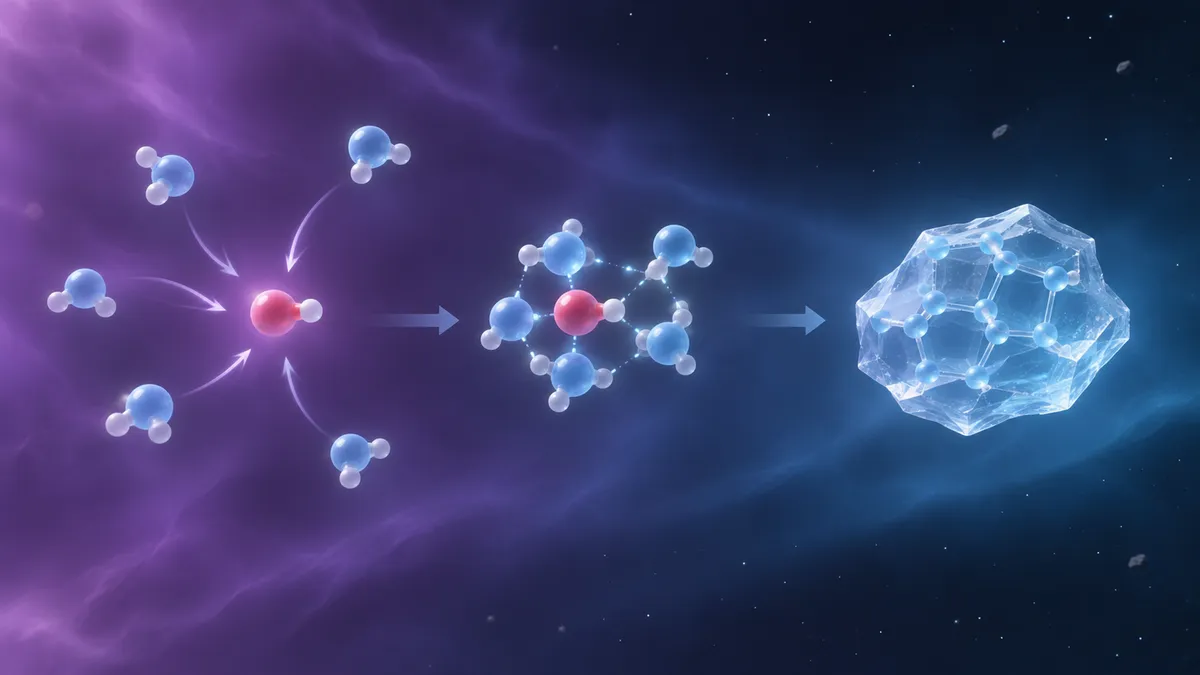
Ice can form around dust, but what happens where suitable dust seeds are scarce? A new laboratory study tracks water molecules clustering around charged particles and points to negative ions as possible starting points for ice. The experiment connects small molecular clusters with visible grains, while leaving open how important this pathway is in natural environments.
Water ice is common in places as different as Earth’s upper atmosphere and the disks of gas and dust around young stars. But the first step in making an ice grain is not always clear. One familiar route is for water to condense on a pre-existing particle, such as a dust grain. The new study investigates another possibility: water molecules gather around negative ions, eventually forming ice without a foreign particle to act as a seed.
The researchers created a weakly ionized plasma—a gas containing a small number of charged particles—in a low-pressure mixture of argon and water vapor. They cooled the electrodes, and the gas near them, to study how water-derived ions and ice grains changed with temperature. A laser revealed grains large enough to scatter light. A mass spectrometer, operated in a way that let the researchers detect positive and negative ions separately, tracked smaller water clusters. The team also compared the measurements with classical nucleation theory and calculations of cluster energetics using density functional theory, a quantum-mechanical modeling method.
The experiment showed visible ice grains when the electrodes were colder than about 190 kelvin. That is a detection threshold, not necessarily the exact temperature at which the first ice formed: smaller grains could have been present but too small to scatter enough laser light to see. In the mass spectra, water clusters attached to negative ions grew larger as the temperature fell. Near 225 kelvin, their average size rose to roughly 15 water molecules; below that point, the measured clusters became much less abundant. The authors interpret this decline as clusters growing beyond the mass spectrometer’s measurable range and rapidly accumulating more water. Positive-ion clusters, by contrast, stayed relatively small and did not show the same temperature-linked pattern.
The proposed explanation combines attraction and survival time. Water molecules are electrically polar, so they are attracted to hydroxide ions, a common negative ion in the experiment. As the gas cools, increasingly large clusters can form. The study’s models suggest that at sufficiently low temperatures a cluster can pass from a stable small size into runaway growth, rather than needing to overcome the usual energy barrier to nucleation. The researchers also argue that positive clusters are more quickly destroyed or lost from the plasma, while negative clusters remain available to collect water.
These observations make negative ions plausible starting points for ice in the experimental system. They do not, by themselves, establish how much ice forms this way in nature. The laboratory used argon as a buffer gas and had higher pressure and water abundance than many atmospheric or astrophysical settings. Its electric fields and small size also affect how charged clusters move and how long they remain in the plasma. The authors note that natural environments lack the same wall losses and confinement, and that other gases and chemical reactions could change cluster growth or destruction.
To explore possible applications, the paper models conditions in a protoplanetary disk and in Earth’s polar mesosphere. For one modeled disk location, the authors estimate that negative-ion nucleation could compete strongly with ice formation on silicate dust. That conclusion depends on assumed abundances, grain sizes, water capture, and other model inputs; it is not a direct observation of disk ice forming through this route. The paper likewise finds its modeled nucleation threshold consistent with conditions associated with mesospheric ice, but that agreement does not prove the mechanism dominates there.
The study’s central contribution is experimental: it observes both water-cluster precursors and larger ice grains in one controlled plasma system, and finds different temperature behavior for negative and positive clusters. Further experiments with gas mixtures closer to natural environments, together with better measurements of ion abundances and growth rates in those settings, will be needed to test how broadly the pathway applies.
This account is based on an arXiv preprint, a manuscript posted for public access that may not yet have been peer reviewed. The results and their interpretation should therefore be treated as provisional. The paper’s extrapolations to natural environments are model-based, and the available search excerpts do not independently establish scientific consensus or rule out competing explanations.
- water ice
- ion-induced nucleation
- negative ions
- laboratory plasma
- protoplanetary disks
- mesosphere
- preprint
Related reading
Automatically matched by shared topic keywords. These links do not imply that the sources agree or establish a consensus.
A proposed Webb survey would map dust, ice and shadows in planet-forming disks
Source published
Shared keywords: protoplanetary disks, water ice
Magnesium-rich dust could offer another route to formamide in space
Source published
Shared keywords: protoplanetary disks
Dust-like surfaces sharply reduce UV-driven ice loss in laboratory tests
Source published
Shared keywords: water ice
Heat model challenges buried-ice explanation for asteroid 1998 KY26
Source published
Shared keywords: water ice
Models of young planet-forming disks struggle to explain low-mass disks
Source published
Shared keywords: protoplanetary disks