TRANSMISSION // 2611.14422v1
Quantum data loading has a hardware energy bill
Source published
Quantum algorithms often treat access to classical data as if it were free. A new theoretical analysis estimates the dynamic energy and power of a quantum random-access-memory query on a superconducting processor, finding that design choices can substantially change the modeled power at a fixed fidelity. The estimates are specific to a representative setup, not measurements of a built device or a universal cost for quantum computing.
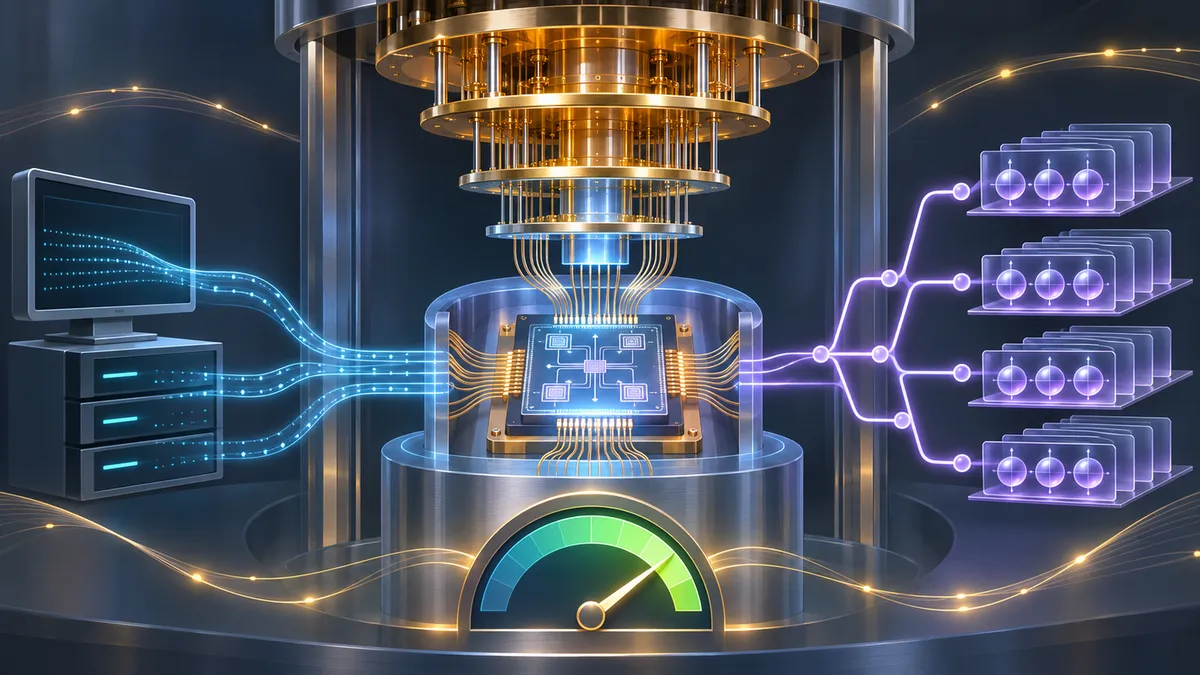
A quantum computer may process information in unfamiliar ways, but its input still has to come from somewhere. This preprint asks what it might cost—in energy and power—to load classical data into a quantum processor using quantum random access memory, or QRAM.
Quantum algorithms for machine learning, chemistry and cryptanalysis sometimes assume that classical data can be accessed coherently, meaning that the computer can query it while preserving quantum relationships among possible inputs. That access is often treated as a convenient starting point rather than a physical operation with engineering costs. The authors of this preprint examine what changes when a QRAM query is treated as a process performed by hardware.
Their focus is dynamic energy: energy used while carrying out the query, rather than the full energy consumption of a facility or the total cost of building and operating a quantum computer. The study asks how query fidelity—the degree to which the operation produces its intended result—and power depend on choices such as gate duration, the relative strength of two-qubit drives, and how signal attenuation is distributed across stages of a refrigerator.
Modeling a query, not measuring a machine
The authors use what they call a metric-noise-resource framework to connect the modeled query’s performance with its physical resources. Their analysis includes thermal photons and gate errors, both of which can affect how faithfully a quantum operation runs. They examine two QRAM designs: a linear-depth multiplexer and a bucket-brigade architecture, which is intended to be more resilient to noise. They adapt the bucket-brigade design to a gate set suited to superconducting hardware and refine its fidelity analysis using a fully decomposed gate schedule.
These details matter because an abstract circuit is not itself a hardware implementation. A query has to be translated into a sequence of physical operations, and those operations take time, require control signals and are exposed to errors. The paper’s approach is to estimate energy and power in relation to that modeled implementation, rather than assume data access is free.
What the estimates show
For a representative bucket-brigade query with a 12-qubit address register, the authors report a query fidelity of 0.969. Their model estimates dynamic energy of 3.51 × 10⁻⁴ joules for the query, with average dynamic power of 4.38 watts and a peak of 64.4 watts.
The headline is not that every QRAM query will use those amounts. The paper’s optimization analysis says that, at a fixed target fidelity, changing the operating point and the attenuation profile can shift average power by a factor of two or more. In other words, choices about how a system is driven and how signals are attenuated can matter substantially even when the desired fidelity is held constant.
That is a useful reminder for quantum-computing proposals: the cost of preparing or accessing input data may deserve attention alongside the cost of the algorithm’s later gates. But this analysis does not establish that QRAM is always too energy-intensive, nor does it compare the modeled query with a complete classical data-loading system. It addresses a particular hardware model and operation, not the overall energy efficiency or practical advantage of a quantum algorithm.
What remains uncertain
The evidence provided here is the paper’s abstract, not its full text. That means the underlying assumptions, equations, parameter choices, sensitivity analyses and detailed comparison between architectures cannot be independently assessed from the available material. The reported figures should therefore be read as results of the authors’ model for a representative case, not as direct measurements from a functioning QRAM device or a general forecast for all superconducting processors.
The source is an arXiv preprint, and the supplied information does not establish whether it has undergone peer review. Further work would be needed to test how well the model describes physical hardware and how results change across devices and implementation choices. The study’s value is narrower but important: it makes the energy cost of a quantum data-loading operation explicit enough to analyze, rather than leaving it outside the accounting.
- quantum computing
- quantum random access memory
- QRAM
- superconducting processors
- energy modeling
Related reading
Automatically matched by shared topic keywords. These links do not imply that the sources agree or establish a consensus.
Quantum cloud test shows why qubit counts are not enough
Source published
Shared keywords: quantum computing
A smarter way to split fermion simulations across quantum processors
Source published
Shared keywords: quantum computing
Moving atoms could make globally controlled quantum computers programmable
Source published
Shared keywords: quantum computing
When Measuring a Stable System Can Be as Hard as Quantum Computing
Source published
Shared keywords: quantum computing
Quantum-assisted simulation follows a proton between two water molecules
Source published
Shared keywords: quantum computing