TRANSMISSION // 2611.14398v1
Counting the cost of simulating light and matter on a quantum computer
Source published
A theoretical study estimates the logical resources a fault-tolerant quantum computer would need to simulate cavity-and-emitter lattices, including models with losses. In three uniform-coefficient examples, its proposed photon-hopping circuit uses fewer Toffoli gates than a specified two-register alternative. These are resource estimates, not a demonstration on quantum hardware.
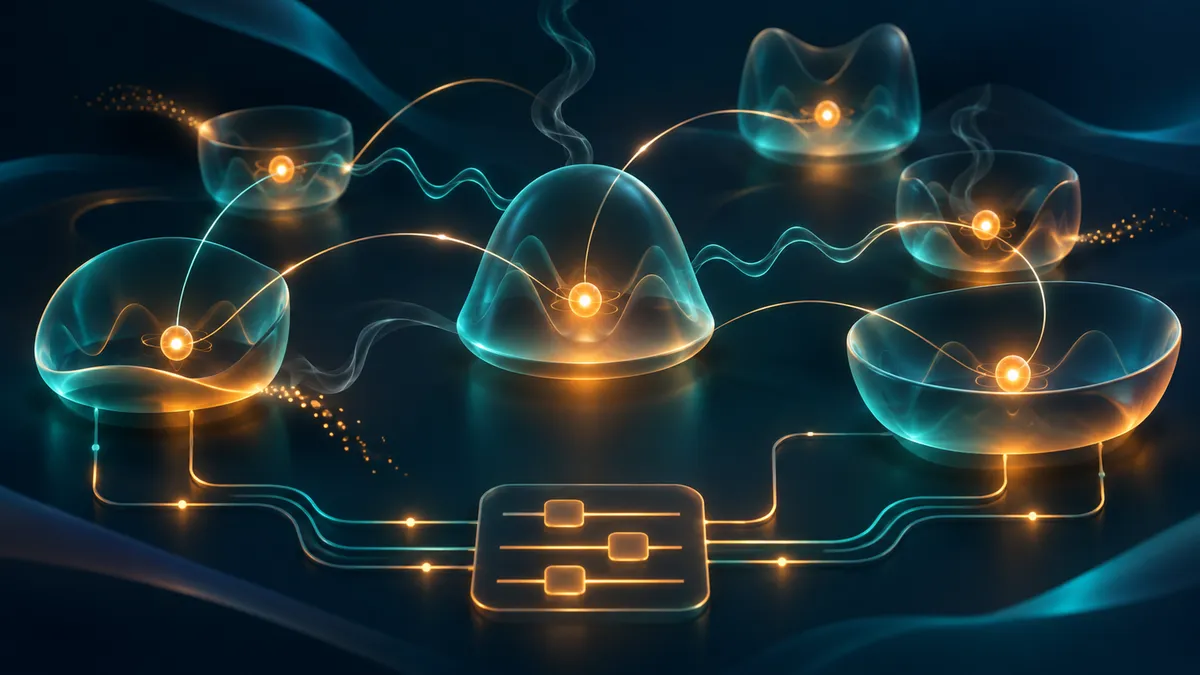
Cavities can trap light while containing emitters that exchange energy with it. Link many such units, and their collective behavior can be difficult to calculate—particularly when emitters do not all lose energy or coherence at the same rate. Soumya Sarkar and colleagues estimate what it would take to simulate these systems on a future fault-tolerant quantum computer.
A lattice of light and matter
The study considers Tavis–Cummings lattices: cavities containing multiple emitters, with photons able to move between cavities and light exchanging energy with emitters inside each cavity. This coupled system can support hybrid light–matter behavior, including polaritonic dynamics.
Keeping track of each emitter matters. When emitters behave identically, symmetry can sometimes simplify calculations. Unequal relaxation or dephasing rates—the loss of energy or coherence—can break that symmetry. The authors note that real-time correlations in these systems can be costly to compute classically, especially in two dimensions. The abstract does not specify that all of the circuits or examples studied use a two-dimensional geometry.
The paper is a resource analysis, not a report of new measurements. It considers a model with L cavities, N emitters per cavity and a maximum photon occupation, or cutoff. A cutoff limits the photon states represented in the calculation.
Constructing circuits and estimating costs
The authors build circuits to represent parts of the lattice Hamiltonian, the mathematical description of its energy and interactions. Their approach uses block encoding, a technique for representing an operator within a larger quantum operation. They construct circuits for photon hopping and local light–matter exchange, then combine them to encode the lattice Hamiltonian.
One design change concerns how photon occupations are updated during hopping. A two-register implementation stores the occupations at the source and destination separately. The proposed controlled-walk circuit updates occupations in place, avoiding an auxiliary photon register. In three examples with uniform coefficients and 16 to 256 cavities, the authors estimate 4.75–8.11% fewer Toffoli gates than for the paired two-register implementation. Toffoli gates are a standard way to count certain costly logical operations in fault-tolerant quantum circuits. The comparison uses matched assumptions for shared state preparation, precision, control and workspace; it does not show that this circuit is better than every alternative.
The paper addresses both closed and open system dynamics. For closed systems, which exclude environmental losses, the authors use generalized quantum signal processing for real-time evolution and bound the cost of estimating retarded cavity spectral functions. These functions describe a system’s response over time to a disturbance.
For open systems, they include photon loss, emitter relaxation and dephasing. A sampled first-order dilation is used to represent dissipative evolution as an expanded quantum process with sampling. The authors bound the runs and time steps needed to estimate transient photon statistics, including the zero-delay correlation measure g²(0). Their estimates explicitly include state preparation and measurement costs.
What the estimates tell us
The main contribution is a framework for estimating logical resources—operations and qubits at the error-corrected level—for simulating these lattices. Such estimates help characterize computational demands, but they are not counts of the physical hardware a particular machine would require, and they do not demonstrate that a practical quantum computer can run the simulations at useful scale.
The estimates depend on modeling and implementation choices, including photon cutoff, target precision, state preparation and measurement. The abstract does not provide enough detail to independently assess the derivations or how costs vary with these choices. The reported gate reduction is a comparison with one specified implementation, not evidence of an overall speedup over classical computation or other quantum algorithms.
This account is based on the abstract rather than a full-text examination. The source is an arXiv preprint; the supplied record does not establish whether it has been peer reviewed. The results should therefore be understood as theoretical resource estimates, not experimental validation. Their value is to give researchers a structured way to discuss the costs of simulating light–matter lattices with and without dissipation.
- quantum simulation
- fault-tolerant quantum computing
- Tavis–Cummings lattice
- light–matter interaction
- open quantum systems
Reviewed cross-references
These connections were reviewed by a model, not independently fact-checked by a human. Similarity does not imply agreement; consult the original papers and the evidence below.
A quantum compiler that keeps error correction in view
Supporting evidence: Both papers illustrate why fault-tolerant resource estimates should account for auxiliary resources: the Tavis–Cummings study reports phase-gradient catalyst and workspace costs separately, while the compiler study finds that a serially reused magic-state factory dominates the peak-qubit estimate for QFT-3. These are different resource models and workloads, so the comparison supports only this general accounting point, not a direct cost comparison.
Model review: · openai-codex/gpt-6-luna
Evidence and provenance
Selected excerpts, not complete papers. PDF extraction can omit figures or damage equations, tables and reading order; sources may be preprints.
2611.14398v1 — Original paper
Excerpt reference:
static/papers/2611.14398v1.md:109-156
Basis: Paper text
Source SHA-256:d571220c1e601885795fe4e9a0464ff95c567121213c5b98d24dcdd1d57084fb2611.13301v1 — Original paper
Excerpt reference:
static/papers/2611.13301v1.md:182-255
Basis: Paper text
Source SHA-256:10ce115b2f5e3261e89b72f08a94780d68306d0544ade3e0974689a24eba76ba
Related reading
Automatically matched by shared topic keywords. These links do not imply that the sources agree or establish a consensus.
A better boundary for simulating quantum systems and their surroundings
Source published
Shared keywords: open quantum systems, quantum simulation
Simulating quantum noise by enlarging the quantum system
Source published
Shared keywords: open quantum systems, quantum simulation
A quantum compiler that keeps error correction in view
Source published
Shared keywords: fault tolerant quantum computing
FusionQ starts quantum error decoding before measurements finish
Source published
Shared keywords: fault tolerant quantum computing
When a quantum sensing limit depends on the model
Source published
Shared keywords: light matter interaction