TRANSMISSION // 2611.14354v1
A Decade of Antarctic Radio Data Tightens the Search for Extreme Neutrinos
Source published
The Askaryan Radio Array searched 10.6 years of data from its five South Pole stations for ultrahigh-energy neutrinos. No candidates remained after background checks. The collaboration reports a stronger upper limit on the diffuse neutrino flux between 50 and 1,000 EeV, while noting important uncertainties in detector response and neutrino interaction physics.
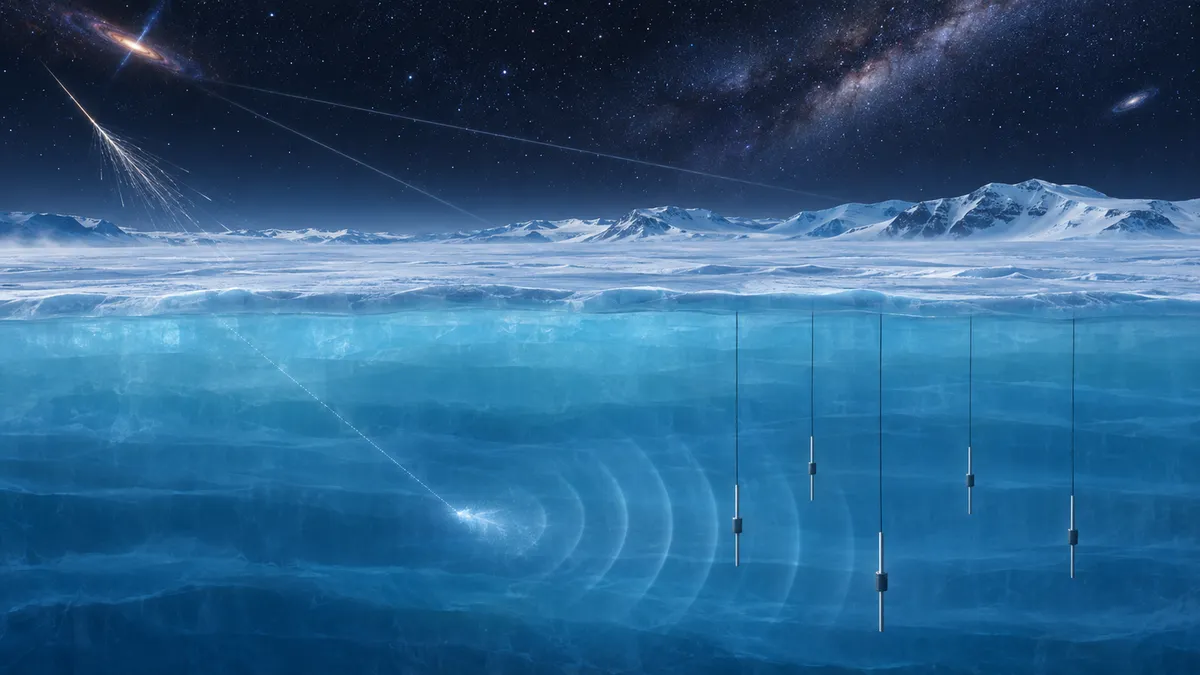
Neutrinos can carry clues about the most energetic cosmic rays, but they are extraordinarily hard to detect. A new analysis combines more than a decade of observations from the Askaryan Radio Array at the South Pole. It finds no surviving neutrino candidates, but sets a new limit on how many ultrahigh-energy neutrinos may be reaching Earth.
The most energetic cosmic rays arrive from beyond Earth, but magnetic fields bend the paths of charged particles, making their origins difficult to trace. Neutrinos offer a different kind of messenger: they carry no electric charge, so magnetic fields do not deflect them. If cosmic rays interact with matter or radiation, those interactions can also produce neutrinos. Finding such neutrinos could therefore help researchers investigate extreme cosmic environments and the origins of ultrahigh-energy cosmic rays.
The challenge is that neutrinos rarely interact with anything. The Askaryan Radio Array (ARA), embedded in Antarctic ice near the South Pole, searches for the brief radio pulse that can arise when a neutrino interaction creates a particle shower in the ice. The shower develops a slight excess of negative charge, producing a coherent radio signal known as Askaryan emission. Antennas buried in the ice can register the pulse.
Looking for a rare pulse
The collaboration analyzed data from all five ARA stations, including the phased-array detector at one station. The data span January 2013 to December 2023. After data-quality selections, the analysis used 25.9 station-years of data, accumulated over 10.6 years of array-wide livetime. A station-year means one station operating for a year; array-wide livetime counts periods when at least part of the array was taking data.
To estimate how the detector responds to neutrinos, the team used simulations. These modeled neutrinos and their secondary particles traveling through Earth, interacting in or near the ice, and producing signals in the antennas. The analysis also accounted for changes in detector conditions over time, including different operating configurations at the stations.
The researchers then processed recorded waveforms and looked for events with features expected of a neutrino signal: a short, strong pulse appearing coherently across antennas, with arrival times consistent with a source in the ice. They used reconstruction and signal-shape measures to distinguish such events from thermal noise, electronics effects, calibration pulses, cosmic-ray events, and human-made radio interference. Cuts were developed using a randomly selected 10% of the data; the other 90% was kept blinded until the selection and background estimates were finalized.
No candidates, and a stronger limit
After unblinding the full dataset, one event initially passed the selection. Further investigation found a simultaneous, anomalous signal in a nearby detector system. The reconstructed radio signal was consistent with emission from within the detector station, rather than a distant neutrino interaction. The team added a selection to remove events coincident with this kind of detector emission. No events remained.
That outcome is consistent with the estimated background: about 0.13 events, with statistical and systematic uncertainties. It is not evidence that ultrahigh-energy neutrinos do not exist. Instead, with no candidates observed, the researchers calculated an upper limit: a boundary on the diffuse neutrino flux compatible with the data at 90% confidence. They report that this is the most stringent limit in the energy range from 50 to 1,000 exaelectronvolts (EeV), where one EeV is a billion billion electronvolts.
The analysis is not equally efficient for every possible neutrino signal. Its efficiency depends on the assumed flux spectrum and energy, as well as on how likely a neutrino is to trigger the detector and survive the selection cuts. The paper reports 28% efficiency for a flux corresponding to current experimental upper limits; its detailed efficiency results also vary with energy and with the flux model. That distinction matters: the limit is not a direct count of all neutrinos passing Earth, but an inference based on modeled detector acceptance and exposure.
What remains uncertain
The team estimates that systematic uncertainties on the detector’s acceptance—the effective exposure to neutrinos—are substantial. They include uncertainty in how radio waves travel through and are absorbed by ice, the modeled Askaryan signal, and the neutrino interaction cross-section. At 1 EeV, the reported acceptance uncertainty is +40% and −29%; at the highest energies, uncertainty in the neutrino cross-section is especially important. Background estimates also have systematic uncertainty, reported as +0.05 and −0.06 events.
The result is a constraint, not a discovery or identification of a cosmic-ray source. It also tests particular flux models only under their stated assumptions: the paper says one trans-GZK flux model is excluded at 90% confidence, while other models remain unexcluded by this analysis. Larger arrays, more exposure, and improvements to background rejection could extend the search. In particular, the collaboration identifies surface-background rejection as a major opportunity to improve efficiency.
This article is based on an arXiv preprint describing the search methodology and results. A preprint is a research paper shared publicly before, or independently of, formal journal peer review; its claims and methods may be revised. The paper also refers to an accompanying results letter. The reported limits should therefore be understood in the context of the analysis and its uncertainties, rather than as a final answer about the origin of cosmic rays.
- ultrahigh-energy neutrinos
- Askaryan Radio Array
- South Pole
- radio astronomy
- cosmic rays
- neutrino detection
Reviewed cross-references
These connections were reviewed by a model, not independently fact-checked by a human. Similarity does not imply agreement; consult the original papers and the evidence below.
South Pole radio array sets new limits on extreme-energy neutrinos
Shared method: These papers describe the methodology and results of the same first array-wide ARA diffuse-neutrino search, not independent studies: the methodology paper says it combines data from all five stations, including the phased array, while the results paper describes using all five stations and the phased array across changing array configurations. The shared scope does not establish independent confirmation.
Model review: · openai-codex/gpt-6-luna
Evidence and provenance
Selected excerpts, not complete papers. PDF extraction can omit figures or damage equations, tables and reading order; sources may be preprints.
2611.14354v1 — Original paper
Excerpt reference:
static/papers/2611.14354v1.md:2123-2186
Basis: Paper text
Source SHA-256:73d4223086136da0d0c88a0ba30b329cb6be5d2b1d8a231b6000d705547804422611.14350v1 — Original paper
Excerpt reference:
static/papers/2611.14350v1.md:167-259
Basis: Paper text
Source SHA-256:c8d3a120e93d169f373d21cf4448b24dc40a557f084dcbd9a68e5cafef4f75eb
Related reading
Automatically matched by shared topic keywords. These links do not imply that the sources agree or establish a consensus.
South Pole radio array sets new limits on extreme-energy neutrinos
Source published
Shared keywords: askaryan radio array, cosmic rays, south pole, ultrahigh energy neutrinos
IceCube’s muons could track Antarctic atmospheric change—if detector drift is controlled
Source published
Shared keywords: cosmic rays
Quieter satellites could protect radio astronomy and Earth-rotation measurements
Source published
Shared keywords: radio astronomy
Which exoplanets could the SKA hear? A radio forecast with important caveats
Source published
Shared keywords: radio astronomy
Simulations explore how three antennas could locate solar radio signals
Source published
Shared keywords: radio astronomy