TRANSMISSION // 2611.14343v1
Can gravitational lensing give telescopes a head start on neutron-star mergers?
Source published
A simulation study asks whether LSST could see the kilonovae accompanying gravitationally lensed neutron-star mergers that gravitational-wave detectors might identify during observing run O5. The modeled prospects are more favorable for binary neutron stars than for neutron star–black-hole systems, but depend strongly on assumptions about the merger population and how its optical glow is modeled.
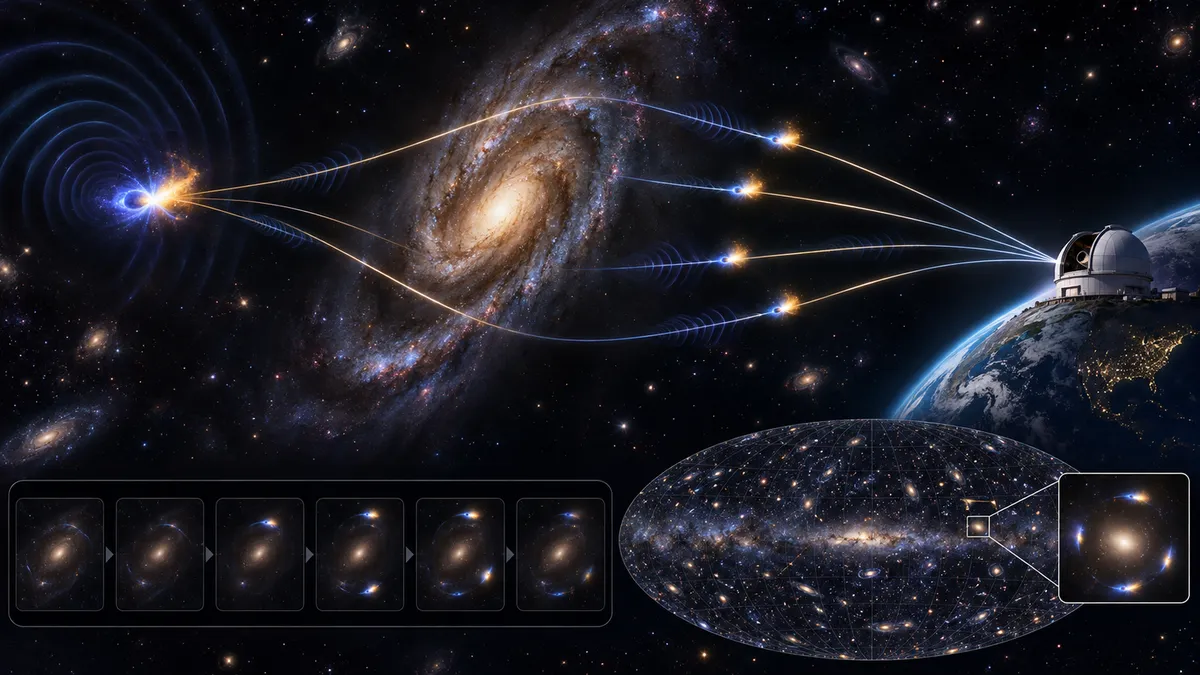
A merger can announce itself in gravitational waves before it happens. If gravity from a foreground galaxy also bends those waves, multiple delayed images may offer a way to anticipate a later signal. Could that lead time help an optical survey catch the merger’s fading glow?
Gravitational waves from a pair of merging neutron stars can provide an alert about a cosmic collision. The collision may also produce a kilonova: a brief glow from material thrown out in the merger. But finding the glow promptly is difficult, especially when the source is far away or the search area is large. A foreground galaxy can act as a gravitational lens, magnifying and splitting light—and gravitational waves—from the distant source into multiple images that arrive at different times. The authors investigate whether lensed mergers could be detectable both by gravitational-wave observatories and by the Legacy Survey of Space and Time (LSST), the upcoming optical survey at the Vera C. Rubin Observatory.
The paper also connects this question to early warnings. In the proposed lensing strategy, an already observed image and information about the lens system could help predict when a later image will arrive, potentially providing hours to days of warning before the merger. The study’s main quantitative exercise, however, is a simulation of whether the gravitational-wave-detectable events’ kilonovae would be bright enough for LSST. It does not report a real event or demonstrate an operational advance warning and telescope observation.
Building a simulated population
The researchers generated populations of lensed binary-neutron-star (BNS) and neutron-star–black-hole (NSBH) mergers for an assumed O5 detector network. They counted a system as detectable in gravitational waves if at least two lensed images passed a signal-to-noise threshold. For each selected event, they used published forward models to estimate the kilonova’s brightness over time and across LSST’s six optical bands. Lensing magnification and the delays between images were included.
For BNS mergers, they used a model implemented in MOSFiT. For NSBH mergers, they compared two approaches: a semi-analytic MOSFiT model and light curves from the POSSIS radiative-transfer code. They then compared predicted peak brightness with assumed LSST exposure limits. Their definition of a joint detection was deliberately permissive: at least one lensed image had to be brighter than the limit in at least one band. They also considered cases where nearby images could not be resolved separately, combining their light.
What the models suggest
In the detailed results, the BNS model produces a substantial potential target population. At the single-exposure limit, the authors report that about 51% of the modeled lensed BNS population is detectable in the g band when images are treated as resolved; the fraction rises to 58% when their unresolved-image rule is applied. The paper’s abstract summarizes the BNS result as approximately 60% observable within a single LSST exposure. These figures describe different presentations or treatments of the simulated population, not a confirmed detection rate in the sky.
The modeled joint-detection population is dominated by systems producing four lensed images, or “quads.” The paper links optical detectability to lens magnification and to the properties and viewing angle of the merger, which shape the kilonova’s color and brightness. These patterns are model-based predictions, not observed population trends.
NSBH results are less straightforward. In the MOSFiT-based model, only a small fraction of modeled kilonovae exceed the single-exposure threshold. The POSSIS model predicts a brighter population and a higher detectable fraction. The authors attribute the difference to how the models treat ejecta geometry, composition, and opacity—all factors that affect how much optical light escapes. The paper’s abstract gives an approximate 10% figure for NSBH kilonovae, while its detailed discussion reports different fractions for the two model choices. The headline number should therefore not be read as a model-independent forecast.
The authors also introduce a detectability index (DI), a logistic-regression score based on simulated source and lens properties, such as magnification, distance, masses, and orientation. They use bootstrap resampling and five-fold cross-validation to assess its stability and performance on held-out portions of their simulated data. The index is intended as a screening tool for prioritizing candidates; it is not a direct measurement of an event’s chance of detection in real observing conditions.
A forecast, not a catch
The work’s central value is in laying out how lensing, merger physics, and survey sensitivity may combine—and where predictions are fragile. The NSBH model disagreement is especially important, and the authors acknowledge that the DI’s calibration depends on population-synthesis choices and current kilonova models. The analysis also relies on assumed detector sensitivity, source and lens distributions, exposure limits, and model prescriptions. Actual observing cadence, sky coverage, weather, and practical follow-up would matter when turning brightness into a discovery.
This is a November 2026 draft preprint, not evidence that LSST has already detected these counterparts or that the projected early-warning program has been validated in practice. Its percentages are conditional estimates from simulations. They indicate a possible route to joint observations—and identify what needs better modeling and real-world testing—rather than promise a particular number of future detections.
- gravitational lensing
- gravitational waves
- kilonova
- binary neutron stars
- neutron star–black hole mergers
- LSST
- multimessenger astronomy
Related reading
Automatically matched by shared topic keywords. These links do not imply that the sources agree or establish a consensus.
Catching a Neutron Star Merger’s Light Before It Fades
Source published
Shared keywords: gravitational waves, multimessenger astronomy
Neutron Star Tides Could Complicate Tests of Einstein’s Gravity
Source published
Shared keywords: gravitational waves
Double gravitational lenses offer a new handle on hidden galaxy mass
Source published
Shared keywords: gravitational lensing
Simulated detector network sharpens the search for neutron stars’ faint internal vibrations
Source published
Shared keywords: gravitational waves
A Swarm-Based Search for Gravitational-Wave Echoes
Source published
Shared keywords: gravitational lensing, gravitational waves