TRANSMISSION // 2611.14339v1
A Magnetic-Drive Proposal for Paired Quantum Emission
Source published
A theoretical preprint reexamines whether periodically changing a magnetic field can trigger a superradiant phase transition in a cavity containing electrons. Its abstract argues that including the induced electric field and preserving gauge invariance rules out that transition in the modeled system. Instead, it predicts dynamical Casimir emission, including polariton–magnetoplasmon pairs and two-color photon pairs. These are theoretical predictions, not reported experimental observations.
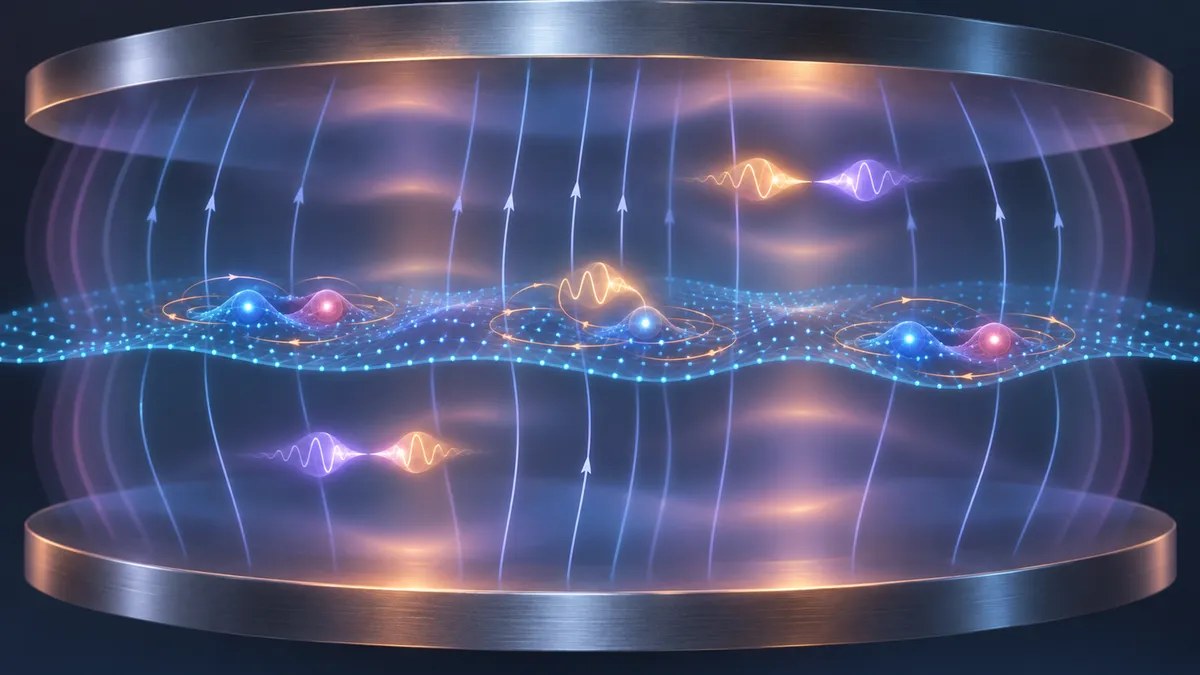
Can periodically changing a magnetic field make a cavity settle into a state filled with light? A new theoretical analysis challenges that proposal: it says the changing field also induces an electric field, and leaving that out can change the predicted physics. With that electric field included, the authors predict pair-producing emission rather than a superradiant phase transition.
A cavity confines light, and a sheet of electrons inside it can interact strongly with the cavity’s electromagnetic field. In a strong magnetic field, the electrons’ motion is quantized. Their coupled excitations with cavity photons are called Landau polaritons. Researchers have asked whether periodically changing the magnetic field could drive this system into a superradiant phase transition—a change associated with a persistent macroscopic light field.
The issue is not simply whether a drive can make the light–matter interaction appear stronger. A changing magnetic field also induces an electric field, as required by Faraday’s law. Quantum descriptions of electromagnetic interactions must also respect gauge invariance, a basic consistency principle. In an arXiv preprint, S. Hughes argues that accounting for these requirements changes the prediction.
Modeling the full drive
The paper develops an exact theoretical treatment of periodically driven Landau polaritons. According to the abstract, Kohn’s theorem reduces the problem to the electrons’ collective center-of-mass motion coupled to the cavity. The resulting Hamiltonian, which specifies the system’s energy and dynamics, can be written as a sum of squares at every instant.
The authors use Krein’s theorem, a mathematical result about the stability of driven systems, to identify a calculable drive-frequency threshold called the Krein frequency. They report that the system is stable above this threshold. Below it, instability occurs only in resonance “tongues”—ranges of drive conditions where the modulation can create pairs from the vacuum. The abstract identifies this process as the dynamical Casimir effect: time-dependent conditions producing excitations from the quantum vacuum.
The authors also describe what happens at high drive frequencies. Rather than giving the electrons an enhanced light–matter coupling, the drive makes them experience the mean magnetic field together with an effective trapping potential, associated with the Fock–Darwin problem.
Why the phase-transition prediction is disputed
The abstract’s central claim is that gauge invariance excludes a Floquet photon condensate in the system they analyze. The authors say this remains true when the electronic bands include Kane-type nonparabolicity, and report deriving a generalized Thomas–Reiche–Kuhn (TRK) sum rule. This kind of sum rule constrains how matter can respond to light.
According to the abstract, the proposed transition arose from averaging a coupling parameter after projecting the system onto a fixed Landau-level basis. The authors argue that this effective model violates the TRK sum rule. They further emphasize that a driven magnetic field requires its induced Faraday electric field to be included. Their modeling prescription is to apply the modulation to the full minimal-coupling Hamiltonian before simplifying it, rather than averaging parameters in a projected model.
Instead of the proposed transition, the abstract predicts dynamical Casimir emission. It describes low-threshold pairs of polaritons and magnetoplasmons driven by the Faraday field, as well as two-color photon pairs with two-mode squeezing reported as reaching up to 5–10 dB. Squeezing means that quantum fluctuations are reduced in one combination of paired modes at the expense of another. These are predictions in the abstract, not reported experimental measurements.
What the evidence does—and does not—show
The available source for this article is the preprint’s abstract, not its full text. It does not provide the detailed derivations, parameter ranges, or assumptions needed to independently assess the stability threshold and predicted emission. Nor does it establish that the emission has been observed in a laboratory. The claims about exact reduction and stability concern the authors’ modeled system; the abstract’s broader modeling advice should not be read as experimental confirmation across all platforms.
The record identifies the work as an arXiv preprint and does not establish that it has undergone peer review. The accompanying search results are incomplete and do not independently confirm or refute the claims. The conclusions should therefore be understood as the authors’ theoretical argument, not settled consensus. The main point is that including the electric field induced by a changing magnetic field may alter the predicted outcome—from a proposed phase transition to pair-producing radiation. Further scrutiny of the full paper and later work will be needed to assess the argument and its implications.
- quantum optics
- Landau polaritons
- dynamical Casimir effect
- gauge invariance
- Floquet driving
- superradiant phase transition
Related reading
Automatically matched by shared topic keywords. These links do not imply that the sources agree or establish a consensus.
Tracing reflections yields exact solutions for quantum fields in moving cavities
Source published
Shared keywords: dynamical casimir effect
How an electron’s quantum connection passes from an ion to light
Source published
Shared keywords: quantum optics
How photon-pair graphs make NOON states
Source published
Shared keywords: quantum optics
A staircase formula for a hidden quantum symmetry
Source published
Shared keywords: quantum optics