TRANSMISSION // 2611.14331v1
A hot-matter test for neutron-star equations of state
Source published
A new theoretical framework extends a high-density QCD consistency bound to hot matter. Applying it to selected neutron-star models, the authors find that the allowed range narrows as entropy rises—but the results depend on the chosen inputs and do not yet amount to a model-independent reconstruction of hot matter.
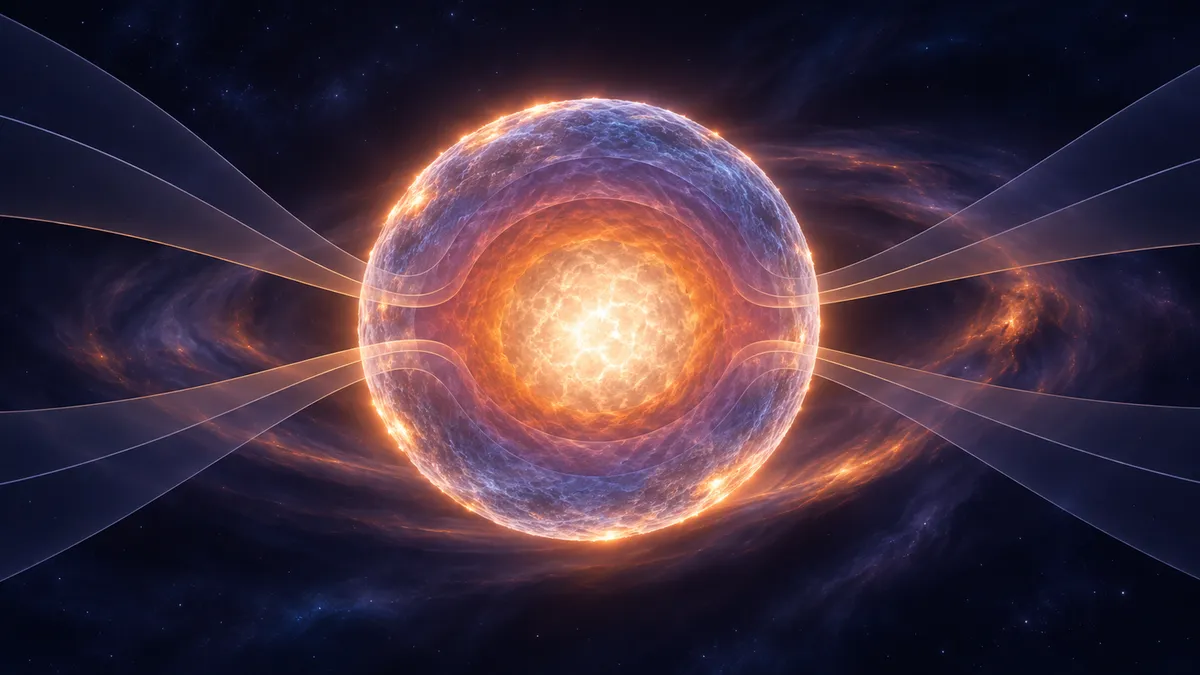
Neutron-star mergers and newborn neutron stars briefly contain matter that is both extremely dense and hot. A preprint by Tyler Gorda, Aleksi Kurkela and Tuhin Malik asks whether a constraint derived from quantum chromodynamics can help test models of that matter, even though the calculation is directly reliable only at much higher densities.
Neutron-star matter is difficult to study because its density can far exceed anything produced in ordinary experiments. Researchers describe it with an equation of state: a relationship between quantities such as pressure, energy density and temperature. But competing models can behave differently under these extreme conditions, especially when the matter is hot, as it can be in a merger remnant or a newly formed neutron star.
In Perturbative QCD Constraints on Hot Neutron-Star Matter, Tyler Gorda, Aleksi Kurkela and Tuhin Malik extend a way of testing such models. Perturbative quantum chromodynamics (pQCD) describes strongly interacting matter at very high density, where its mathematical expansion becomes reliable. Neutron-star cores are at much lower densities. The key idea is that the high-density result can still restrict the possibilities at lower density when combined with requirements that matter be thermodynamically consistent, mechanically stable and causal—meaning that sound does not travel faster than light.
Earlier versions of this constraint applied to cold matter. The authors show how to carry it over to finite temperature along paths of constant entropy per baryon, called adiabats. In this construction, specific enthalpy takes the mathematical role played by the baryon chemical potential in the cold case. The result is not a direct calculation of every possible hot equation of state: it is an allowed band, bounded by low- and high-density inputs and by the physical requirements above.
The team applies the method to a selection of relativistic mean-field (RMF) models, which describe nuclear matter using effective interactions, and to samples from two Bayesian collections of nucleonic equations of state. For the DD2 model, the density at which its equation of state becomes inconsistent with the bound falls from about 1.0 to 0.74 inverse cubic femtometres as entropy per baryon rises from zero to five. The authors report that the allowed region narrows monotonically with increasing entropy, with a similar pattern across the two structurally distinct mean-field families they examine.
At six times nuclear saturation density, the bound excludes five of eleven tested RMF models at entropy per baryon two, and seven at four. In the two Bayesian collections, the authors find that roughly half the sampled models have become inconsistent by entropy per baryon of about 3.4 in one collection and 4.4 in the other. These figures describe the models and setup studied—not the fraction of all possible equations of state that nature permits.
The authors also map the boundary into temperature and density. In their calculation, it passes through conditions around 100–150 mega-electronvolts, a range they identify as relevant to matter briefly present in neutron-star mergers and proto-neutron stars. This makes the bound potentially useful when checking the finite-temperature tables used in astrophysical simulations. It does not show that a particular merger has already measured or violated the bound. Nor does it establish that the most restrictive conditions occur inside a stable hot star: the paper notes that its bound remains outside the centres of the modeled stars along the isentropes considered, while merger remnants may sample matter differently.
There are important qualifications. The high-density anchor comes from scale-averaged pQCD calculations, which carry uncertainty; the paper notes that changing the pQCD pressure within its scale-averaging range changes the cold exclusion count, even though the overall trend with entropy remains. The low-density anchor is based on the DD2 model, and the comparisons cover a finite selection of RMF models and two Bayesian posteriors. The authors explicitly say that fully model-agnostic inference of hot matter is not currently achievable, given sparse and indirect astrophysical data.
This is a preprint, not evidence by itself of peer-reviewed validation or scientific consensus. Its contribution is a proposed extension of an existing theoretical consistency test, with calculations showing how that test affects selected models. Further work—including alternative low-density inputs and finite-temperature inference—will be needed to establish how broadly the bound applies.
- neutron stars
- quantum chromodynamics
- dense matter
- equation of state
- neutron-star mergers
- preprint
Related reading
Automatically matched by shared topic keywords. These links do not imply that the sources agree or establish a consensus.
Neutron Star Tides Could Complicate Tests of Einstein’s Gravity
Source published
Shared keywords: equation of state, neutron stars
Nuclear interaction models offer a baseline for heavy-ion fluctuation signals
Source published
Shared keywords: equation of state, neutron stars
How neutron-star tides could reveal the stars’ hidden vibrations
Source published
Shared keywords: neutron stars
Simulated detector network sharpens the search for neutron stars’ faint internal vibrations
Source published
Shared keywords: neutron stars
A future X-ray glimpse of SN 1987A could test neutron-star superfluidity
Source published
Shared keywords: neutron stars