TRANSMISSION // 2611.14330v1
Searching Old Telescope Data for Distant Solar System Objects
Source published
A search of archived DECam observations identified 65 candidate outer Solar System objects, including four candidate L4 Neptune Trojans. The study also highlights how observing gaps and incomplete catalogues limit what can be inferred from archival searches.
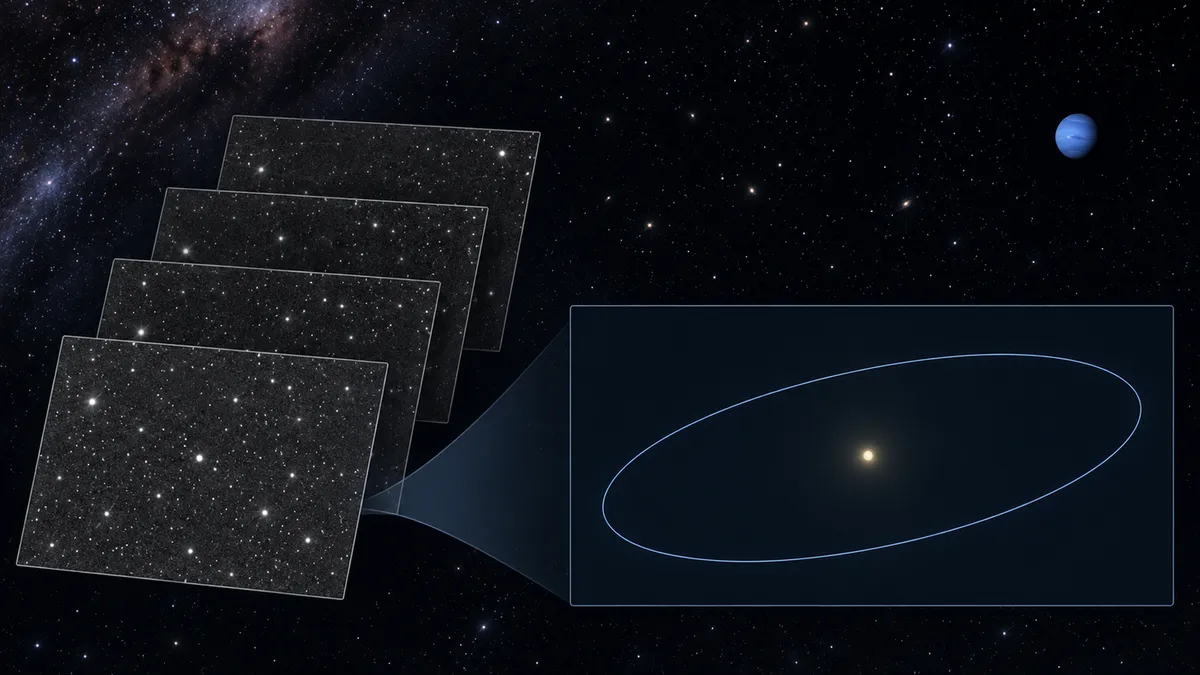
Faint, slow-moving bodies in the outer Solar System can hide in telescope images taken years ago. Gioele Cerati’s arXiv preprint describes a search for them in the NOIRLab Source Catalog DR2—and explains why its candidate list is not a complete census.
Some of the Solar System’s most distant small bodies are difficult to find: they are faint, move slowly against background stars, and may appear in old telescope images without being recognized as moving objects. Could observations already collected reveal them after the fact?
Gioele Cerati’s study searches single-epoch detections in the NOIRLab Source Catalog DR2, which includes observations made with the Dark Energy Camera (DECam) from 2012 to 2019. The search looks for objects in the outer Solar System, including trans-Neptunian objects and bodies that share Neptune’s orbit.
Linking faint points across time
A moving object may appear as a point of light on several nights, but identifying the same object across images is challenging. The search links single-night detections using a model in which an object follows a gravitationally bound orbit. Proposed matches are checked against possible image artefacts, stationary sources, and objects already known.
The study also seeks support in archival observations not used to fit the proposed orbit. It uses forced photometry: measuring light at a predicted position, even when the source is too faint to appear clearly in a general catalogue. The abstract describes confirmation checks on new archival nights and tests using exposures not included in the fit.
In a specific test, the linking method recovered 96% of known objects that were present on four nights within one sky tile. This result is not the overall recall of the search. The abstract estimates end-to-end recall at about 7%, limited by observing cadence, sky tiling, and catalogue incompleteness. It does not specify a denominator that would support a broader interpretation of what population that percentage represents.
65 candidates, with different levels of support
The search produced 81 catalogue objects, four of which were already designated. The other 77 were assigned evidence grades: 53 are class A, described as appearing across multiple oppositions and at least nine nights; 12 are class B; and 12 are class C. The main candidate set comprises the 65 class A and B objects, not the class C objects.
Checks on exposures independent of the orbit fits provide support, but require careful interpretation. Of 41 objects that could be tested, forced photometry detected objects at 99% of their predicted positions, similar to the rate for known trans-Neptunian objects. This is a detection rate for those 41 testable objects, not a general confirmation rate. At control positions, the detection rate was 6%. A post hoc rule classified 22 objects as passing this check; 19 were inconclusive, and none failed.
The archival-image checks alone do not independently establish every candidate. Shifted control positions were never confirmed in the archival image search, but were confirmed in 2.2% of trials by the catalogue-precovery step behind most scripted confirmations. The abstract cautions that the image-search nights alone are not sufficient. The evidence can be supportive without being decisive.
What the orbits suggest—and what they do not
The paper reports 10-million-year orbital integrations for the 65 class A and B candidates. Four are described as candidate L4 Neptune Trojans: objects thought to orbit the Sun in a region ahead of Neptune. In this discussion, the reported observation arcs range from 13 to 19 years; the abstract does not specify that this range applies only to those four. The remaining candidates are classified by inferred orbital behaviour: 21 resonant, 13 detached, nine scattering, two Centaurs, and 16 classical objects. One detached class-B candidate has a reported perihelion distance of 48.8 astronomical units: its closest approach to the Sun is about 48.8 times Earth’s average distance from it.
These classifications reflect orbital behaviour inferred from observations and integrations; they are not all equivalent to formal designations. Candidate positions are withheld until designation or June 30, 2027, while digests of those positions are published.
No object beyond 80 astronomical units was confirmed. The abstract says this barely constrains the Planet Nine hypothesis. It does not establish that no such objects were detected or exist. With estimated end-to-end recall of about 7% and no selection function provided, the study cannot show how complete its sample is or use non-confirmation as a strong population limit.
A useful archive, not a finished census
The study presents a way to mine existing sky surveys and a candidate list accompanied by checks and caveats. Its two recall figures answer different questions: the high recovery rate applies to known objects present on four nights in one sky tile, while the much lower end-to-end estimate reflects limitations including observing gaps and catalogue incompleteness.
This account is based on the paper’s abstract, not a full-text review. The work is an arXiv preprint; the supplied source does not establish peer-review status. The authors’ stated lack of a selection function is an important limitation. Further observations and independent assessment will be needed to clarify which candidates are secure and what they imply about the distant Solar System.
- outer Solar System
- trans-Neptunian objects
- Neptune Trojans
- archival astronomy
- DECam
- NOIRLab Source Catalog