TRANSMISSION // 2611.14295v1
An unentangled quantum record can require entangled measurements
Source published
A theoretical preprint identifies a narrow regime where a quantum record contains no entanglement, yet reading its long-range information requires measurement effects that are entangled across the probes.
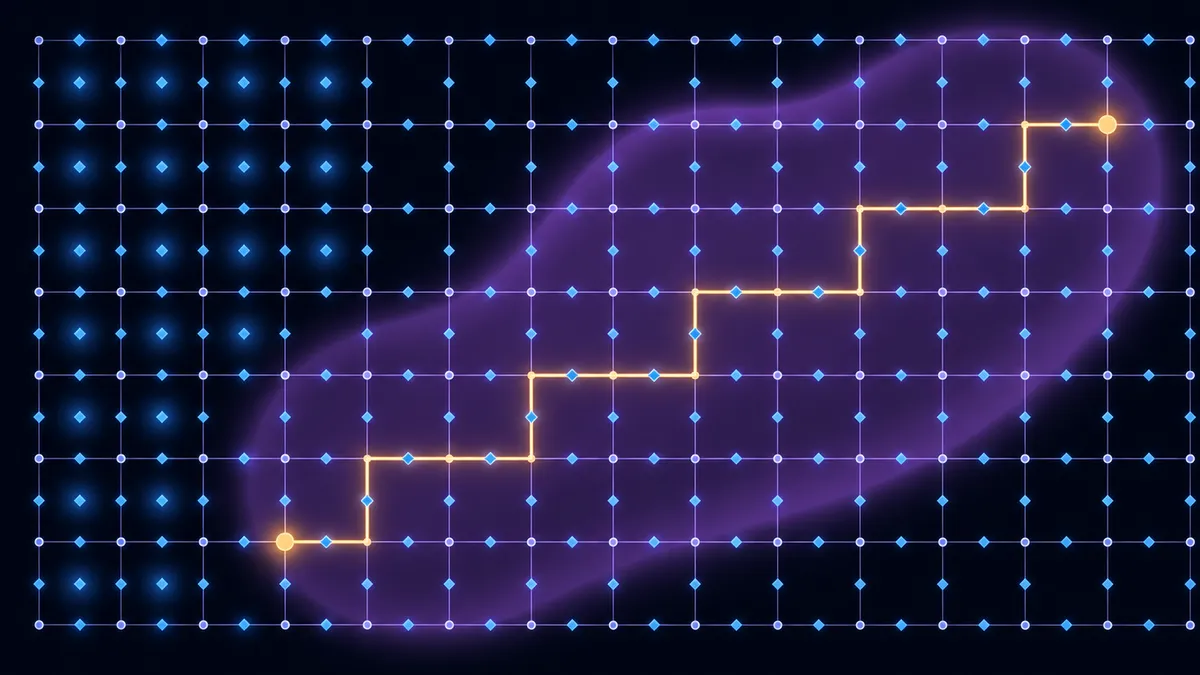
A collection of quantum probes can contain no entanglement and still resist being read one probe at a time. In a new preprint, Qingtian Miao constructs a lattice-based example: separate measurements eventually lose the ability to tell whether two distant spins are aligned, while a joint measurement retains an advantage. The distinction lies not in how the record is stored, but in how it is measured.
Recording relationships rather than individual spins
The model places spins on the sites of a square lattice and one probe qubit on every bond between neighboring sites. The spins begin in an uncorrelated product state. Their up-or-down labels along the chosen measurement axis are independent and equally likely.
Each probe interacts locally with its two neighboring spins. It records whether their labels agree or disagree, rather than either spin’s individual orientation. Those two possibilities produce two quantum states whose overlap is controlled by a parameter called p: their overlap is 1 − p.
When p is close to zero, the states are almost identical and difficult to distinguish. At p = 1, they are orthogonal and the bond label can be read without error.
For any fixed configuration of spin labels, the probes occupy a product state. Averaging over the spins produces a mixture of these product states. The resulting record is therefore fully separable: it contains no entanglement between probes. Even the two records conditioned on the answer to the prediction task are fully separable.
The receiver gets one copy of the probe collection and must guess whether two prescribed, distant spins have the same or opposite labels. Both answers start equally likely, making one-half the success probability of an uninformed guess.
A narrow but proved separation
The preprint compares different ways of measuring exactly the same record.
One option allows each probe to be measured locally, with classical messages coordinating later measurements. This includes adaptive strategies, local auxiliary systems and local quantum memory. A more permissive mathematical class allows any measurement whose effects are separable across the probes. Measurement effects are the positive operators specifying the probabilities of different outcomes.
The paper proves a restriction even for a broader class, defined by positivity under partial transposition across every division of the probes.
For record strengths up to p = 1 − 1/√2, approximately 0.292893, the best success probability in these restricted classes approaches one-half as the target spins move farther apart.
By contrast, an unrestricted joint measurement retains a positive, distance-independent advantage above one-half for p at least 0.29181.
The overlap between these ranges, from 0.29181 to approximately 0.292893, establishes the separation. Within that interval, retaining a nonvanishing long-range advantage requires at least one entangled measurement effect. An unentangled stored state does not make separable readout sufficient.
Why paths and loops matter
The restricted-readout proof compares the quantum record with an imagined classical record. In that comparison, each bond label is independently revealed with probability p(2 − p), or marked as missing.
A connected path of revealed labels determines the relationship between its endpoints: multiplying the labels along the path gives their relative orientation. Without such a path, flipping all spins in the revealed cluster around one endpoint preserves the available labels but reverses the answer. The two answers then remain equally likely.
The author bounds the squared prediction advantage of restricted quantum measurements by the probability of a revealed connection. On the square lattice, long-distance connection probabilities vanish when the reveal probability is at most one-half. This supplies the restricted-readout threshold.
For joint measurements, the argument uses a different, auxiliary inference problem. Its edge bits obey parity constraints: an even number of marked edges meet at ordinary vertices, while the two target vertices may have odd parity. Hidden paths make the two possibilities difficult to distinguish. Through an exact mathematical mapping, that uncertainty supplies a lower bound on the physical joint-readout advantage.
The decisive improvement comes from analyzing the four edges meeting at a vertex together. Their parity constraint creates redundancy that a bond-by-bond comparison misses. This permits a hidden-edge probability just above the square lattice’s connectivity threshold, proving a positive long-range advantage.
Loops are essential to the difference between readouts. On a tree, which has only one path between two sites, local measurements already attain the joint optimum. Their advantage nevertheless decays with path length for imperfect records.
What the result leaves open
This is a theoretical preprint, not an experimental demonstration. Its long-range statements take the system-size limit at fixed spin separation before increasing that separation.
The positive joint advantage is a mathematical guarantee, not a demonstrated practical readout protocol or a promise of a large usable signal. Constructing joint measurements and determining their circuit depth or required coherent measurement size remain future tasks identified in the paper.
A statistical-mechanics mapping, combined with previously published numerical estimates, suggests that the separation may extend down toward p ≈ 0.21844. That broader interval is suggested rather than analytically established here. The proved result is narrower: locally created, unentangled records can hold long-range information that separable measurement effects cannot recover.
- quantum information
- quantum measurements
- separable states
- quantum data hiding
- bond percolation
- Ising spins
Reviewed cross-references
These connections were reviewed by a model, not independently fact-checked by a human. Similarity does not imply agreement; consult the original papers and the evidence below.
Choosing the next link can help quantum networks connect sooner
Shared method: Both papers use classical bond-percolation mappings to analyze quantum-network connectivity: Miao bounds restricted prediction advantage by the square root of the connection probability for independently revealed bond labels, while Shao and Motter map their random singlet-conversion baseline to bond percolation. The shared method concerns connectivity, not equivalent resources or outcomes: Miao studies information readout from a separable record, whereas Shao and Motter start with entangled links and introduce cluster-dependent edge selection beyond the random baseline. These selected preprint excerpts do not establish transferable thresholds.
Model review: · openai-codex/gpt-6.1-sol
Evidence and provenance
Selected excerpts, not complete papers. PDF extraction can omit figures or damage equations, tables and reading order; sources may be preprints.
2611.14295v1 — Original paper
Excerpt reference:
static/papers/2611.14295v1.md:412-480
Basis: Paper text
Source SHA-256:28983d359d03d8bd5f29ff26dbaa3687227ccb2763a25db7cbe958fcff8983a12611.10119v1 — Original paper
Excerpt reference:
static/papers/2611.10119v1.md:120-178
Basis: Paper text
Source SHA-256:0f5e13c6980dd7f397b6c79a88c0945f57c53326adb202282729912da2107999
Related reading
Automatically matched by shared topic keywords. These links do not imply that the sources agree or establish a consensus.
Repeated measurements enable rational quantum spectral filters
Source published
Shared keywords: quantum measurements
A changing grid could offer a new way to protect quantum information
Source published
Shared keywords: quantum information
A broader proof links quantum information to horizon geometry
Source published
Shared keywords: quantum information
Nuclear symmetry breaking rearranges where correlations live
Source published
Shared keywords: quantum information
A quieter route to tunable light–matter interactions
Source published
Shared keywords: quantum information