TRANSMISSION // 2611.14271v1
A Chern insulator’s edge may add quantum weight
Source published
A theory study argues that measuring quantum fluctuations in a finite Chern-insulator flake can include a contribution from its chiral edge, not just its bulk. The balance depends on how quickly a coupled circuit responds. The authors support the prediction with exact calculations for free-fermion lattice flakes; the result is limited to weak coupling, and the evidence available here is the paper’s abstract, not its full text.
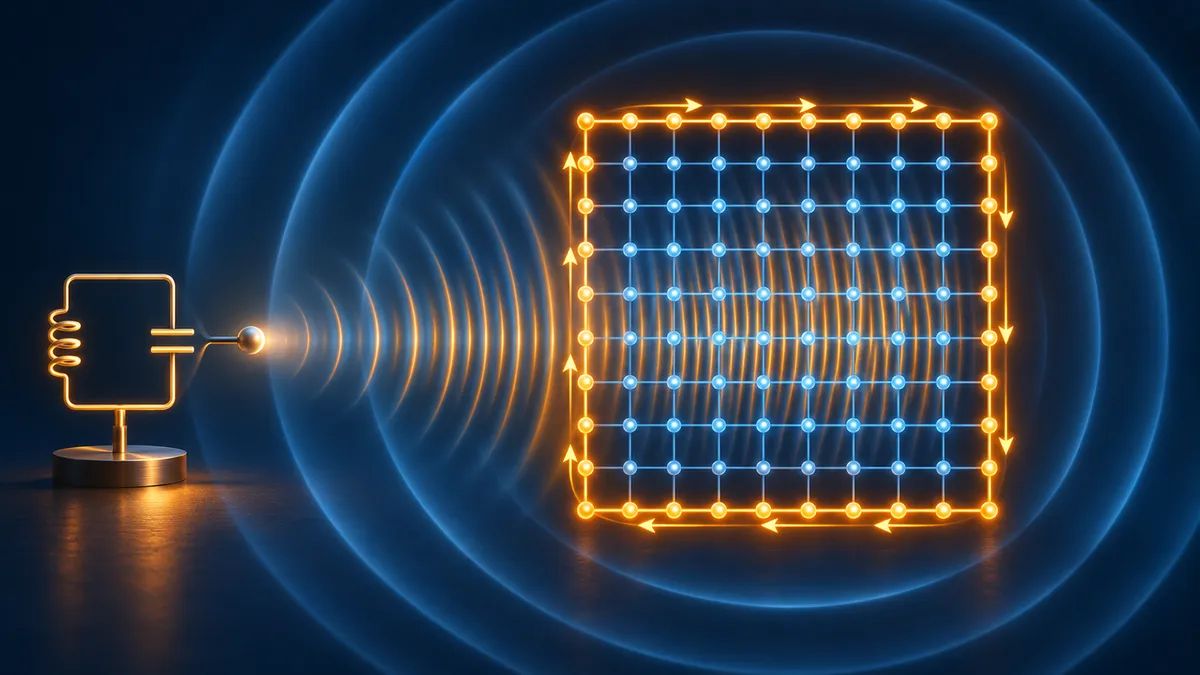
A topological insulator is often described through its bulk: a Chern number captures a global property of its electronic states and constrains their response. But a real sample has an edge, where special chiral modes can travel in one direction. Could those boundary modes affect a measurement intended to reveal the bulk?
A quantum circuit coupled to an insulator can register fluctuations in the material’s polarization. The resulting zero-point energy—the energy that remains even at the lowest temperature—can therefore act as a probe of quantum fluctuations. In a crystal, this response is called the bulk quantum weight. The paper’s abstract says the Chern number, a topological index of the insulating band structure, places a lower bound on that bulk quantity: it must be at least the magnitude of the Chern number.
Rohit Narula’s preprint asks what changes when the sample is finite. Its central claim is that a finite Chern-insulator flake has an additional contribution from its edge. This edge contribution does not disappear simply because the flake is made larger. The authors call it an edge quantum weight, built from the squared dipole matrix elements of low-frequency transitions carried by the chiral edge modes.
The proposed lower bound is striking: the edge weight is at least the magnitude of the Chern number per unit area. The abstract gives a physical argument for this “floor.” Each transition absorbs positively for both circular polarizations, while the circular dichroism—the difference in absorption between the two polarizations—cancels between edge and bulk. The floor is thus presented as a consequence of combining positive absorption with that cancellation, not as a claim that edge and bulk responses are identical.
The measurement depends on the circuit’s response frequency. A weakly coupled circuit that is slower than the edge modes is predicted to register the bulk and edge contributions together, averaged over two field directions. A faster circuit, provided it remains below the bulk energy gap, is predicted to approach the bulk quantum weight alone. In practical terms, the same flake need not yield one universal reading: the probe’s timescale matters.
This leads to an order-of-limits issue. Making the flake larger brings in the edge contribution, while making the circuit slower allows it to respond to the edge modes. The abstract says which quantum weight is measured depends on which of these changes is made first. It does not provide enough detail here to reconstruct the precise limiting procedure or its assumptions, so the claim should be read as a theoretical result within the model described by the authors.
For their method, the authors report exact free-fermion calculations on lattice flakes. They say these calculations support both the edge-weight floor and the predicted frequency dependence. They also report that, above the floor, the edge weight for one channel is set by boundary shape and edge velocities; square and rectangular lattice flakes follow the stated value to within 0.003. Additional edge channels contribute their own such numbers, while the edge’s circular dichroism tracks only the net chirality. The abstract does not give the calculation details, model parameters, or a broader survey of geometries, so these numerical statements should not be generalized beyond what is reported.
There is an important caveat: the result is stated for weak coupling. The authors note that a flake growing at fixed coupling will eventually leave that regime. So the prediction does not establish what happens for arbitrarily large samples under unchanged coupling, nor does it by itself show how an experimental device would behave.
The broader lesson is about what a probe measures. A circuit designed to sense quantum fluctuations may respond to both a material’s interior and its boundary, and changing the probe’s speed can change their relative contribution. This is a theoretical proposal supported by calculations, not an experimental demonstration. The source available for this article is the arXiv abstract for version 1 of the preprint; the full paper was not available in the supplied evidence, and preprints may not have undergone peer review.
- Chern insulator
- quantum fluctuations
- edge modes
- topological matter
- circuit measurement
Related reading
Automatically matched by shared topic keywords. These links do not imply that the sources agree or establish a consensus.
A compact calculation explores quantum topology on a fractal
Source published
Shared keywords: chern insulator
Two imaging methods reveal microwave patterns in a superconducting lattice
Source published
Shared keywords: edge modes
Disorder slows the spread of quantum fluctuations
Source published
Shared keywords: quantum fluctuations