TRANSMISSION // 2611.14243v1
How Neutron-Star Vibrations Shape Gravitational Waves
Source published
A theoretical study models how a companion’s gravity can excite internal vibrations in neutron stars, and how those vibrations affect gravitational waves and the star’s crust. In one representative model, the waveform phase shift is small, even as some modes may strain the crust beyond its breaking threshold.
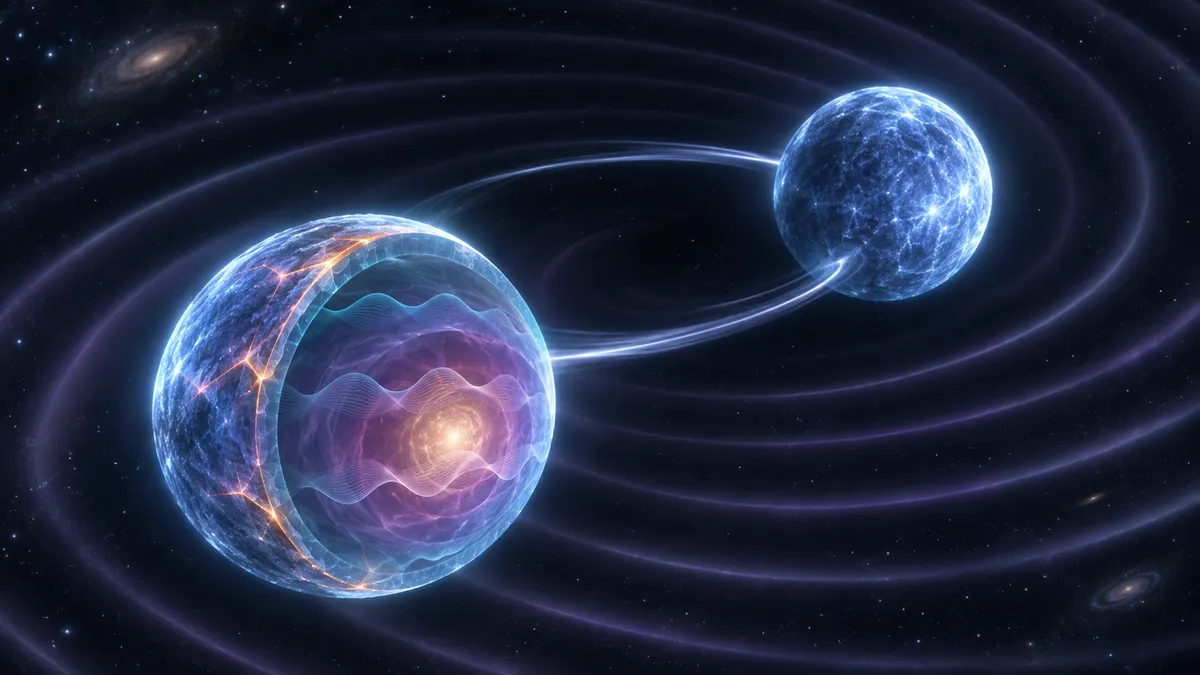
When two neutron stars spiral toward each other, each pulls on the other, deforming it and potentially setting its interior vibrating. Those vibrations could reveal details of matter inside the stars—but describing them in the strong gravity of a neutron-star binary is challenging.
The question: can a star’s internal motion leave a detectable trace?
A neutron star in a close binary is not necessarily deformed in a smooth, unchanging way. Its companion’s gravity changes as the stars orbit, and this changing tide can excite vibrations inside the star. Different kinds of vibration are connected to different internal features, including composition layers, the solid crust, and possible transitions between forms of matter. The challenge is to model both the star’s response in general relativity and its effect on the binary’s gravitational-wave signal.
Yong Gao and Jan Steinhoff develop a framework for following that response in nonrotating neutron stars. Their calculations account for composition stratification, an elastic crust, and possible first-order phase transitions. They use analytical solutions for the star’s exterior and match the stellar response to an effective field theory. In the frequency range relevant to the inspiral, they represent the response as a collection of harmonic oscillators, each standing for a stellar vibration with its own frequency and coupling to the tide. They then couple these oscillators to relativistic binary dynamics, including gravitational redshift and frame dragging, and calculate how the vibrations are driven and how they evolve.
What the calculations suggest
The authors report that their analytical estimates of mode amplitudes are accurate to within a few percent during inspiral. They also reconstruct how strain—the deformation—varies through the crust over time.
For one representative binary, with component masses of 1.20 and 1.50 times the Sun’s mass and a hadronic–hybrid model for the stars, the combined effects of gravity, interface, and shear modes change the gravitational-wave phase by no more than about 0.01 radians. That is a small shift in the modeled signal. Yet the same calculation suggests that gravity-mode excitation could strain the crust beyond its breaking threshold near the base, while the lowest-frequency shear mode could cause overstrain across a wider area.
This points to an important distinction: a mode’s effect on the observed waveform need not be large for its effect on the crust to be substantial. The result concerns a model, however; it is not an observation that a neutron-star crust has fractured.
What remains uncertain
The finding is based on a theoretical framework and a representative binary, not a survey of all possible neutron-star structures or binary systems. The abstract does not give enough information to assess the full range of model assumptions, how the crust’s breaking threshold is set, or how robust the strain estimates are to changes in those assumptions. Nor does it establish whether these effects can be measured in gravitational-wave data.
This article is based on the paper’s abstract rather than a full-text examination. The paper is identified as an arXiv preprint, so its peer-review status is not established by the available source. The results should be read as a proposed modeling approach and calculations, not as settled observational evidence. Source: arXiv:2611.14243v1.
- neutron stars
- gravitational waves
- dynamical tides
- stellar oscillations
- neutron-star crust
- general relativity
Reviewed cross-references
These connections were reviewed by a model, not independently fact-checked by a human. Similarity does not imply agreement; consult the original papers and the evidence below.
A single stellar vibration captures much of neutron stars’ tidal response
Shared method: Both papers represent relativistic neutron-star tidal response using mode-based sums: Gao and Steinhoff extract poles and residues and approximate the response with harmonic oscillators, while Hegade et al. construct a near-zone mode sum in Regge–Wheeler gauge. This is a methodological connection, not evidence that their formulations or convergence properties agree; the latter paper specifically cautions that its truncated sum is not expected to converge strictly.
Model review: · openai-codex/gpt-6-luna
Evidence and provenance
Selected excerpts, not complete papers. PDF extraction can omit figures or damage equations, tables and reading order; sources may be preprints.
2611.14243v1 — Original paper
Excerpt reference:
static/papers/2611.14243v1.md:12-96
Basis: Paper text
Source SHA-256:b7e72504ad408deddabd922a4b973e6f078c6653362eca40db35d88eab194a782605.08569v2 — Original paper
Excerpt reference:
static/papers/2605.08569v2.md:12-58
Basis: Paper text
Source SHA-256:087e9e559ac889df56aa71d8c94995f931a5b7bf8268088b222f666c8e30b96e
Related reading
Automatically matched by shared topic keywords. These links do not imply that the sources agree or establish a consensus.
How neutron-star tides could reveal the stars’ hidden vibrations
Source published
Shared keywords: dynamical tides, general relativity, gravitational waves, neutron stars, stellar oscillations
A single stellar vibration captures much of neutron stars’ tidal response
Source published
Shared keywords: dynamical tides, general relativity, gravitational waves, neutron stars, stellar oscillations
New method sorts newborn neutron stars’ vibrations by their physics
Source published
Shared keywords: gravitational waves, stellar oscillations
Neutron Star Tides Could Complicate Tests of Einstein’s Gravity
Source published
Shared keywords: general relativity, gravitational waves, neutron stars
Can a simpler star simulation recover tides in gravitational waves?
Source published
Shared keywords: general relativity, gravitational waves, neutron stars