TRANSMISSION // 2611.14200v1
Disorder slows the spread of quantum fluctuations
Source published
Numerical studies of weakly interacting bosons find that disorder can make quantum fluctuations spread logarithmically for a time, even while the mean-field wavefunction stays localized. The growth eventually slows and saturates. A theoretical model links the pattern to increasingly weak generation of fluctuations at greater distances; the results are computational and do not establish experimental observation.
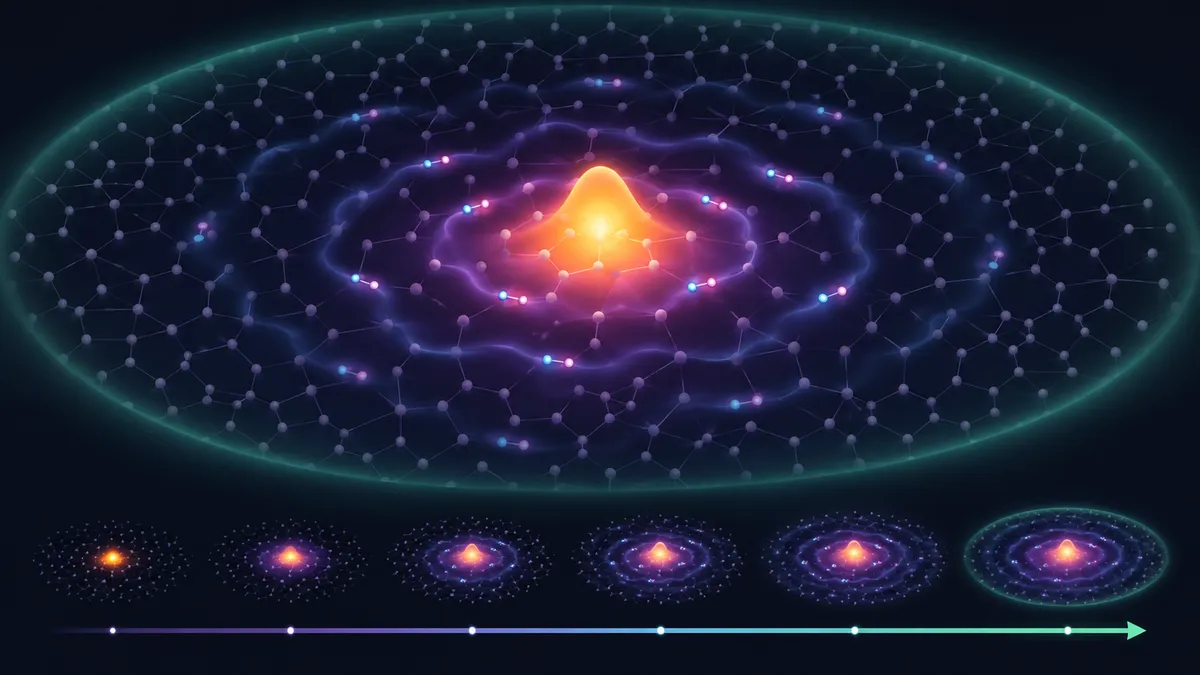
Disorder is often described as a brake on motion: in quantum systems, it can keep particles from spreading freely. But what happens to the small quantum corrections that a mean-field description leaves out? A new theoretical study tracks those fluctuations in disordered boson lattices and finds a slow, temporary form of spreading.
A cloud of bosons in a lattice can be described approximately by the Gross–Pitaevskii (GP) equation, a mean-field model in which particles are represented by a shared wavefunction. The approximation leaves out quantum fluctuations: deviations between that simplified description and the more complete many-body dynamics. Ang Yang, Jingxuan Zhang and Lei Ying ask how those deviations travel when the lattice contains disorder.
The authors compare the Bose–Hubbard model, which describes interacting bosons hopping between lattice sites, with the GP equation. They calculate the difference between the models’ local particle densities as a measure of fluctuation strength. Their simulations begin with bosons concentrated at one site, and examine both random disorder and a regular, quasiperiodic pattern of disorder. They also use time-evolving block decimation for some many-body calculations, and develop a time-dependent Bogoliubov–de Gennes (BdG) description to interpret the results. BdG treats small excitations around the evolving mean-field state.
In a system without disorder, the fluctuation pattern spreads ballistically: its distance grows roughly in proportion to time. With either type of disorder, the authors instead find an intermediate period in which the characteristic spread grows approximately as the logarithm of time. In plain terms, the fluctuations continue to reach farther out, but each comparable increase in distance takes progressively longer. The mean-field wavefunction can remain spatially localized during this period.
The effect is not unlimited. At later times, the fluctuation profile slows and approaches a bounded extent in the simulations. The paper therefore describes logarithmic spreading as a transient regime, followed by saturation, rather than perpetual expansion. Increasing disorder reduces the fitted rate of growth; the authors report that this rate decreases algebraically with disorder strength over the range they study. They also report stronger suppression for quasiperiodic than random disorder in their comparisons. The pattern appears across the particle numbers examined and in simulations of a two-dimensional lattice.
The proposed explanation comes from the BdG analysis. The localized GP wavefunction acts as a time-varying pairing background: it can generate pairs of quantum excitations. Because the background and the relevant excitation modes are localized, the calculated generation rates become smaller with distance. If distant fluctuations are produced at exponentially lower rates, it takes increasingly long for them to become appreciable. That gives a physical route to a front that advances roughly logarithmically in time. The analysis reproduces key features of the simulations, but the paper’s supplementary discussion makes clear that some simplified descriptions of the rates and eventual saturation rely on assumptions and phenomenological modeling.
There are important boundaries to the claim. These are model calculations for weakly interacting bosons, not a report of a laboratory measurement. The authors study selected initial states, disorder settings, particle numbers and lattice sizes; the two-dimensional results, in particular, use a limited particle number. The reported algebraic trend is fitted over a moderate range, not a universal law established for every disorder regime. And while the authors draw a resemblance to slow entanglement growth in many-body localization, they present the relationship as a question for future work, not as an established connection.
The work is a preprint on arXiv, so its claims should be read as research results that have not necessarily undergone peer review. Numerical findings depend on the modeled system and approximations, and the extracted text of the paper may not preserve every detail of its figures or equations. The central contribution is a proposed dynamical regime: disorder may not simply stop quantum fluctuations, but can slow their outward growth to a logarithmic crawl before they settle into a finite profile.
- quantum fluctuations
- disorder
- bosonic systems
- Bose–Hubbard model
- Gross–Pitaevskii equation
- Bogoliubov–de Gennes
Related reading
Automatically matched by shared topic keywords. These links do not imply that the sources agree or establish a consensus.