TRANSMISSION // 2611.14197v1
A New Search Strategy for Gravitational Waves from Eccentric Neutron-Star Binaries
Source published
Researchers have developed and tested a method for searching LIGO data for faint, persistent gravitational waves from neutron stars in wide, highly eccentric binary systems. Using Gaia-measured orbits to narrow the search, they show through simulated signals that the approach is feasible—not that any of the candidate stars has been detected through gravitational waves.
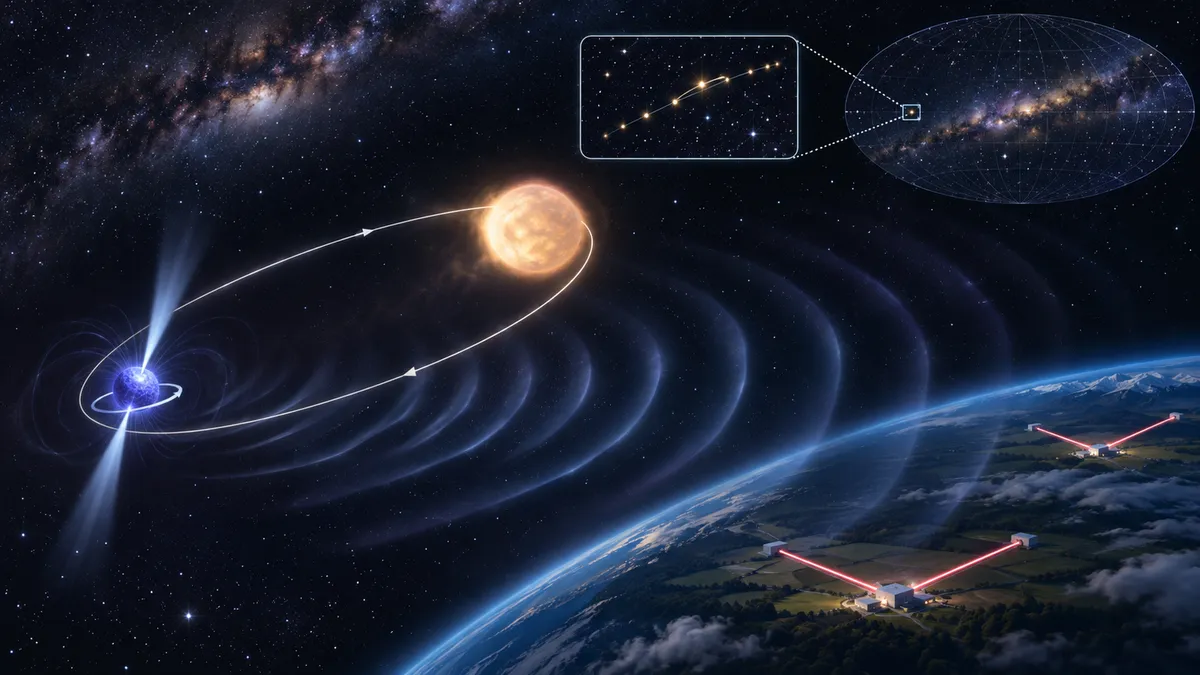
Neutron stars in wide, stretched-out orbits pose a challenge for gravitational-wave searches: their motion shifts a signal in ways that standard circular-orbit searches are not built to track. A new study uses orbital information from Gaia to design a search for these systems and tests the method by adding artificial signals to detector data.
A rotating neutron star could emit a very faint, persistent gravitational-wave signal if its mass distribution is slightly uneven. Finding such a signal could offer clues about the star’s interior. But if the star orbits a companion, its motion also shifts the signal’s frequency over time. That shift is particularly tricky to model when the orbit is highly eccentric—more oval than circular.
The study by M. Ball and colleagues asks whether gravitational-wave data can be searched efficiently for signals from neutron stars in wide, eccentric binaries identified as possible targets by the Gaia space telescope. Gaia observations help constrain where these systems are in the sky and how their orbits work. The neutron stars’ rotation rates, however, are not known, so the search must look across a range of possible signal frequencies.
The researchers focus on 21 candidate systems identified in earlier work combining Gaia observations with follow-up measurements. Their orbits have periods of roughly 189 to 1,046 days and eccentricities from 0.12 to 0.80. These values put them outside the ranges handled well by many earlier searches, which were designed for circular or nearly circular orbits.
Following a signal through an eccentric orbit
The team developed a way to space out the trial signal models—often called templates—so that they cover uncertainties in the measured orbital parameters. Their “frequency metric” estimates how much a small change in an orbital parameter shifts the predicted signal frequency. The method uses Gaia’s measurements to narrow the range of orbital possibilities, while still accounting for their uncertainties.
There is a computational hurdle: calculating the frequency shift caused by an eccentric orbit requires solving an equation repeatedly. The authors built on the FastTracks search framework and reduced the number of calculations by evaluating the orbital correction at less frequent time intervals, then interpolating between them. They also used a hybrid template strategy: a grid for the signal frequency and its rate of change, with orbital parameters sampled according to Gaia-informed distributions.
To test the approach, they added artificial signals, or injections, to both simulated Gaussian noise and real LIGO data from the second part of the fourth observing run (O4b). The analysis used data from the Hanford and Livingston detectors. It tested two of the 21 candidates, selected because one required comparatively few templates and the other represented a more computationally demanding case. The injections covered two narrow frequency ranges near the low and high ends of the study’s 50–200 hertz search band.
The authors report that the injected signals could be recovered using their procedure. Tests in real detector data gave results consistent with tests in simulated noise, supporting the claim that the method is workable under realistic data conditions. This is a demonstration of search feasibility, not a detection of gravitational waves from the Gaia candidates. The paper does not report that any candidate’s rotation or gravitational-wave emission has been measured.
A promising method, with open questions
The study is an early feasibility assessment, and its results have important boundaries. The injection campaign concentrates on two candidates, not all 21, and on a limited set of injected frequencies and signal properties. Its conclusions therefore support the method’s potential; they do not establish how sensitive a completed search would be for every candidate or every possible signal.
The authors also note that their frequency metric treats parameter spacings separately and does not account fully for correlations among orbital parameters. Those correlations could affect how templates should be placed. In addition, the paper’s computational estimates and sensitivity depend on choices about the search, including its frequency range and candidate-selection threshold. A future search would need to apply follow-up procedures and distinguish genuine signals from instrumental features that can resemble them.
The work lays groundwork for combining Gaia’s measurements with continuous-gravitational-wave searches. A real search could test these systems using detector data, but its outcome is not known from this feasibility study. The paper is a preprint, so its findings should be read as research in progress rather than as a settled result; the source version may not have undergone peer review.
- gravitational waves
- neutron stars
- Gaia
- LIGO
- eccentric binary orbits
- continuous-wave searches
Related reading
Automatically matched by shared topic keywords. These links do not imply that the sources agree or establish a consensus.
Eccentric black-hole signals may reveal the environments around them
Source published
Shared keywords: gravitational waves
Catching a Neutron Star Merger’s Light Before It Fades
Source published
Shared keywords: gravitational waves
Could daily pulsar observations probe a gravitational-wave blind spot?
Source published
Shared keywords: gravitational waves
Neutron star binaries may get their chance after a cluster’s black holes leave
Source published
Shared keywords: neutron stars
Neutron Star Tides Could Complicate Tests of Einstein’s Gravity
Source published
Shared keywords: gravitational waves, neutron stars