TRANSMISSION // 2611.14188v1
How many electric-field levels does a quantum simulation need?
Source published
A theoretical preprint derives explicit error bounds for replacing infinite electric-flux ladders with finite registers in a compact U(1) lattice gauge theory. The guarantee covers entire low-energy bands, including coherent superpositions, but depends on strict conditions on the initial state and model.
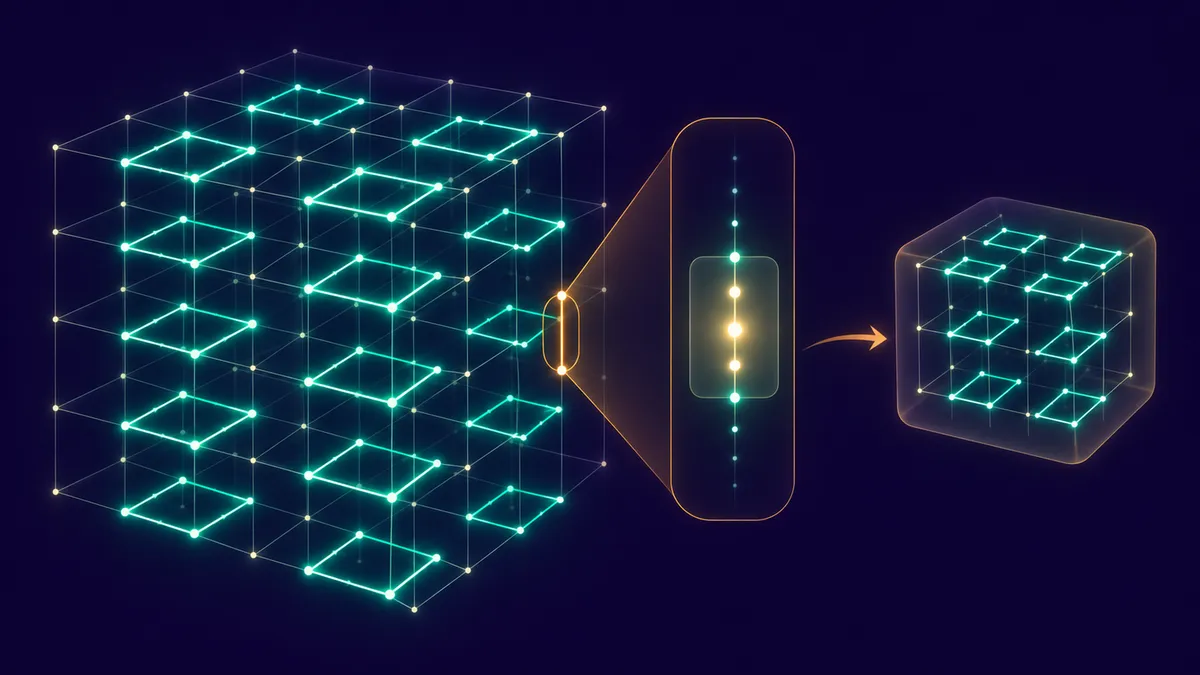
A quantum field can require infinitely many possible values even after space has been divided into a finite grid. A computer cannot store them all. In a new preprint, independent researcher Yi Liang derives a mathematical guarantee for discarding large electric-flux values in one lattice gauge theory—and shows when the resulting finite model preserves its low-energy dynamics.
A second cutoff, beyond the spatial grid
Lattice gauge theories describe fields using sites and the links connecting them. In the pure compact U(1) model studied here, every link carries an electric flux that can take any integer value, positive or negative. Dividing space into a grid therefore does not, by itself, make the system finite-dimensional.
A practical simulation can retain only flux values between a negative and positive cutoff. But that changes the model: transitions that would cross the boundary are removed. The question is how much this local restriction changes the evolving quantum state and the quantities measured from it.
Liang's preprint addresses a three-dimensional periodic cubic lattice, with at least three sites along each direction, no dynamical matter and a vanishing theta angle. It considers states obeying Gauss's law in the sector with zero global electric flux.
The chosen truncation is a hard wall. Flux-changing operators act normally inside the retained interval and stop at its endpoints. They do not wrap around from one boundary to the other. That distinction matters: the bounds do not automatically apply to other finite-register constructions.
A guarantee for a whole energy band
The main result concerns states supported entirely within a specified energy interval above the exact vacuum of the original, untruncated Hamiltonian. It covers every normalized superposition in that interval, not just individual energy eigenstates.
That is useful because quantum dynamics can depend on interference between different energies. A guarantee for isolated eigenstates need not provide an equally strong guarantee for their superpositions.
The proof does not require the energies inside the interval to be nondegenerate, or require a separating gap at the interval's upper edge. Its local error bound also avoids a factor proportional to the number of states in the interval.
The mechanism behind the result has two ingredients. Electric energy grows quadratically with flux, while each magnetic plaquette interaction changes a link's flux by only one step. Reaching increasingly large flux therefore encounters increasingly large energy penalties through successive steps.
To make this reasoning quantitative, Liang temporarily removes one link's electric-energy term and the magnetic interactions touching it. Comparing the ground energy of that remaining environment with the original vacuum supplies a local energy threshold. An operator estimate then turns successive flux steps into an explicit product bound.
The resulting high-flux amplitude bound falls roughly like an inverse factorial squared, apart from parameter-dependent factors. This is a bound on a state's tail norm; the corresponding tail probability is bounded by its square.
Preserving motion, not just a static state
The exact evolution keeps an initial state inside its original energy window. The same tail estimate consequently remains available throughout that evolution.
The paper compares this exact trajectory with hard-wall evolution starting from the normalized projection of the same initial state. It obtains a finite-time state-distance bound and corresponding expectation-value bounds for bounded observables. These are analytical guarantees, not measurements from quantum hardware.
A worked strong-coupling example shows that the protected dynamics need not be trivial. On a lattice with three sites per direction, the author identifies a window containing the vacuum and a 162-dimensional excited band. A coherent combination of the vacuum and an excited wavepacket produces a plaquette-observable change exceeding 1.30.
Keeping seven flux levels per link preserves a change exceeding 1.29 under the stated bounds. Seven levels fit into three qubits per independent link register, before reducing the description using gauge constraints. This is not a three-qubit simulation of the whole lattice.
What the certificate leaves open
The energy-window assumption is stronger than merely having low average energy. A state can have a small admixture of extremely high flux while retaining a modest mean energy. The paper constructs examples showing why that weaker condition cannot imply the same factorial suppression.
Imperfect preparation therefore needs a separate bound on leakage outside the target energy interval. Hardware noise, approximate time evolution and measurement sampling also remain separate error sources. The paper additionally treats local electric-square measurements, whose unbounded values require extra care.
As the lattice is refined at fixed physical volume, positive bare coupling, energy-window width and duration, a flux cutoff growing like log N divided by log log N, with a coefficient greater than two, suffices for the stated dynamical error to vanish. This does not establish a continuum limit or cover a coupling that changes during refinement. It supplies a controlled local truncation once those other physical and computational requirements are addressed.
- lattice gauge theory
- quantum simulation
- compact U(1)
- electric flux
- Hilbert-space truncation
- low-energy dynamics
- quantum computing
Related reading
Automatically matched by shared topic keywords. These links do not imply that the sources agree or establish a consensus.
A quantum processor watches electric strings spread
Source published
Shared keywords: lattice gauge theory, quantum simulation
Counting the cost of simulating light and matter on a quantum computer
Source published
Shared keywords: quantum simulation
When a fixed plan can cut the measurement cost of quantum simulations
Source published
Shared keywords: quantum computing, quantum simulation
Encoding a black-hole mass model in qubits
Source published
Shared keywords: quantum computing
A framework for tracking grid errors in quantum field simulations
Source published
Shared keywords: quantum simulation