TRANSMISSION // 2611.14113v1
Looking ahead to describe what changes in a video
Source published
A video caption can name an object and its activity yet miss the detail that distinguishes one moment from the next. LASER, a system for reading object states, uses possible next-step changes to decide what to inspect now, then checks its guesses against later frames. In tests on two captioning benchmarks, it improved on several comparison methods. The results are promising, but rely on benchmark captions and automated scoring; they do not establish performance in real-world applications.
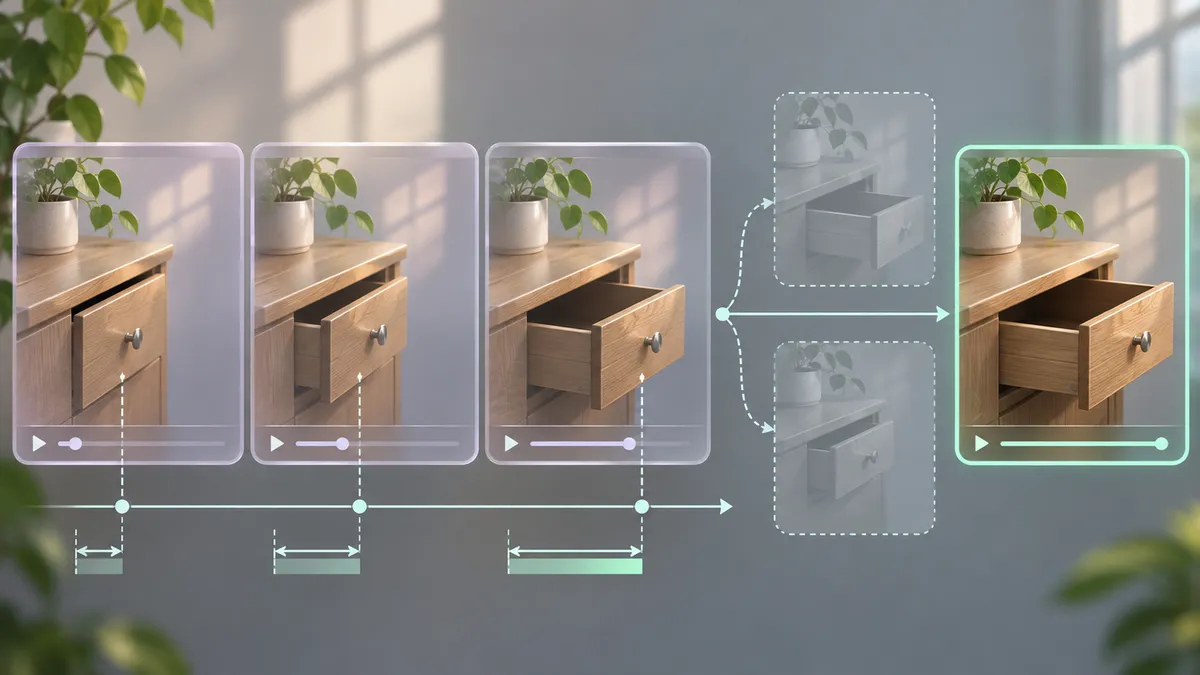
To explain how an activity progresses, an AI system needs more than a list of objects. It must notice how a particular object’s state changes—and which visible details make that change clear. A new approach called LASER tries to improve this process by asking what might happen next, then using that possibility to guide a closer look at the present.
Why look ahead?
Imagine watching a drawer being opened. A general caption might mention a person in a kitchen but omit how far the drawer is extended—the very detail that could distinguish opening from closing or no movement at all. Tracking an object’s state means describing its condition across video frames and identifying transitions, not simply naming what appears in a scene.
Yuanhe Tian and Yan Song propose a system called look-ahead state readout, or LASER, to address this challenge. Its central idea is to use possible next-step changes to decide which attributes deserve attention in the current frame. The system does not treat a forecast as fact: it checks descriptions and predictions against later visual evidence.
From possible changes to visual checks
LASER takes ordered video frames, a prompt identifying the object, and an instruction specifying what kind of description is wanted. A multimodal language model (MLLM)—a model that processes images and text—uses reusable textual “observation skills” to guide what it looks for.
First, the model forms a grounded description of the current observation. It then considers possible changes at the next observation. For a drawer, those might include opening further, closing, or staying in place. The alternatives point to an informative attribute—in this case, the drawer’s extension—and LASER turns it into a question about what is visible now. The question is meant to guide inspection, not dictate the answer; if the frame does not provide enough evidence, the value can remain unresolved.
When another frame arrives, the system checks earlier descriptions and forecasts against observations obtained independently of those forecasts. If the new frame contradicts a prediction, LASER can reject the prediction while retaining an earlier state that the evidence still supports. It updates a record of observed attributes, changes, and supporting evidence, then uses that record to produce the final description. When it cannot establish that the same object appears in both frames, it leaves the transition unresolved.
The authors also describe a way to revise the observation skills. The system traces differences between its captions and reference captions back to instructions that may have caused an omission or unsupported claim. It proposes changes, then tests them on separate videos from those used to identify the problem. A proposed revision is kept only if caption quality improves without increasing contradictions with reference facts. The underlying model parameters stay frozen, and the revised skills are fixed during evaluation.
What the tests found
The researchers evaluated LASER on OSCaR and PLM RCap, two benchmarks for describing object states or regions in video. They compared it with approaches including direct captioning, sequential readout without anticipation, attribute checklists, and other existing methods. Tests used four MLLM backbones.
The paper reports that LASER’s full approach consistently outperformed direct captioning, sequential readout, and generic reinspection across the reported metrics and backbones. It also scored higher than attribute checklists and free anticipation in those tests. In comparisons using Qwen3.5-9B, LASER scored above five adapted existing approaches on both benchmarks.
Ablation tests removed individual parts of the system. Scores fell when LASER no longer reinspected the current frame, lacked visual signs to distinguish possible changes, or let the initial observer see the predictions. These results support the value of those components within the tested setup; they do not, by themselves, prove why the full system performs better in every situation.
What remains uncertain
A forecast can be wrong, and the paper’s examples show why later evidence matters: LASER rejects a forecast of continued standing when a later frame shows a person seated on a bicycle. This is a useful design feature, not a guarantee that every error will be detected. The authors’ tests concern benchmark captioning, not downstream robotic decisions or performance in uncontrolled settings.
The evaluation also depends on reference captions and automated measures of caption similarity or quality. Such measures can reward agreement with a reference without capturing every aspect of whether a description is useful or visually complete. The paper describes safeguards against explicit contradictions, but those safeguards likewise depend on comparisons with reference facts.
This article is based on the arXiv v1 preprint, not an independent replication or a confirmed peer-reviewed publication. The paper reports encouraging benchmark results for a specific strategy: use possible changes to choose what to inspect, then check the resulting account against later observations. Whether that strategy transfers broadly remains an open question.
- video understanding
- object state tracking
- multimodal language models
- video captioning
- artificial intelligence
Related reading
Automatically matched by shared topic keywords. These links do not imply that the sources agree or establish a consensus.
V-STORM tests whether video AI can connect the evidence it finds
Source published
Shared keywords: video understanding
BlenderFORGE trains AI models to make measurable 3D edits
Source published
Shared keywords: multimodal language models
A Tomato-Health Chatbot Shows Promise—but Not Proven Diagnostic Accuracy
Source published
Shared keywords: artificial intelligence
AI radiology summaries can miss small words with important meanings
Source published
Shared keywords: artificial intelligence
Keeping the right evidence when AI inputs must shrink
Source published
Shared keywords: artificial intelligence