TRANSMISSION // 2611.14108v1
Quantum fluctuations can remember how a system began
Source published
In numerical studies of a quadratic quantum model, researchers found that the size of long-time fluctuations in observable expectation values tracks a property of the starting state called non-Gaussianity. The finding suggests that clues to a system’s initial state can persist in the time evolution of averages, not only in their long-time values. The relationship is not equally clear for every observable, and the study is a theoretical preprint, not an experimental demonstration.
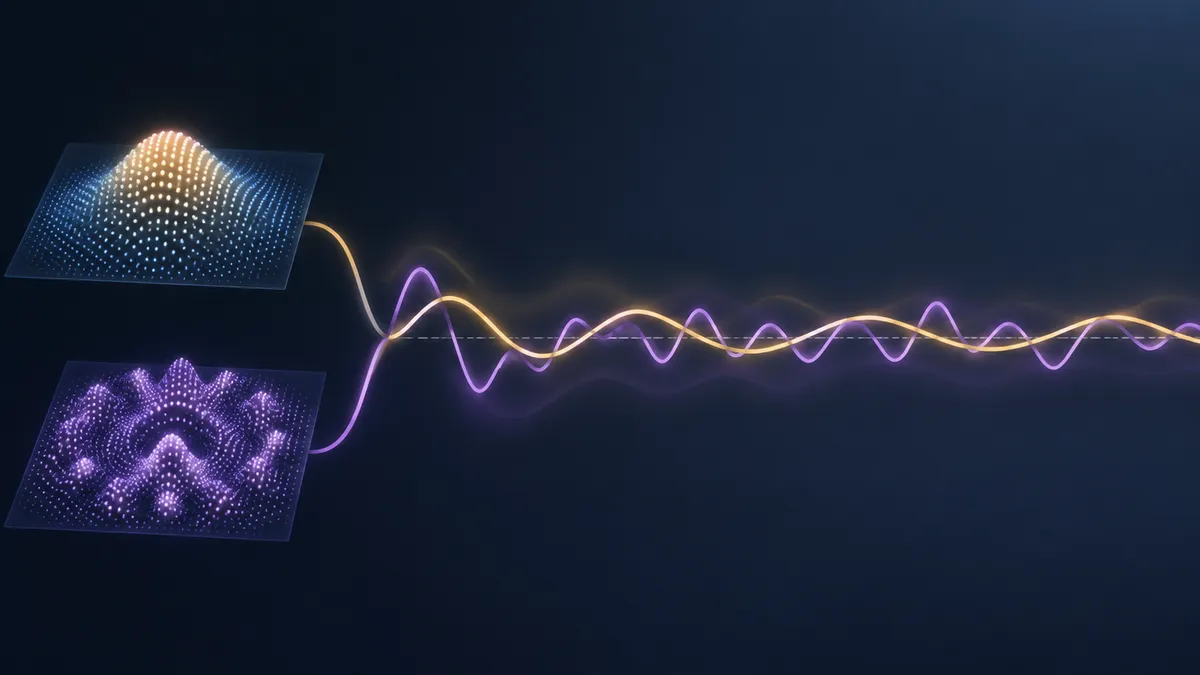
After a quantum system is suddenly made to evolve under new rules, the expectation value of an observable may settle near a long-time average while continuing to vary. A theoretical study asks whether those variations hold clues about the system’s starting state—and whether a property called non-Gaussianity helps explain their size.
A quantum system can settle toward a steady average without its observable expectation values becoming constant. Those values can continue to vary over time around their long-time average. These temporal fluctuations are not the same as random differences among individual measurement outcomes: the study tracks how calculated expectation values change during the system’s evolution. Could those changes reveal details that the long-time averages alone do not?
Julia Koczorowska, Lev Vidmar and Patrycja Łydżba investigate this question in a theoretical study of quadratic quantum systems. In such systems, the Hamiltonian—the mathematical description of energy and evolution—is quadratic in particle creation and annihilation operators. Their dynamics are often more tractable than those of interacting systems. After a sudden change, or “quench,” averages of simple observables may retain information about the initial state, as described by a generalized Gibbs ensemble. The authors ask whether that memory also appears in temporal fluctuations around the averages.
They characterize the initial state using an entropy-based measure of non-Gaussianity. It is calculated from the eigenvalues of the state’s one-body correlation matrix, and measures departure from a Gaussian state. In this setting, Gaussian states have a particularly simple structure; non-Gaussian states are not fully described by that structure.
The researchers numerically studied the quadratic Sachdev–Ye–Kitaev model, called SYK2, after a quench. They calculated the time-dependent expectation values of several one- and two-body observables and quantified their variation around long-time averages over a specified late-time window. The initial states included Gaussian states and non-Gaussian states, including eigenstates of an interacting SYK4 model. They also constructed families of initial states with different non-Gaussianity, enabling comparisons between that property and the size of the temporal fluctuations.
For several observables, the reported fluctuation size changed smoothly with the initial state’s non-Gaussianity. In the cases studied, fluctuations after Gaussian initial states decreased polynomially with system size, while those after typical non-Gaussian initial states decreased exponentially. The authors interpret this as evidence that non-Gaussianity helps explain the different scaling patterns and that initial-state information can persist in fluctuations as well as long-time averages. These are changes in expectation values over time—not claims about the spread of outcomes in a single measurement.
The relationship is not equally clear for every observable. The paper reports a smoother, more consistent connection for some two-body observables than for others. For other two-body observables, the relation depended on system size, and the authors could not establish a single size-independent curve. They note that larger systems might clarify whether one emerges, but that remains unresolved.
The findings also have limits. The central numerical tests concern one quadratic model, selected observables and particular families of initial states. The non-Gaussian comparisons reach system size 18; larger-size calculations for Gaussian states in the supplementary material do not remove that limit for the non-Gaussian cases. The results therefore do not show that the same relationship holds for every quadratic system or every quench, and the study does not report an experimental demonstration.
This work is an arXiv preprint and may not have undergone peer review. Its numerical results support a proposal about initial-state memory in the model studied, rather than a settled conclusion across quantum systems. The cautious takeaway is that non-Gaussianity may help predict how strongly certain observable expectation values continue to vary after a quench—and that tracking those variations may reveal information not apparent from their long-time averages alone.
- quantum dynamics
- non-Gaussianity
- temporal fluctuations
- quantum quench
- SYK2 model
- initial-state memory
Related reading
Automatically matched by shared topic keywords. These links do not imply that the sources agree or establish a consensus.