TRANSMISSION // 2611.14107v1
Why Two Gamma-Ray Components Sometimes Form Separate Peaks
Source published
A model study suggests that a cosmic-ray source’s surroundings may determine whether two gamma-ray components appear as separate peaks or blend together. The authors also calculate neutrino spectra as predictions for future observations—not as detections.
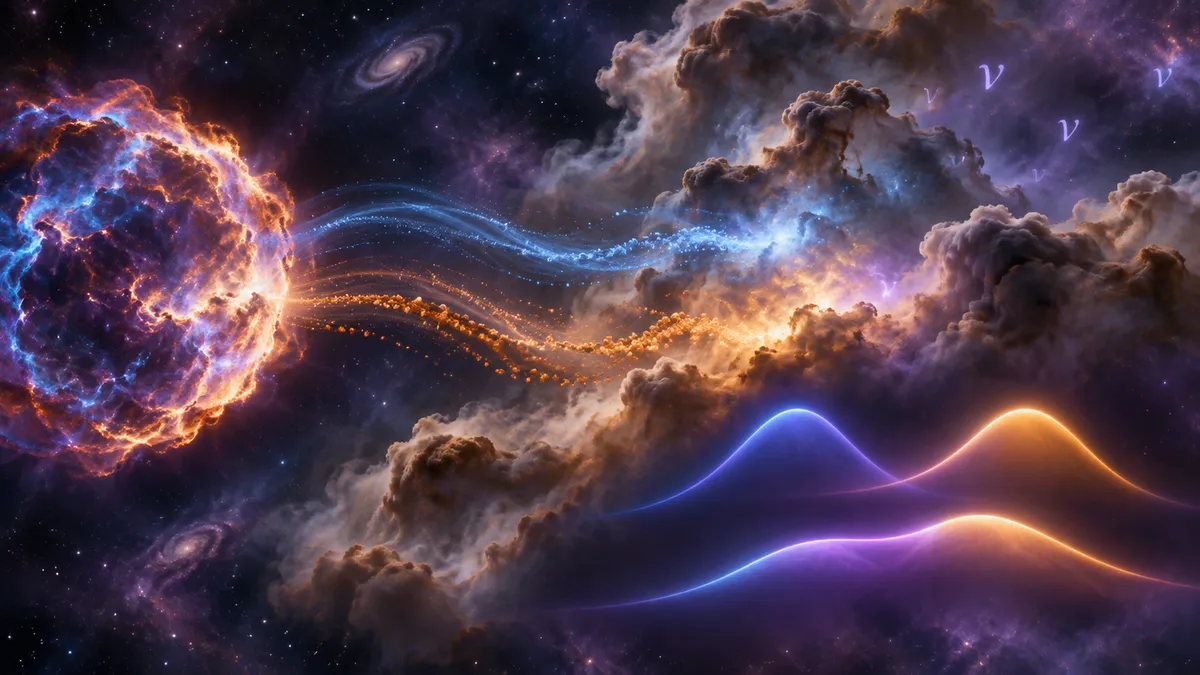
Some cosmic-ray sources emit gamma rays in spectra with two components. A new modeling study asks whether a shared physical picture can explain these features, and why they appear as distinct peaks in some cases but blend into a broad shoulder in others.
Two components, different origins
Cosmic rays are energetic particles that travel through the Galaxy. When they interact with gas, they can produce gamma rays and neutrinos. A spectrum with two components does not, on its own, reveal which particles produced the radiation or where those particles came from.
Lin Nie and colleagues examine a proposed explanation: one contribution comes from Galactic cosmic rays already present around a source; another comes from particles accelerated by the source itself. They ask whether this framework can describe gamma-ray spectra across a broader set of sources, and whether differences in the surroundings could explain why the components look distinct in some spectra but overlap in others.
Modeling particles and their surroundings
The researchers apply their model to sources with gamma-ray observations from experiments including LHAASO and Fermi-LAT. They use a Galactic cosmic-ray propagation model, implemented with GALPROP, to estimate background protons at each source. In the proposed picture, shocks can compress and reaccelerate these particles in nearby dense clouds. Interactions with gas then produce gamma rays through neutral-pion decay and neutrinos through the decay of charged particles.
A second population consists of particles accelerated by the source. Depending on the assumed environment, high-energy gamma rays from this population may come from electrons scattering background light—a process called inverse Compton emission—or from freshly accelerated protons interacting with gas. The researchers fit the model to measured gamma-ray data and use Markov chain Monte Carlo sampling to estimate parameter ranges. They also calculate neutrino spectra from proton–proton interactions. These are model predictions based on the proton component, not fits to detected neutrinos or simple conversions of the total gamma-ray flux.
How surroundings may shape the spectrum
In the model, sources in relatively low-density surroundings but near dense molecular clumps can have two clearly separated spectral peaks. Sources embedded in denser environments, with additional dense clumps nearby, can still have two underlying components, but the combined spectrum may be smoother. In that case, the higher-energy contribution can appear as a broad shoulder rather than a distinct second peak.
The authors interpret the lower-energy contribution mainly as gamma rays from background cosmic rays compressed and reaccelerated in dense gas. The origin of the higher-energy contribution depends on local conditions: it may be inverse Compton emission from freshly accelerated electrons, or emission from freshly accelerated protons interacting with gas.
W51C is an example of the model’s proton-dominated scenario. The authors assume that its high-energy gamma rays are dominated by freshly accelerated protons and predict a harder high-energy neutrino contribution in this case. Where electrons dominate the higher-energy gamma rays, the neutrinos calculated from proton interactions instead mainly trace the background-proton component. The actual detectability of these predicted signals remains uncertain and depends, among other factors, on source extension and detector sensitivity.
More broadly, the authors argue that their results lend support to a picture in which local sources contribute much of the high-energy cosmic-ray population, while lower-energy cosmic rays largely reflect the combined contributions of sources elsewhere in the Galaxy. This is an interpretation supported by the model’s fits, not a direct measurement of the origin of individual particles.
What remains uncertain
A model that fits observations is not necessarily the only explanation. The analysis relies on assumptions about source histories, gas densities, particle acceleration and transport, and whether electrons or protons dominate particular emissions. Gamma-ray spectra alone may not distinguish all these possibilities. The neutrino predictions also depend on the modeled proton population; they cannot be inferred simply by scaling the total gamma-ray flux.
The extracted manuscript includes a figure caption warning that convergence is unverified for some plotted neutrino uncertainty ranges. That is a reason for caution when interpreting those ranges. The paper also describes some additional spectral peaks as predictions that future observations may test, rather than established features in the data. These details make it important to distinguish observed spectra from model interpretations and forecasts.
The paper is a preprint prepared for submission to JCAP. Its claims should therefore be treated as a modeling proposal awaiting further scrutiny, not as settled conclusions. More gamma-ray data and future neutrino searches could test whether the proposed connections between particle origins, environments, and spectral shapes hold up.
- cosmic rays
- gamma-ray astronomy
- molecular clouds
- supernova remnants
- neutrinos
- particle acceleration
Related reading
Automatically matched by shared topic keywords. These links do not imply that the sources agree or establish a consensus.
W49B’s shocked clouds point to intense cosmic-ray ionization
Source published
Shared keywords: cosmic rays, molecular clouds, supernova remnants
Can cosmic rays gain a second boost behind a supernova shock?
Source published
Shared keywords: cosmic rays, supernova remnants
How ground-based telescopes are tracing the Universe’s most extreme particles
Source published
Shared keywords: cosmic rays, gamma ray astronomy
Gamma rays reveal differences in how galaxies retain cosmic rays
Source published
Shared keywords: cosmic rays, gamma ray astronomy
Dust maps offer a new way to estimate cosmic-ray scattering in a star-forming cloud
Source published
Shared keywords: cosmic rays, molecular clouds