TRANSMISSION // 2611.14077v1
How neutron-star tides could reveal the stars’ hidden vibrations
Source published
A theoretical study links detailed calculations of a neutron star’s response to a companion’s gravity with a simpler oscillator model. For one assumed model of dense matter, the oscillator model closely reproduces the calculated response, including resonances associated with stellar vibrations. The work also explores how tides enter binary dynamics, while noting that resonant effects still need fuller treatment.
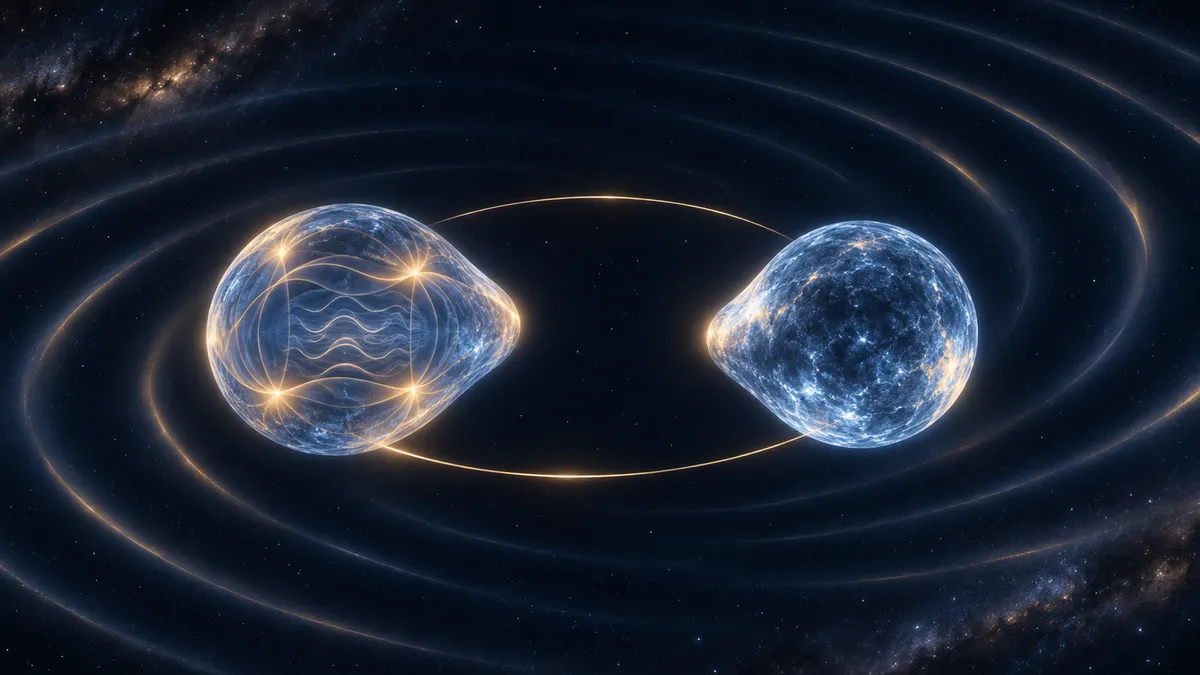
Neutron stars are not perfectly rigid. As two orbit one another, each star’s gravity pulls and deforms the other. That changing shape can carry clues about the star’s interior—and subtly affect the gravitational waves from the pair. A challenge is to describe this response in general relativity in a way that is both physically grounded and useful for calculations of binary motion.
A neutron star in a binary is continually tugged by its companion. Its response depends not only on how easily it deforms, but also on how the strength and frequency of the tug line up with the star’s natural vibrations. Those dynamic tides may encode information about matter under extreme conditions. The question for M. V. S. Saketh and colleagues is how to calculate this frequency-dependent response and represent it in a practical model of binary dynamics.
The team combines two kinds of theory. First, they use relativistic stellar perturbation theory: mathematical equations describing small disturbances to a model neutron star. They calculate how gravitational waves scatter from the star and compare the result with scattering from a black hole. The difference in scattering phase isolates the star’s tidal contribution.
Second, they connect this result to a worldline effective field theory, a framework that represents a compact star as a moving object with additional variables for its internal response. The researchers calculate gravitational corrections to the response through fourth post-Minkowskian order, an expansion in the strength of gravity. They then fit an effective model in which the star’s quadrupolar deformation behaves like a collection of relativistic harmonic oscillators. This model includes the fundamental oscillation, or f-mode, and low-frequency gravity modes, or g-modes. The latter are supported by buoyancy inside the star.
For the stellar calculations, the authors use the BSk22 equation of state, one particular model of how dense matter behaves, and examine stars with different masses within that model. They also incorporate the response into a post-Newtonian description of circular binary motion. Post-Newtonian calculations approximate general relativity in successive orders, making the equations more manageable in suitable regimes.
The central result is that the fitted oscillator model reproduces the full calculated response very closely for the cases studied. The paper reports agreement better than 0.015% over a stated frequency range for its 1.4-solar-mass BSk22 model. The response includes resonances associated with both g- and f-modes. This is a comparison between two theoretical descriptions of the same modeled star—not a measurement of a real neutron star or a demonstration that the model matches observed gravitational-wave data.
The authors also find that gravitational corrections beyond the leading order matter in fitting the response, particularly near the f-mode resonance. In their binary calculations, they examine equal-mass, circular systems using BSk22 stars. The calculated tidal interaction energy differs between first- and third-order post-Newtonian treatments by as much as 16% for the lighter modeled binary and 30% for the heavier one near contact. These are differences between approximation orders in a specific calculation, not estimates of an observed effect. In a separate, adiabatic calculation of the total tidal binding energy, the third-order result differs from the Newtonian result by about 66% and 75% for the two modeled systems near contact.
There are important qualifications. The response itself depends on a chosen renormalization scale; the authors emphasize that the response function alone is not an observable, although physical predictions should be independent of that arbitrary choice when quantities are combined consistently. The stellar results rely on one equation-of-state model, so they do not establish how the fitted mode parameters vary across possible neutron-star interiors.
The binary treatment is also incomplete near resonances. In the authors’ 3PN calculation, radiative effects that would give resonances a finite width are omitted. As a result, the response can diverge at resonance, and the authors exclude small regions around some mode crossings. Their binding-energy estimate uses an adiabatic approximation; a complete calculation without that approximation, including the g-mode contributions, remains future work. They also identify spinning stars, viscous dissipation, and incorporation into gravitational-wave waveform models as further steps.
The work therefore offers a method for connecting relativistic stellar calculations to a compact oscillator description—not a finished prediction for what detectors will observe. It is a preprint, and its conclusions should be read as theoretical results that have not necessarily undergone peer review. The source is arXiv:2611.14077v1.
- neutron stars
- dynamical tides
- gravitational waves
- stellar oscillations
- effective field theory
- general relativity
Related reading
Automatically matched by shared topic keywords. These links do not imply that the sources agree or establish a consensus.
How Neutron-Star Vibrations Shape Gravitational Waves
Source published
Shared keywords: dynamical tides, general relativity, gravitational waves, neutron stars, stellar oscillations
A single stellar vibration captures much of neutron stars’ tidal response
Source published
Shared keywords: dynamical tides, general relativity, gravitational waves, neutron stars, stellar oscillations
New method sorts newborn neutron stars’ vibrations by their physics
Source published
Shared keywords: gravitational waves, stellar oscillations
Neutron Star Tides Could Complicate Tests of Einstein’s Gravity
Source published
Shared keywords: general relativity, gravitational waves, neutron stars
Can a simpler star simulation recover tides in gravitational waves?
Source published
Shared keywords: general relativity, gravitational waves, neutron stars