TRANSMISSION // 2611.14023v1
A smaller physics model helps a neural network learn 50-qubit spin chains
Source published
A preprint uses the Jordan–Wigner transformation to shrink a neural-network calibration problem from exponentially many outputs to a quadratic number. Synthetic tests reach 50 qubits, but local frequency estimates need additional fitting, and the treatment of unwanted interactions remains approximate.
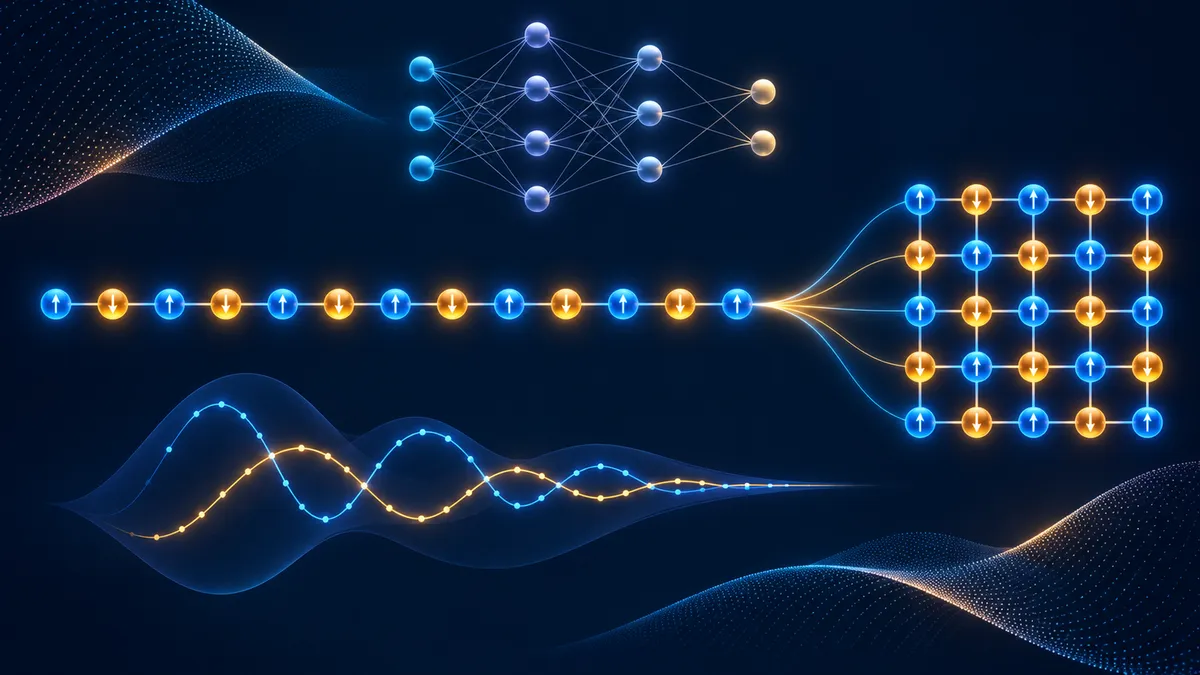
Learning how a quantum device actually behaves means working backwards from measurements to the interactions that produced them. A new preprint shows how choosing a smaller, physically appropriate description can make that task manageable for certain long chains of qubits.
Calibrating a quantum device requires more than knowing its intended design. The strengths of interactions between qubits, and the frequencies at which individual qubits evolve, determine what the device actually does. These quantities appear in its Hamiltonian: the mathematical description that generates its dynamics. Hamiltonian learning works backwards, using measured changes to infer those unknown parameters.
In a preprint, Gubio G. de Lima combines a physics-informed neural network with the Jordan–Wigner transformation to learn particular one-dimensional spin chains. The numerical demonstrations reach 50 qubits. The central advance is not a network that somehow compresses arbitrary quantum behaviour, but a reformulation that exploits the restricted physics of the chain.
Change the description before training
An inverse physics-informed neural network learns both a system’s evolving behaviour and the unknown parameters in its equations. Training penalizes disagreements with measured data and violations of the governing physics.
The difficulty is deciding what the network must represent. Describing an entire quantum density matrix, or all combinations of spin expectation values, requires a number of outputs that grows exponentially with the number of qubits. That quickly becomes impractical.
The paper considers an open chain in which neighbouring spins exchange excitations, with local longitudinal fields. The Jordan–Wigner transformation rewrites this spin model using fermionic operators. Without additional interactions, the equations for an N-by-N one-body density matrix close exactly: their evolution depends only on that smaller matrix.
Its diagonal entries describe occupations, while its off-diagonal entries describe coherences between sites. This is not the full many-qubit density matrix, but it contains enough information to predict the observables used here. The network therefore needs N squared real outputs rather than roughly four to the power N. At 50 qubits, that means 2,500 outputs.
What the network learns from
The simulations begin with alternating up and down spins. The network receives time as its input and predicts the smaller matrix. Its construction enforces the initial condition and Hermiticity, while training also penalizes violations of the equation of motion and excitation-number conservation.
The data comprise local magnetizations and two kinds of nearest-neighbour correlations, including spin currents. They can be collected using five global measurement settings, regardless of chain length. That is a statement about measurement configurations, not a claim that five experimental repetitions suffice: expectation values still require sampling at different times.
The different observables matter because magnetizations alone leave sign ambiguities. Correlations and currents provide additional distinguishing information. There is also an unavoidable reference choice: the dynamics cannot reveal a uniform shift of all local frequencies, so the first site’s frequency is fixed and the others are learned relative to it.
Strong coupling estimates, weaker frequency estimates
All reported learning tests use synthetic data. For the 50-qubit chain without measurement noise, the mean absolute percentage error in exchange couplings was 0.034%. The relative local frequencies were harder: their corresponding error reached 7.5%. Small errors in neighbouring frequency differences can accumulate into offsets across long sections of the chain.
A direct least-squares fit, initialized with the network’s estimates, improved the results. With added Gaussian noise of standard deviation 0.01, this combined procedure produced coupling and frequency errors of 0.047% and 0.71%, respectively, at 50 qubits. The network alone gave 0.15% and 14%.
The comparison also limits what can be claimed for machine learning. For this exactly solvable model, direct fitting was faster and more accurate when it converged. It became trapped in a local minimum in the reported 32-qubit case; starting from the network estimate avoided that failure. The evidence supports a complementary role for the network, not blanket superiority over conventional fitting.
Unwanted interactions narrow the guarantee
The paper also considers residual ZZ interactions, a form of crosstalk between neighbouring qubits. These break the exact closure. A time-dependent Hartree–Fock approximation restores a manageable equation by approximating higher-order correlations.
This extension was tested against exact eight-qubit spin simulations using noise-free data. Crosstalk-parameter errors rose from 0.97% to 4.1% as the tested interaction strength increased. The approximation is intended for weak crosstalk and moderate evolution times, not strongly interacting chains.
The work remains a preprint, with no experimental validation reported. Each configuration was trained once with a single random seed, so the results do not establish reliability across many devices or training runs. Its strongest lesson is nevertheless concrete: exploiting a model’s physical structure can remove an exponential representation bottleneck, while leaving optimization errors and approximation limits clearly visible.
- Hamiltonian learning
- physics-informed neural networks
- Jordan–Wigner transformation
- quantum calibration
- spin chains
- quantum crosstalk
Reviewed cross-references
These connections were reviewed by a model, not independently fact-checked by a human. Similarity does not imply agreement; consult the original papers and the evidence below.
Stretching coordinates helps neural networks learn sharp solution changes
Shared method: De Lima's PINNverse and Yu and Oseledets's CTPINNs both train neural solution representations using governing-equation residuals at collocation points. PINNverse uses a Jordan-Wigner reduction to a fermionic one-body density matrix for spin-chain Hamiltonian inference, whereas CTPINNs jointly learn coordinate transformations and PDE solutions to redistribute sharp gradients. The shared method is residual-based physics-informed training, not the transformation itself; these preprint excerpts do not establish that CTPINNs improve Hamiltonian inference.
Model review: · openai-codex/gpt-6.1-sol
Evidence and provenance
Selected excerpts, not complete papers. PDF extraction can omit figures or damage equations, tables and reading order; sources may be preprints.
2611.14023v1 — Original paper
Excerpt reference:
static/papers/2611.14023v1.md:12-74
Basis: Paper text
Source SHA-256:6e58196fafaf53f4a192dc3418dc5cbe8b269234810323b9af4ecdbf7f08cd782611.14023v1 — Original paper
Excerpt reference:
static/papers/2611.14023v1.md:75-140
Basis: Paper text
Source SHA-256:6e58196fafaf53f4a192dc3418dc5cbe8b269234810323b9af4ecdbf7f08cd782611.09053v1 — Original paper
Excerpt reference:
static/papers/2611.09053v1.md:70-150
Basis: Paper text
Source SHA-256:c6277b3ebc352d2be858590c31bca7be21b4bac1ec7a2e7afc81f852c3a6760d
Related reading
Automatically matched by shared topic keywords. These links do not imply that the sources agree or establish a consensus.
AI agents test quantum-spin predictions and flag a drifting signal
Source published
Shared keywords: quantum calibration
Stretching coordinates helps neural networks learn sharp solution changes
Source published
Shared keywords: physics informed neural networks
PINNeval asks physics-informed AI benchmarks to test the whole training pipeline
Source published
Shared keywords: physics informed neural networks
Can a language model build a neural network from physical laws?
Source published
Shared keywords: physics informed neural networks
Weaker end connections could improve quantum energy transfer
Source published
Shared keywords: spin chains