TRANSMISSION // 2611.14006v1
Can a quantum circuit be learned as a flowing probability cloud?
Source published
An arXiv preprint models quantum circuits using linked generative models on curved phase spaces. Its benchmarks show promising accuracy against neural-network alternatives, but higher training costs and limited tests leave broader scalability unresolved.
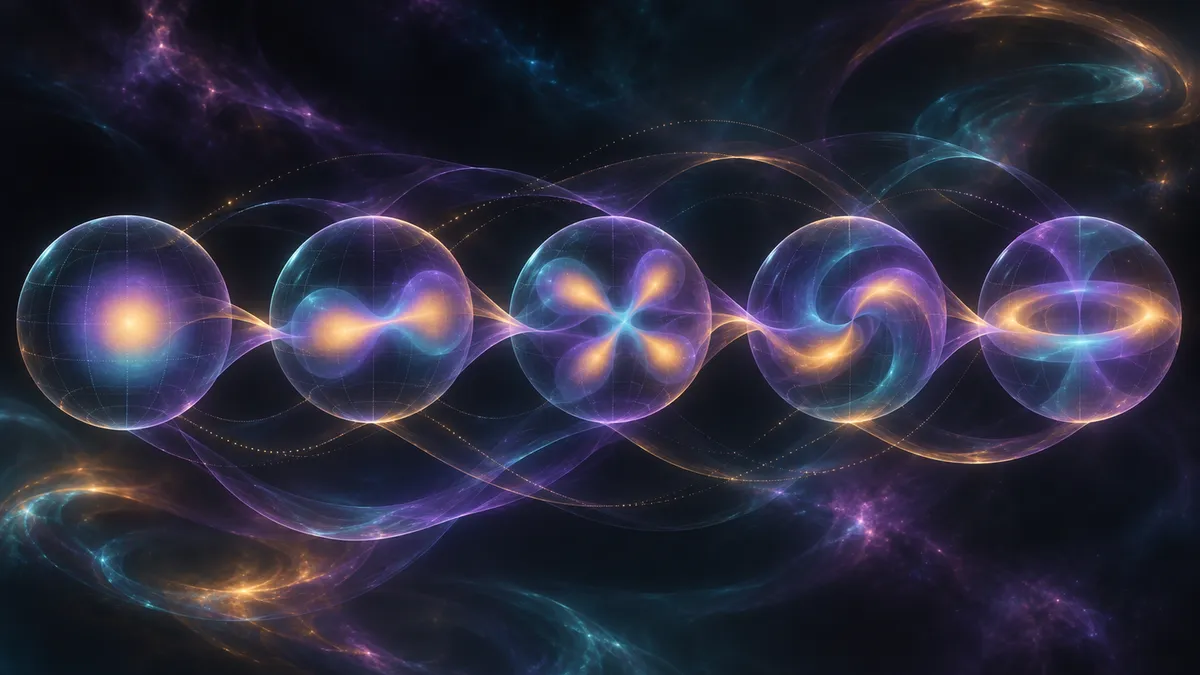
A quantum circuit changes a many-qubit state one gate at a time. What if a classical simulator could follow those changes by reshaping a probability cloud instead of tracking every quantum amplitude? Edward Jiang, Timothy Heightman and Marcin Płodzień explore that idea in a new preprint, using a machine-learning technique called normalizing flows.
A different place to keep a quantum state
Directly storing a general quantum state becomes exponentially more demanding as qubits are added. The researchers instead use a phase-space representation called the Q function: a positive probability distribution defined over a collection of spheres, one for each qubit.
Each sphere needs two angular coordinates, so an N-qubit system has a phase space with 2N dimensions. That sounds dramatically smaller than an exponentially long list of amplitudes, but it does not automatically make simulation easy. The probability distribution can still have complicated structure. The challenge moves from storing amplitudes to learning a sufficiently expressive distribution.
There is another catch. Although the Q function is positive, the mathematical kernel describing a quantum gate can contain negative values. It therefore cannot generally be treated as an ordinary probabilistic rule for moving samples around.
The proposed workaround is to learn a transformation between the distributions before and after each gate.
One flow per gate
A normalizing flow reshapes a starting probability distribution through an invertible transformation, while keeping track of how its density changes. Here, those transformations operate on the qubits’ spherical phase space.
The simulator starts with all qubits in the zero state, whose Q function is easy to sample and evaluate exactly. It then attaches a trainable flow to each circuit gate. Composing the flows produces an approximation to the final state's distribution.
The implementation uses continuous normalizing flows, with multilayer neural networks specifying how points move. Training first proceeds gate by gate for stability, followed by joint fine-tuning. The objective compares each learned distribution with the distribution obtained by applying the corresponding gate kernel to the preceding approximation.
Importantly, the authors say exact Q functions are used for evaluation, not training. Their training procedure relies on the learned distributions and the known gate kernels, with Monte Carlo estimates of the objective.
What the benchmarks show
The preprint tests three circuit families: preparation of one-dimensional cluster states, preparation of Greenberger–Horne–Zeilinger, or GHZ, states, and a 10-qubit variational circuit for preparing a transverse-field Ising model ground state at its critical point.
For cluster states, the flow model reaches a classical fidelity of approximately 0.96 at 64 qubits. The reported comparison values are approximately 0.91 for a transformer-based probabilistic method and 0.84 for a neural quantum-state method, both at 60 qubits.
For GHZ preparation, the authors report approximately 0.965 for their method, compared with 0.95 and 0.96 for the two alternatives. In the Ising-model circuit, the flow model finishes at approximately 0.985, compared with 0.965 for the transformer baseline. Its fidelity falls roughly linearly across that experiment, by about 0.0003 per gate.
These figures measure classical fidelity between probability distributions, not quantum-state fidelity. They should not be read as a percentage of quantum gates simulated correctly. The transformer comparison also uses a different probabilistic representation, and its benchmark values are taken from earlier work rather than generated in a shared training run.
Accuracy has a computational price
The comparisons are explicitly not compute-matched. Every additional gate adds another flow and more parameters. Training later flows requires evaluating distributions through earlier transformations, giving the proposed method a total training cost that the paper describes as quadratic in gate count. The baseline neural methods instead repeatedly retrain a fixed-size model, with total cost described as linear in gate count.
The benchmark circuits also limit what can be concluded. GHZ and cluster preparation have Clifford structure, which permits efficient specialized classical simulation. The flow method does not exploit that structure, but success on those examples is not evidence of an advantage over the best classical simulators. The non-Clifford variational example involves only 10 qubits.
Finally, a learned flow is not generally a reusable implementation of an entangling gate. Its transformation depends on the incoming distribution; a different input can require retraining. Single-qubit gates are a useful exception, admitting exact sphere rotations independent of the input state.
This arXiv preprint offers a promising representation, not a general solution to quantum simulation. The authors identify harder dynamical circuits and noisy evolution as future benchmarks. The central question is whether these flowing probability clouds can remain accurate when both circuit complexity and the cost of training them increase.
- quantum circuit simulation
- normalizing flows
- phase space
- Q function
- generative models
- neural quantum states
- classical fidelity
Related reading
Automatically matched by shared topic keywords. These links do not imply that the sources agree or establish a consensus.
Delaying data transfers speeds up quantum circuit simulations on GPUs
Source published
Shared keywords: quantum circuit simulation
A discrete-time bridge between deterministic diffusion and flow matching
Source published
Shared keywords: generative models
Quantum-derived inputs reshape a malware detector, with no clear final detection edge over a dimension-matched Gaussian model
Source published
Shared keywords: generative models