TRANSMISSION // 2611.13967v1
Uneven ion spacing changes how a quantum of vibration travels
Source published
An experiment with ten trapped calcium ions shows how uneven spacing shapes the spread of a single vibrational excitation. Starting near the chain’s edge produces partial refocusing at the opposite end; starting near its center produces a spreading pattern consistent with a quantum walk. Simulations reproduce the main features when they include motion during the laser-control pulses.
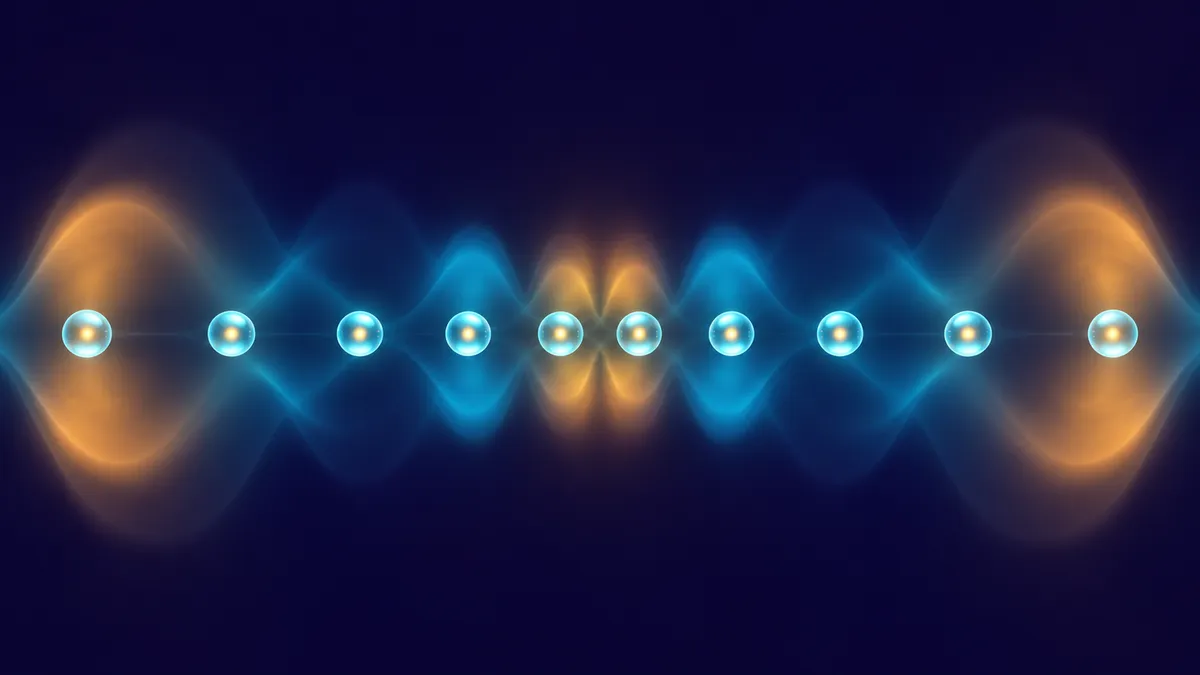
A quantum of vibration can travel along a row of trapped ions without the ions themselves changing places. A new preprint from Takumi Yuri, Yu-Xuan Chen and Kenji Toyoda at the University of Osaka investigates how that journey depends on where it begins. Their ten-ion experiment turns a common feature of ion traps—uneven spacing—into a way to explore different kinds of quantum transport within the same device.
One excitation, ten possible locations
A phonon is a quantum of vibrational excitation. In this experiment, it describes a small amount of motion perpendicular to a chain of trapped ions. Electric repulsion couples the ions’ vibrations, allowing an excitation prepared at one ion to spread to others. The ions remain near their equilibrium positions; it is the excitation that travels.
Such systems can act as quantum simulators: controllable devices that reproduce the dynamics of a chosen physical model. Here, the researchers studied single-excitation transport, rather than a many-particle system or a quantum computation.
Their arXiv preprint, submitted on November 10, 2026, reports measurements on ten calcium ions held in a linear Paul trap.
Why the gaps matter
The trap confines the chain along its length with a harmonic potential. Combined with the ions’ mutual repulsion, this produces closer spacing near the center and wider gaps near the ends. The measured neighboring-ion separations ranged from approximately 16 micrometers in the center to 22 micrometers at the edges.
Those differences affect transport in two ways. They change how readily an excitation transfers between ions, and they shift each ion’s local vibrational frequency. The coupling falls with the inverse cube of separation, making nearby ions the strongest partners.
A frequency mismatch can suppress transfer even between neighbors. Near the center, coupling is strong enough relative to those mismatches to support substantial neighboring-site exchange. At the edges, the mismatch with the next ion is more restrictive. The starting position therefore selects a different balance between coupling and frequency differences.
Preparing and reading the vibration
The team used ten individually controlled laser beams, one for each ion. After cooling the radial motion close to its ground state, they applied laser pulses to prepare one local vibrational excitation at a selected site. They then switched off the lasers for an adjustable interval, allowing the coupled vibrations to evolve.
To read the result, another set of pulses mapped vibrational excitation onto the ions’ internal electronic states. Fluorescence detection then distinguished those states at each site.
Repeating the sequence at different evolution times built up a picture of the excitation’s distribution. These measurements are not a continuous recording of one phonon following a definite route through the chain.
Three starting points, different patterns
When preparation targeted Ion 1, at an end of the chain, the excitation spread across other sites and partially refocused at Ion 10 after roughly 200 microseconds. Population later refocused at the starting end. Neither concentration was complete: some excitation remained distributed elsewhere.
The authors interpret this behavior through the combination of suppressed neighboring-site exchange at the edges and matching local frequencies at the two ends. It is not evidence that the excitation bypasses the intervening system.
Starting at Ion 3 produced an intermediate pattern, with population splitting among several regions. Starting at Ion 6, near the center, distributed excitation across much of the chain relatively quickly. Simulations showed alternating regions of high and low probability characteristic of a continuous-time quantum walk. A less distinct version appeared in the experimental measurements.
The control pulses are part of the dynamics
Preparation and readout were not instantaneous. The relevant sideband pulses lasted about 35 microseconds, long enough for appreciable hopping to occur during the operations, especially near the chain’s center.
Simulations that included these finite pulse durations generally reproduced the measurements, including early-time features missed by an idealized treatment. This matters because the measured pattern reflects both free evolution and the operations used to prepare and detect it.
Residual differences remain. The authors identify imperfect cooling, preparation, laser control and readout as possible contributors. They measured heating of about 0.029 vibrational quanta per millisecond and argue that heating was not a major limitation over their longest, one-millisecond propagation interval.
The demonstrated dynamics remain within an effectively single-particle model. Multiple excitations and interacting spin–vibration systems are proposed extensions, not results of this experiment. Reaching them would require more demanding preparation and detection, alongside stable trapping, cooling and individual control of larger ion chains.
- trapped ions
- phonons
- quantum transport
- quantum walks
- quantum simulation
- vibrational excitation
Reviewed cross-references
These connections were reviewed by a model, not independently fact-checked by a human. Similarity does not imply agreement; consult the original papers and the evidence below.
Compressed quantum circuits reproduce tunneling on two processor types
Shared method: Yuri et al. describe single-phonon propagation using an effective single-particle hopping Hamiltonian; Hanada et al. represent a discretized coordinate by one excitation whose location labels a grid site, with hopping implementing the kinetic term. Both use a site-basis single-excitation representation of dynamics, but physical phonon sites and digitally encoded coordinate sites are different realizations. The supplied preprint excerpts do not establish that the unary circuit-compression result applies to the ion-chain experiment.
Model review: · openai-codex/gpt-6.1-sol
Evidence and provenance
Selected excerpts, not complete papers. PDF extraction can omit figures or damage equations, tables and reading order; sources may be preprints.
2611.13967v1 — Original paper
Excerpt reference:
static/papers/2611.13967v1.md:1464-1527
Basis: Paper text
Source SHA-256:9251b7af876ff783b1507c9263bfe0224a13a4a2d539fa977c4b7c07b46c60e62611.13079v1 — Original paper
Excerpt reference:
static/papers/2611.13079v1.md:120-157
Basis: Paper text
Source SHA-256:06ca265f9d0be114ac25d507b89647d898cbb88c81e78d53a98640c35bdce35d2611.13079v1 — Original paper
Excerpt reference:
static/papers/2611.13079v1.md:2861-2903
Basis: Paper text
Source SHA-256:06ca265f9d0be114ac25d507b89647d898cbb88c81e78d53a98640c35bdce35d
Reading a quantum network depends on how you look
Shared method: Yuri et al. prepare a localized phonon, measure its propagation site by site and describe the single-phonon dynamics with a single-particle hopping Hamiltonian; Popovic et al. use coherent continuous-time quantum walks and position measurements to infer network couplings. The common method is site-basis coherent-hopping evolution with position-resolved observation. Popovic et al.'s analytical estimation results assume circulant networks with translational symmetry, unlike the nonuniform harmonically confined ion chain, so these preprint excerpts do not justify transferring those precision bounds to the experiment.
Model review: · openai-codex/gpt-6.1-sol
Evidence and provenance
Selected excerpts, not complete papers. PDF extraction can omit figures or damage equations, tables and reading order; sources may be preprints.
2611.13967v1 — Original paper
Excerpt reference:
static/papers/2611.13967v1.md:70-132
Basis: Paper text
Source SHA-256:9251b7af876ff783b1507c9263bfe0224a13a4a2d539fa977c4b7c07b46c60e62611.13967v1 — Original paper
Excerpt reference:
static/papers/2611.13967v1.md:1464-1527
Basis: Paper text
Source SHA-256:9251b7af876ff783b1507c9263bfe0224a13a4a2d539fa977c4b7c07b46c60e62611.13948v1 — Original paper
Excerpt reference:
static/papers/2611.13948v1.md:74-207
Basis: Paper text
Source SHA-256:7f8ff0bb5b5a0b4687c37933672e0c4e4cb657b92dfc40a109e064a6ca80dac22611.13948v1 — Original paper
Excerpt reference:
static/papers/2611.13948v1.md:3588-3641
Basis: Paper text
Source SHA-256:7f8ff0bb5b5a0b4687c37933672e0c4e4cb657b92dfc40a109e064a6ca80dac2
Related reading
Automatically matched by shared topic keywords. These links do not imply that the sources agree or establish a consensus.
Reading a quantum network depends on how you look
Source published
Shared keywords: quantum walks
Simulating quantum noise by enlarging the quantum system
Source published
Shared keywords: quantum simulation
Compressed quantum circuits reproduce tunneling on two processor types
Source published
Shared keywords: quantum simulation
A framework for tracking grid errors in quantum field simulations
Source published
Shared keywords: quantum simulation
A better boundary for simulating quantum systems and their surroundings
Source published
Shared keywords: quantum simulation