TRANSMISSION // 2611.13951v1
A galaxy’s gas tail offers clues to its journey through Virgo
Source published
A new reconstruction uses glowing gas trailing NGC 4569 to infer its recent journey through the Virgo cluster. The favoured interpretation places its strongest encounter with the cluster’s hot gas about 163 million years ago. But uncertainty over the galaxy’s distance leaves competing orbital histories, and the result depends on a simplified model of the tail.
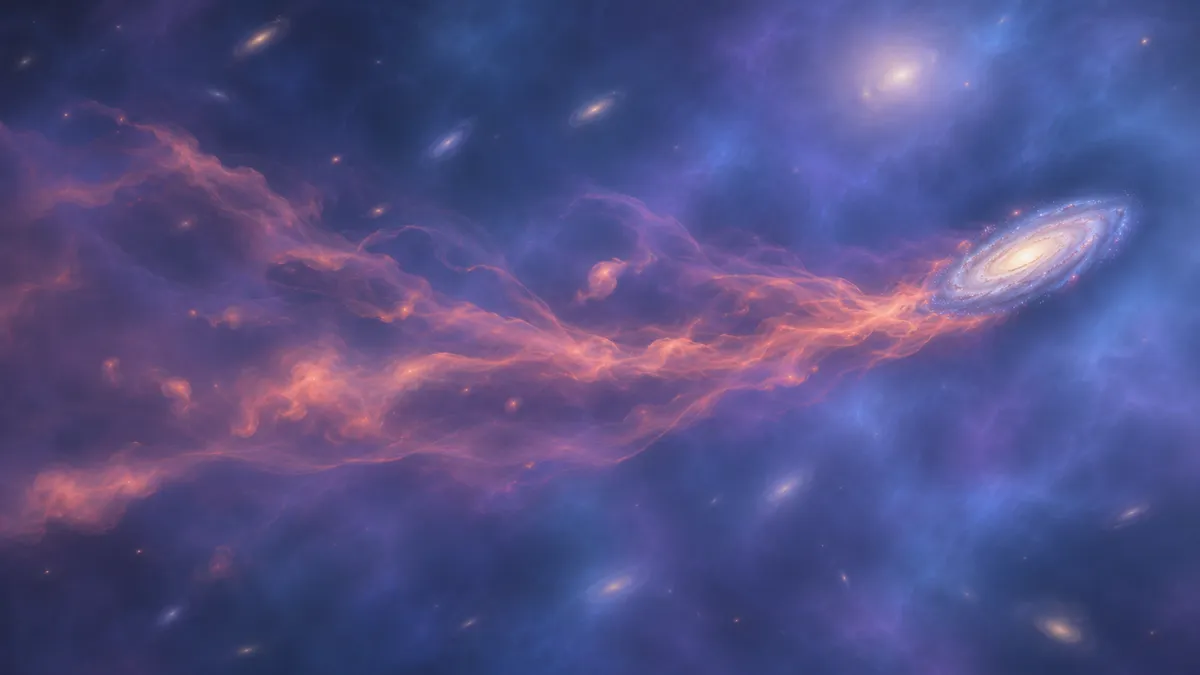
A galaxy can leave part of its history behind in the gas it loses. For NGC 4569, a spiral in the Virgo cluster, that record stretches across an enormous glowing tail. Researchers have used the positions and velocities of emitting regions to reconstruct a possible recent orbit—and investigate when the galaxy experienced the pressure that stripped away its gas.
NGC 4569 has an extended tail of ionised gas: gas whose atoms have lost electrons. Observations trace its faint emission to a projected distance of roughly 230 kiloparsecs, about 750,000 light-years. A new preprint uses that structure to reconstruct the galaxy’s recent motion through the Virgo cluster, finding evidence that its most intense encounter with the cluster’s hot gas is already behind it.
That conclusion is conditional, however. The same tail measurements can fit substantially different histories depending on the assumed distance to the galaxy. The researchers favour the past-encounter interpretation because it better explains the gas already missing from NGC 4569’s disc—not because the tail alone selects a unique orbit.
Why a galaxy leaves a gas tail
Galaxy clusters contain a thin, hot atmosphere called the intracluster medium. A galaxy moving through it experiences ram pressure, which increases with the surrounding gas density and the square of the galaxy’s relative speed. When that pressure overcomes the gravitational force holding gas in the galaxy, it can push material out of the disc.
Removing gas also removes fuel for future star formation. Understanding when and where stripping occurred therefore helps explain how a cluster environment changes its galaxies.
The new study asks whether stripped gas can serve as a record of that journey. It uses sky positions and line-of-sight velocities—motion towards or away from us—for 94 regions emitting H-alpha, a characteristic wavelength of hydrogen. These regions trace the galaxy and its tail, with a coherent velocity trend along the extended structure.
Working backwards from the wake
The researchers introduce ORFEO, short for Orbits Reconstruction For Emitting Objects. Instead of prescribing an encounter and simulating its consequences in detail, the method searches for a galaxy trajectory whose model gas tail matches the observations.
The calculation combines a spherical model of Virgo Cluster A’s gravitational field, inferred from member-galaxy motions, with a hot-gas density profile based on X-ray observations. For each assumed galaxy distance, it adjusts the two velocity components across the sky that cannot be measured directly from the spectra.
Model gas parcels begin at different points in the galaxy’s past journey and then lag behind under drag. Crucially, they are confined to the reconstructed orbital path. This describes the tail’s broad position and velocity pattern rather than its individual filaments or full three-dimensional gas physics.
At the reference distance of 16.5 megaparsecs, roughly 54 million light-years, the fitted tail has a dynamical age of 250 million years, with reported uncertainties extending 19 million years lower and 37 million years higher.
This is not the time for which the gas has been glowing, nor necessarily when stripping first began. It is the oldest model age assigned to the observed emitting regions; older material could be undetected.
The same reconstruction places peak ram pressure about 163 million years ago, with an uncertainty range of approximately 152–178 million years ago. The galaxy’s closest approach to the cluster centre was about 305 kiloparsecs. Its inferred motion across the sky is predominantly west to east.
Distance changes the story
Repeating the reconstruction at distances between 15.0 and 18.5 megaparsecs produces two families of solutions with broadly comparable fits to the tail.
At lower distances, the galaxy has already passed its pressure maximum. At higher distances, that maximum lies in the future. The transition occurs around 16.8–17.1 megaparsecs. Published distance estimates discussed in the paper do not settle which family is correct.
To distinguish them, the team estimates the pressure needed to remove gas at the observed outer edge of the remaining gas disc. The lower-distance histories more naturally supply sufficient pressure in the past while leaving the present pressure too weak to strip that remaining disc. A future pressure peak cannot explain truncation that has already happened.
This favours a post-stripping interpretation, but does not turn the calculation into a precise distance measurement.
A useful reconstruction, not a complete simulation
ORFEO neglects disc rotation, the galaxy’s gravitational pull on released gas, sideways gas motions and bulk flows in the cluster atmosphere. Its quoted reconstruction uncertainties do not include all systematic effects from the assumed cluster, atmosphere and tail models.
The work is a preprint, and its findings remain provisional. Its practical attraction is speed: the authors report roughly 10–11 minutes of computation for NGC 4569. Such reconstructions could guide more detailed simulations, provided their simplified treatment of gas tails is tested across a wider range of systems.
- NGC 4569
- Virgo cluster
- ram-pressure stripping
- galaxy evolution
- ionised gas tails
- ORFEO
- orbital reconstruction
Related reading
Automatically matched by shared topic keywords. These links do not imply that the sources agree or establish a consensus.
Gas stripping leaves galaxy discs’ stellar spin largely intact
Source published
Shared keywords: galaxy evolution, ram pressure stripping
How JWST Could Trace the Seeds of the First Massive Black Holes
Source published
Shared keywords: galaxy evolution
Cluster galaxies show a subtle nitrogen–oxygen abundance offset
Source published
Shared keywords: galaxy evolution
Distant galaxy lenses offer a new sample for studying cosmic evolution
Source published
Shared keywords: galaxy evolution
ALMA measures dust in less metal-rich galaxies at cosmic noon
Source published
Shared keywords: galaxy evolution