TRANSMISSION // 2611.13948v1
Reading a quantum network depends on how you look
Source published
A theoretical preprint calculates how accurately a quantum walker could reveal interaction strengths in symmetric networks. Carefully prepared probes improve the ideal precision limit, but limited detector resolution can erase that advantage—and sometimes erase all information about the couplings.
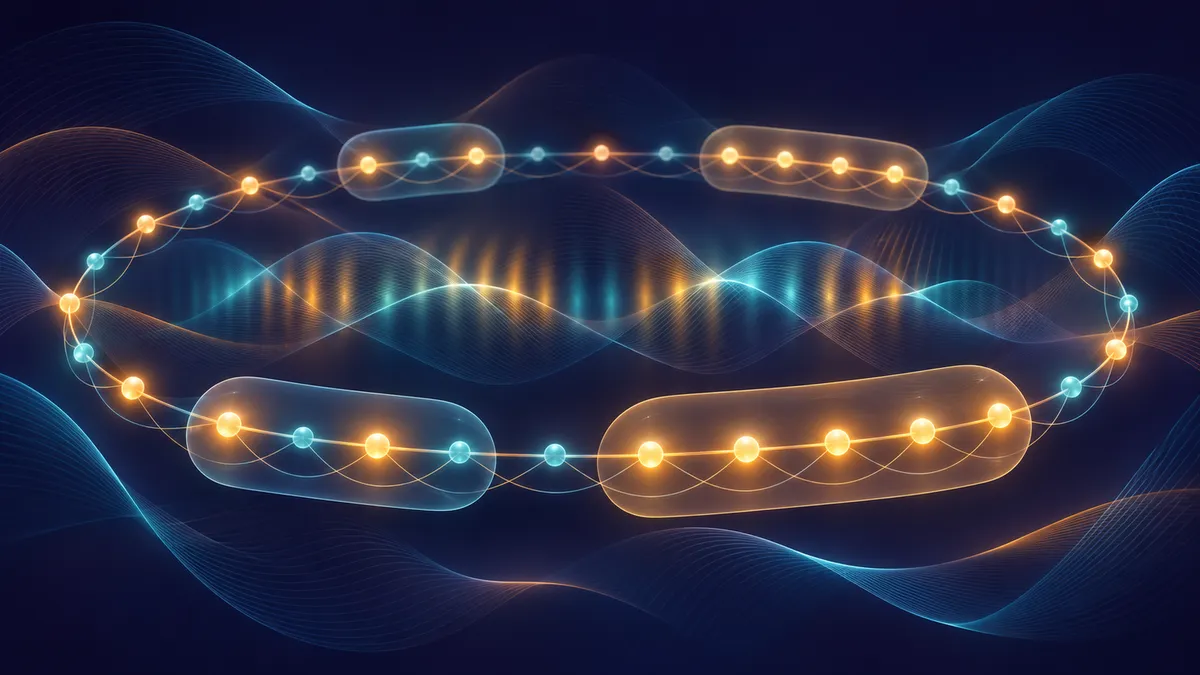
To characterize a quantum network, researchers can let an excitation spread through it and examine where it appears. The spreading pattern carries clues about the connections between sites. But which clues survive depends on both the excitation’s starting state and the detector. A new theoretical study shows how these choices interact, including cases where a supposedly optimal probe becomes useless when neighbouring sites are measured together.
Maria Popovic, Silvia Cassina, Ilaria Gianani and Claudia Benedetti investigate this problem in a preprint posted to arXiv on November 10. Their subject is a continuous-time quantum walk: coherent quantum propagation across connected sites, rather than a particle following one definite route. The study combines analytical calculations with numerical optimization and simulations; it does not report a laboratory demonstration.
The networks have a special repeating structure called circulant symmetry. Imagine sites arranged around a ring, with the same interaction strength between every pair separated by a given number of steps. Nearest neighbours share one coupling strength, second neighbours another, and so on. The unknowns are these distance-dependent strengths—not a separate value for every connection or an arbitrary unknown network layout.
That symmetry makes the calculation manageable. The researchers express the walker’s state in collective wave patterns extending around the network. They then derive its quantum Fisher information matrix, a mathematical description of how sensitively the state responds to changes in several couplings. From this they calculate a quantum Cramér–Rao bound: a lower limit on the combined estimation variance across repeated measurements.
Estimating several quantities at once can create conflicting measurement requirements. In this model, the mathematical operators associated with the different couplings commute. For the pure states considered, that satisfies the compatibility condition needed to attain the quantum bound locally. It does not mean that any detector or starting state reaches the limit, or that finite experimental data automatically deliver it.
Probe preparation matters. Starting the walker at one site gives a particularly simple result: apart from a special complete-network case, the bound on total variance grows exactly linearly with the number of unknown coupling strengths. Numerically optimized probes also show approximately linear growth in the examples studied, but the authors do not provide a general closed-form result for their optimum.
For a closer comparison, the paper concentrates on estimating two strengths: nearest-neighbour and second-neighbour couplings. Numerical optimization identifies families of starting states combining selected collective wave patterns. Their details depend on the number of sites modulo four, although their precision limits converge as networks become large.
In the paper’s time convention, the optimized large-network bound approaches 0.1636 divided by the squared evolution time. A walker initially confined to one site gives 0.25 divided by the squared time for networks larger than four sites. These numbers describe ideal limits on the sum of the two estimation variances, multiplied by the number of repetitions—not measured errors from an experiment.
The next question is whether simply detecting the walker’s position can exploit that sensitivity. The answer depends on timing. Position-measurement performance oscillates, and a state optimized for the ultimate quantum bound does not necessarily make this accessible measurement optimal. The authors compare the two bounds and examine measurement times within a finite window. Being close to the quantum limit at a very early time can still mean poor absolute precision, because both bounds remain large.
Limited spatial resolution introduces another obstacle. The researchers model detectors that report which equal-sized cluster of adjacent sites contains the walker, without distinguishing sites inside it. For the analyzed optimal probes on networks whose size is a multiple of four, grouping sites into clusters also divisible by four cancels the informative spatial pattern. Every cluster then has a coupling-independent probability: the detector learns nothing about either strength.
Localized probes remain useful in other coarse-grained settings. Surprisingly, larger clusters sometimes produce a better variance bound than smaller clusters. In simulations involving 105 sites and 10,000 coupling configurations, the probability of beating at least one finer coarse-grained scheme reaches roughly 40% in some cases. This never beats fully resolved position detection. Different cluster sizes can place boundaries differently; the finding is not a general benefit from discarding information.
The practical message is to design the probe and readout together. Its reach remains limited by the assumptions: exact circulant symmetry, real symmetric couplings, uniform site energies and noiseless pure-state evolution. Less symmetric networks and decoherence are proposed extensions, not demonstrated capabilities.
- quantum networks
- quantum walks
- multiparameter estimation
- quantum Fisher information
- detector resolution
- circulant graphs
Reviewed cross-references
These connections were reviewed by a model, not independently fact-checked by a human. Similarity does not imply agreement; consult the original papers and the evidence below.
Quantum sensing proposal aims to stop gravitational-wave signals cancelling out
Shared method: Popovic et al. and He et al. both derive a multiparameter quantum Fisher information matrix to optimize joint estimation and compare quantum precision bounds with the classical Fisher information of specified readouts. Popovic et al. study circulant-network couplings with walker-position measurements; He et al. study gravitational-wave polarization amplitudes with optical readout. This is a shared estimation method, not independent confirmation of either result; the different systems and resources preclude directly equating their precision scalings, and the supplied evidence is from preprints.
Model review: · openai-codex/gpt-6.1-sol
Evidence and provenance
Selected excerpts, not complete papers. PDF extraction can omit figures or damage equations, tables and reading order; sources may be preprints.
2611.13948v1 — Original paper
Excerpt reference:
static/papers/2611.13948v1.md:3588-3641
Basis: Paper text
Source SHA-256:7f8ff0bb5b5a0b4687c37933672e0c4e4cb657b92dfc40a109e064a6ca80dac22611.11157v1 — Original paper
Excerpt reference:
static/papers/2611.11157v1.md:1678-1740
Basis: Paper text
Source SHA-256:cf6d4a82280168a9a625392860690c5a7f892660267d3757b674e6035c645f96
Related reading
Automatically matched by shared topic keywords. These links do not imply that the sources agree or establish a consensus.
Quantum sensing proposal aims to stop gravitational-wave signals cancelling out
Source published
Shared keywords: quantum fisher information
When a quantum sensing limit depends on the model
Source published
Shared keywords: quantum fisher information
Uneven ion spacing changes how a quantum of vibration travels
Source published
Shared keywords: quantum walks
Choosing the next link can help quantum networks connect sooner
Source published
Shared keywords: quantum networks
Circular gratings guide photons from telecom quantum dots
Source published
Shared keywords: quantum networks