TRANSMISSION // 2611.13866v1
What Switzerland gains from trading electricity with its neighbours
Source published
A modelling preprint estimates that cross-border electricity trade could benefit Switzerland by about €1.5 billion in 2040 compared with complete isolation. Consumers gain from lower wholesale prices, while domestic producers earn less. A separate €7 billion GDP-equivalent calculation is illustrative, not a causal forecast or an additional welfare benefit.
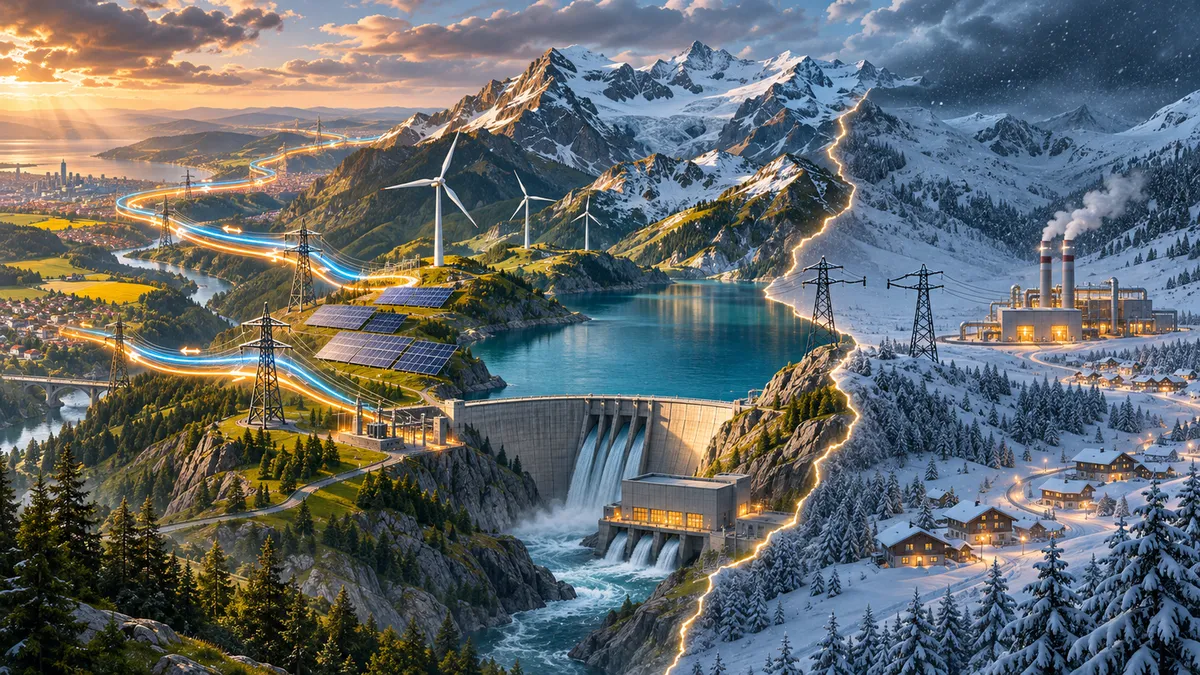
Switzerland can export more electricity than it imports over a year and still depend on its neighbours during winter. A new study explores the economic consequences of replacing that seasonal exchange with an entirely self-sufficient electricity system.
An annual surplus can hide a winter gap
Electricity independence is not simply a question of producing enough power over a whole year. Supply must also meet demand when it is needed. According to the paper, Switzerland averaged net electricity exports of 1.7 terawatt-hours annually over 2015–2025, but net winter imports averaged 4.2 terawatt-hours.
That seasonal mismatch motivates a study by Benjamin Lietti and colleagues comparing two possible Swiss electricity systems in 2040: one with expanded cross-border trading capacity, and another with no electricity exchange at all. Their arXiv preprint presents a model-based comparison, not an observed experiment or an established prediction.
Building two systems with comparable security
The researchers first use two models within the Nexus-e framework to determine what infrastructure each scenario needs. CentIv selects cost-efficient generation and storage investments and their operation. Cascades assesses cascading failures and identifies transmission upgrades needed to reach a reference level of supply security.
This matters because the comparison does not simply disconnect Switzerland and count the resulting shortages. Each scenario receives infrastructure intended to achieve comparable security of supply.
Both must also meet a renewable generation target of 39.2 terawatt-hours in 2040. Demand and developments in neighbouring electricity systems are specified through projections. Under isolation—called autarky—the capacity available for cross-border exchange is set to zero.
The resulting infrastructure configurations feed into BKW’s LPP power-market model. It simulates hourly generation and wholesale prices using demand profiles, weather conditions, fuel and carbon prices, and technical constraints such as reservoir storage and power-plant operating limits.
Isolation needs more gas and grid upgrades
Both scenarios require substantial wind and solar expansion. The clearest additional requirement under isolation is 1.7 gigawatts of gas-fired generation. The isolated system also needs upgrades to 14 transmission lines, compared with five under trade.
Trade provides access to electricity generated elsewhere when domestic resources are insufficient. It also offers an outlet for surplus production. Without exports, the model produces more solar curtailment: available generation that cannot be used and is therefore reduced.
Isolation does not make electricity more expensive at every moment. During some summer periods, abundant domestic renewable supply produces lower prices. Across the year, however, these periods do not offset the cost of losing access to cheaper foreign generation.
The load-weighted average wholesale price rises from €73 per megawatt-hour under trade to €111.5 under isolation, an increase of 53%. Price volatility also increases. These are wholesale prices, not complete household bills: network charges, taxes and retail pricing arrangements are not represented in those figures.
Consumers gain more than producers lose
For its direct electricity-market calculation, the study holds hourly demand identical across scenarios. It measures consumers’ savings, producers’ revenues above marginal production costs, and annualised infrastructure investment differences.
Trade benefits consumers by approximately €3.2 billion in 2040, while reducing domestic producer surplus by approximately €1.8 billion. Lower generation and grid investment requirements contribute a further €118 million. The net estimated welfare gain is €1.481 billion, expressed in constant 2024 euros.
Much of the consumer benefit therefore reflects redistribution from producers, which the paper describes as largely publicly owned. The €3.2 billion consumer gain is not itself the net benefit to Switzerland.
The result depends on assumptions. Alternative fuel and carbon prices retain trade’s advantage but change its magnitude substantially: the tested welfare gains range from approximately €1.1 billion to €1.9 billion.
Why the GDP number is different
A separate exercise allows electricity demand under isolation to fall until its average wholesale price matches the trade scenario. This requires a reduction of 1.14 terawatt-hours.
The authors then translate that adjustment into a GDP-equivalent quantity using the historical association between temperature-adjusted electricity consumption and Swiss GDP. Their preferred regression uses 43 quarterly observations excluding comparison windows affected by the pandemic and European energy crisis.
The resulting estimate is about €7 billion. It is explicitly non-causal: electricity consumption acts as a proxy for economic activity, not proof that reducing electricity use causes a particular GDP loss. The calculation also assumes price convergence and a historical relationship that remains applicable in 2040. It must not be added to the electricity-market welfare estimate.
A comparison of extremes
The scenarios are bounding cases, not direct estimates of accepting or rejecting a particular Swiss–EU electricity agreement. Other limitations include fixed demand in the main welfare calculation, transmission expansion restricted to existing corridors, and exclusion of local air-pollution externalities and possible institutional integration costs.
Within those boundaries, the study’s central finding is clear: matching supply security through domestic infrastructure alone is more costly in the model than combining domestic production with cross-border exchange.
- Switzerland
- electricity trade
- energy security
- electricity prices
- power-system modelling
- economic welfare
Related reading
Automatically matched by shared topic keywords. These links do not imply that the sources agree or establish a consensus.
Bigger markets cannot always fix restrictive bundle rules
Source published
Shared keywords: economic welfare
Did high electricity prices make Norwegian bonds greener?
Source published
Shared keywords: electricity prices
Two Ways Electricity Prices Change Tell Different Stories About Renewables
Source published
Shared keywords: electricity prices